


Dry Patches on Kids' Skin: A Calm Parent's Guide to What Helps
Dry patches on kids' skin are common and usually harmless — but they deserve a proper look. This guide walks through where to look, what to note, gentle bath and moisturizer habits that help dryness, and the clear signs for seeing a doctor.
Dry patches on kids' skin are common and often harmless — frequently just dryness, worse in cold weather and after long hot baths. Look calmly in good light, note where they are, what they look like, and whether they itch; keep baths short and lukewarm and moisturize on damp skin. See a pediatrician for spreading, oozing, pain, fever, or no improvement after about two weeks.

The short version
- Look like a detective in good light: where the patches are, their color, shape, surface, and feel — then write it down with a dated photo.
- The itch matters more than the look: scratching, rubbing, and broken sleep are the details doctors weigh most.
- Think back over recent changes — weather, heating, new soaps or detergents — and put them in the note.
- Gentle care helps dryness: short lukewarm baths, cleanser only where needed, fragrance-free cream on damp skin, soft cotton clothing.
- Only a doctor can say what a patch is. Go promptly for spreading, oozing, crusting, pain, swelling, fever, or no improvement in about two weeks.
- Age
- Ages 3–4
- Play time
- 10 min
- Mess
- None
- Difficulty
- Easy
- Where
- Indoor
Why kids love this
Children do not love the patch; they love how this guide handles it. Looking happens in a calm moment, not a worried grab; touching is gentle and explained before it happens; the "note" turns into a small detective game they help with; and the care itself — a short warm bath, cream smoothed on like a quiet ritual, the softest cotton shirt — feels like being looked after, not being treated. Kids also love being believed: when a parent takes an itch seriously without taking it fearfully, a 3- or 4-year-old learns that their body is worth attention and that doctors are just the next helpful step, not a threat. Calm is contagious, and this guide runs on it from the first step.
What you'll need
- Good light — daylight near a window, or after-bath bathroom light
- Clean, warm hands and short nails for the gentle feel-check
- A phone or notebook for the observation note (step 7)
- A plain, fragrance-free moisturizing cream or ointment made for children or sensitive skin
- Your child's gentlest cleanser — used sparingly, only where needed
- Soft cotton clothing for afterward
- Your pediatrician's number, for step 10 if it is needed
Before you start
1. Pick a low-stakes moment — after a bath or during a cuddle — never when your child is hungry, tired, or already upset. 2. Warm your hands and tell your child the whole plan first: "We're going to look at your skin together, like detectives." 3. Gather the note, the cream, and the cotton clothes nearby so the look flows into the care without a scramble. 4. Decide your own role in advance: observer and comforter. Naming what the patch is is a doctor's job, and this guide never asks you to do it.
How to do it
-
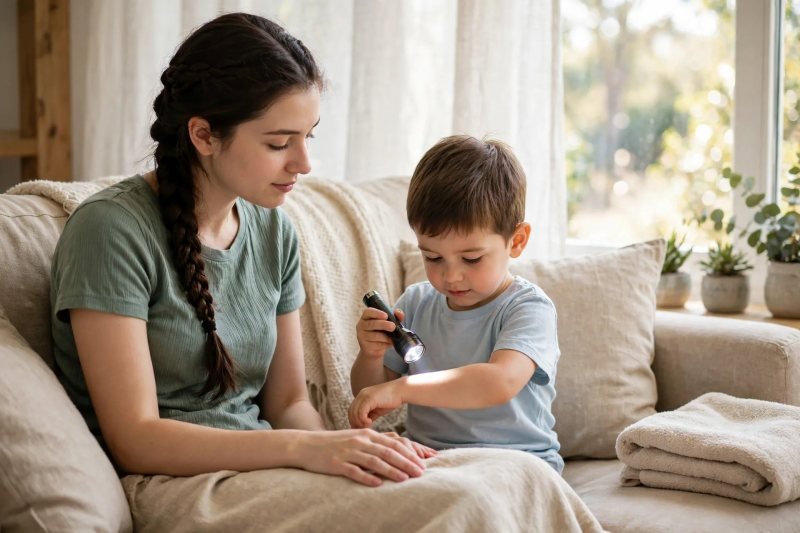
Step 1: Choose a calm moment in good light for the first proper look. Dry patches on kids' skin get examined worst at midnight by flashlight and best after a bath, in daylight, when the skin is clean and your child is relaxed. Sit somewhere cozy, skin uncovered where the patches are, and just look first — no touching, no lotions yet, because creams change how a patch looks and you want the honest picture. Say: "We're skin detectives today — our job is to look carefully and write down what we see." This unhurried first look matters more than any product in the bathroom: where a patch sits, what it looks like today, and whether it bothers your child are the three facts every later step — and every doctor — builds on.
-
Step 2: Map where the patches are — the pattern is information. Dry patches have favorite addresses on young children: the cheeks; the backs of the arms; elbows and knees; the fronts of the legs; the tummy and back where waistbands and seams rub; and spots that clothing, straps, or a favorite blanket touch all day. Walk the map with your eyes and name each place out loud with your child ("one on the elbow, one behind the knee") so the note in step 7 writes itself. Say: "Where a patch lives tells a story — patches love elbows, knees, and anywhere something rubs." A patch exactly where a new waistband sits tells a different story from patches in several places at once, and the pattern is one of the first things a pediatrician will ask about. Patches on the cheeks are common enough to have their own closer look — see dry skin on a child's face.

-
Step 3: Look closely at color, shape, and surface — describe, don't diagnose. Now the detective detail: what color is the patch compared with the skin around it — paler, pinker, redder? Is it round, ring-like, or an irregular splodge? Is it one patch or a scattered few? Does the surface look flat and slightly flaky, or raised and rough like fine sandpaper? Take a clear photo in the same light if you can — dated photos are the single most useful thing you can hand a doctor, because patches change and memory blurs. Say: "We describe it like we'd describe a cloud — shape, color, edges." Description is a parent's superpower here; it is also the honest limit of home observation, and this guide will keep returning to it. If a patch keeps returning in the same place, our guide to eczema signs in kids explains what doctors look for when they examine it.

-
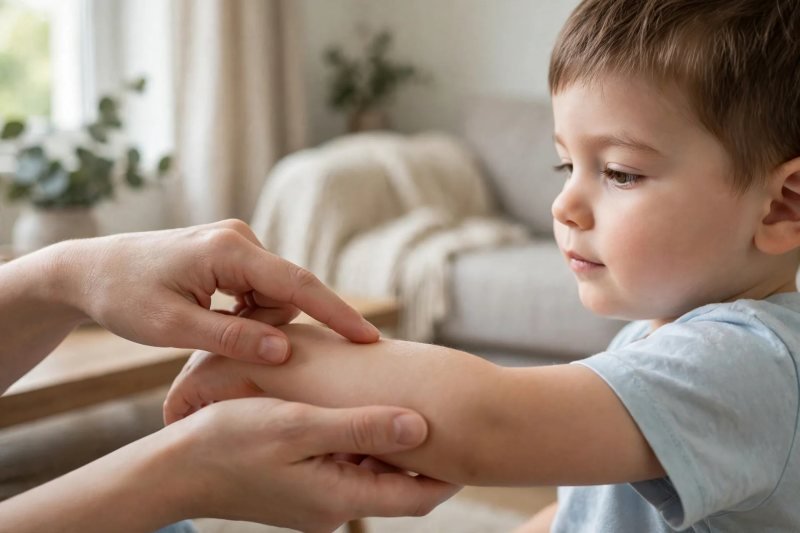
Step 4: Feel gently with one clean fingertip — texture and warmth tell you plenty. With warm, clean hands, rest one fingertip lightly on the patch and then on normal skin beside it: does the patch feel rough, dry, or slightly scaly where the other skin feels smooth? Does it feel warmer than the skin around it? Is the skin there thicker, or the same thickness with a different surface? Let your child feel too — their report ("it's scratchy," "it feels bumpy," "it feels like nothing") is real data at ages 3–4, delivered in their own words. Say: "Soft touch, detective fingers — rough or smooth, warm or same?" Stop if it hurts: a patch that is tender, sore, or painful to a light touch has already told you something important, and it upgrades the doctor conversation in step 10.
-
Step 5: Watch the itch — behavior is your child's honest review. A patch's importance is written less on the skin than in the day: is your child scratching it, rubbing it against furniture, or mentioning it at all? Is it disturbing sleep — night scratching, restlessness, waking? Or is it simply there, unbothered by its owner, discovered by you at bath time? Say: "Does it itch, or does it just sit there? Both answers help." An itchy patch that is costing sleep matters more than a dramatic-looking one that its owner ignores completely, and doctors weigh the itch's effect on sleep and mood heavily. Note what you have actually seen across a few days, not what you fear — a couple of honest lines about scratching and sleep belong in the note in step 7.

-
Step 6: Think back over the last few weeks — dry patches often follow a change. Before treating anything, interview the calendar like a detective: has the weather turned colder or the heating come on (dry air is the classic background for dry skin)? A new soap, bubble bath, shampoo, or laundry detergent? New pajamas, a new blanket, more baths than usual, swimming lessons in a chlorinated pool? Say: "Patches often arrive after something changes — let's find what changed." You are not proving a cause; you are collecting suspects, and the list is genuinely useful: sometimes the whole answer is "the heater came on and bath time doubled," and sometimes no change can be found at all — which is also information worth writing down for the doctor.

-
Step 7: Write the observation note while it is all fresh. Open the phone note and write five short lines: where the patches are (step 2); what they look like (step 3); how they feel (step 4); the itch report, including sleep (step 5); and any recent changes (step 6), plus the date you first noticed them and the photo if you took one. Say: "Detectives write it down — doctors love notes." This little document transforms any future appointment: instead of "there's been a patch, I think for a while, somewhere on his arm," you arrive with dates, places, descriptions, and a timeline. Update it once a week while you watch — one line is enough — and bring the same note-taking habit to anything skin-related from now on.

-
Step 8: Run baths short, lukewarm, and gentle while you watch a patch. Bath habits can quietly feed dryness, so reset them: keep baths around ten minutes in lukewarm — never hot — water; use a gentle cleanser only where it is actually needed (hands, bottom, the day's dirt) rather than all over; skip bubble bath and heavily fragranced products for now; and pat dry rather than rubbing with the towel. Say: "Short warm bath, gentle soap only on the grubby bits." None of this is a treatment for anything specific — it is simply removing the everyday things that dry young skin out, so that whatever the patch is doing, it is doing it without your bath routine arguing against it. If your child's whole routine could use this gentleness, this site's simple kids skincare routine builds it step by step.

-
Step 9: Moisturize on damp skin, right after the bath. The best moment for cream is within a few minutes of the bath ending, while the skin is still slightly damp: smooth a plain, fragrance-free moisturizing cream or ointment over the dry areas (and anywhere else that tends to dry) with clean hands, gently, in the direction that feels comfortable. Say: "Cream goes on the damp skin, like sealing in the bath's water." Choose products by the calm criteria you would use for any kids' skincare — fragrance-free, made for children or sensitive skin, no perfumes or novelty sparkle — and keep it a pleasant ritual, never a battle; a child who helps smooth their own cream will still be moisturizing willingly at six. Repeat daily, and on very dry days, twice.

-
Step 10: Dress soft, keep watching, and know exactly when to book the doctor. Finish the daily routine with soft cotton next to the skin — avoid scratchy wool and rough seams directly over patches — then simply watch across the coming days with your note and photos. Book the pediatrician promptly if you see any of these: the patch spreads quickly or new patches appear fast; it oozes, crusts, weeps, or shows yellowish crusts; there is fever, pain, swelling, or redness spreading outward; the itch destroys sleep night after night; the skin cracks or bleeds; or a patch is unchanged or worsening after about two weeks of gentle care — or sooner, any time you are worried. Say: "We watch calmly, and if we see those signs, the doctor joins the team — that is the plan, and plans are not scary." Bring the note and dated photos to the appointment; walking in prepared makes the visit shorter, calmer, and far more useful — the same trick this site recommends for a first haircut appointment, because small children and new rooms go better with a plan.



Make it easier
Do the whole look during the after-bath cream routine you may already have — observation hides inside an existing cozy habit, and no special "examination" ever happens. Let your child hold the phone flashlight (in daylight it is a prop, and props make detectives) or choose which patch gets looked at first. Keep the note to the five lines in step 7 — a shorter note actually kept beats a perfect chart abandoned by day two.
Make it harder
Add a weekly dated photo in the same spot and light, lined up in the note — change over time is the hardest thing to judge from memory and the easiest to see in pictures. Let your 4-year-old dictate their own itch report each evening ("itchy: a little, a lot, or zero") and write their exact words — children this age are surprisingly precise witnesses. Turn the recent-changes detective work into a family timeline on paper: when the heating came on, when the new detergent arrived, when the patch appeared — and take the timeline to any appointment.
Other ways to play it
- The winter version: when heating season hits, add a bedroom humidifier conversation with your pediatrician's office if dry air is a known trigger in your home, moisturize twice daily, and watch cheeks and hands hardest — cold wind outside and dry air inside is the classic double act.
- The one-patch version: a single patch that appeared after a new product, a costume, or a plaster is the simplest case — note it, remove the new thing, gentle care, and watch; it still gets the full step-10 red-flag list, because simple cases occasionally are not.
- The sibling version: patches on more than one child at once, or a patch that seems to travel between children, deserve an earlier doctor call and a note of who had what, when — patterns across children are exactly the kind of clue professionals are trained to read.
How it changes by age
- Age 3: At three, the look and the notes are entirely yours; your child's jobs are to hold the flashlight, report "itchy or not itchy," and enjoy the cream ritual. Keep each session under ten minutes and narrate everything before you do it — surprises are what make skin checks feel medical at this age.
- Age 4: Fours can be real partners: feeling the patch versus the smooth skin, dictating the itch report, even choosing the cotton shirt. Explain the doctor plan in advance and in the same calm words you would want used on you — at four, "the doctor will look and help" lands well when it has never been said in a worried voice.
What they're learning
Body awareness and vocabulary: patches, itch, rough, smooth, damp, moisturize — children who can describe what their skin is doing can tell adults what they need, early and accurately. Observation before action: the whole guide models a life skill — look carefully, write it down, then act — applied to something small enough to master. Calm health habits: gentle baths, daily cream, soft clothes, and unworried doctor visits are the rhythm of a childhood where health care is care, not drama. Honest reporting: being asked "does it itch?" and having the answer recorded teaches a child that their experience counts as evidence — because it does.
Clearing up
There is almost nothing to clear — and that is the design. The cream returns to its shelf, the note stays in your phone, the cotton clothes go in the wash as usual. The one habit worth keeping tidy is the evidence: keep the dated photos in one album and the note updated weekly while you watch, so the record stays clean and complete. If and when the patches fade, keep the gentle bath and moisturizer habits — they were never really about the patch; they are just how young skin likes to be treated.
Questions parents ask
What causes dry patches on kids' skin?
How can I tell if a dry patch is eczema or just dry skin?
What can I put on my child's dry patches at home?
When should I see a doctor about a dry patch on my child's skin?
Do dry patches on kids go away on their own?

save it for later
Pin this for the next rainy afternoon
Keep it on a board so it is there when you need it, rather than when you happened to find it.
Save to Pinterest

