


Cream vs Lotion for Kids: Which Is Better?
Thinking about cream vs lotion kids use daily? Lotion feels light, cream seals in more moisture, and ointment helps tiny patches. Compare all three by touch.
For most everyday dryness, cream is the better default for kids because its thicker texture seals in more moisture, especially on damp skin after a bath. Lotion is lighter, for mild dryness and warm days. Ointment seals the most, but save it for tiny dry patches only.

The short version
- Lotion has more water: it runs, spreads fast, and feels light — best for mild dryness and warm days.
- Cream has more oil: it holds its shape and seals in more moisture — the better default after baths and in winter.
- Ointment is the thickest and greasiest: use a rice-grain amount on tiny dry patches only, never all over.
- Apply moisturizer within a few minutes of washing, while skin is still slightly damp, to lock water in.
- Choose fragrance-free products, patch-test anything new for 24 hours, and see a pediatrician for cracked, bleeding, oozing, or spreading skin.
- Age
- Ages 3–4
- Prep
- 5 min
- Mess
- Low
- Difficulty
- Easy
- Where
- Indoor
Why kids love this
Children this age learn with their hands, and a cream vs lotion kids test is made for little fingers: pumping, scooping, watching one texture run and another sit still, then announcing which hand feels softer. It turns a choice you usually make for them into their own discovery, ending with a rule they can repeat — runny for light days, thick for dry days.
What you'll need
- A plain, fragrance-free lotion in a pump bottle
- A plain, fragrance-free cream in a round tub
- A plain ointment in a small tube, for tiny dry spots only
- A clean hand towel beside the sink
- A sturdy step stool so your child can reach the counter
- Lukewarm water and a gentle wash for hands before you start
- A small tray or clear space on the counter
Before you start
1. Wash both pairs of hands with lukewarm water and dry well, so you compare textures on clean, dry skin. 2. Line the three containers up in a row — pump bottle, cream tub, ointment tube — caps loosened only by you. 3. Patch-test anything new a day ahead: a dab on the inner forearm, then wait 24 hours before full use. 4. Agree the rules first: containers stay on the counter, nothing goes in mouths, and Mom handles the ointment.
How to do it
-
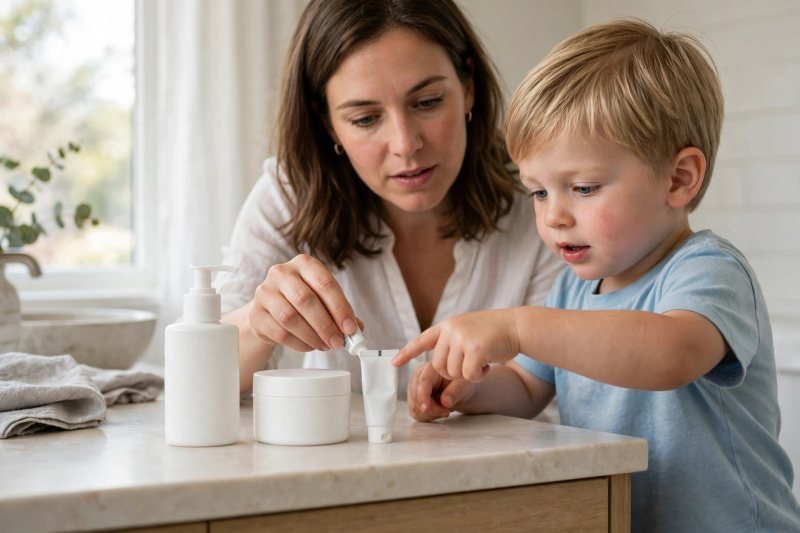
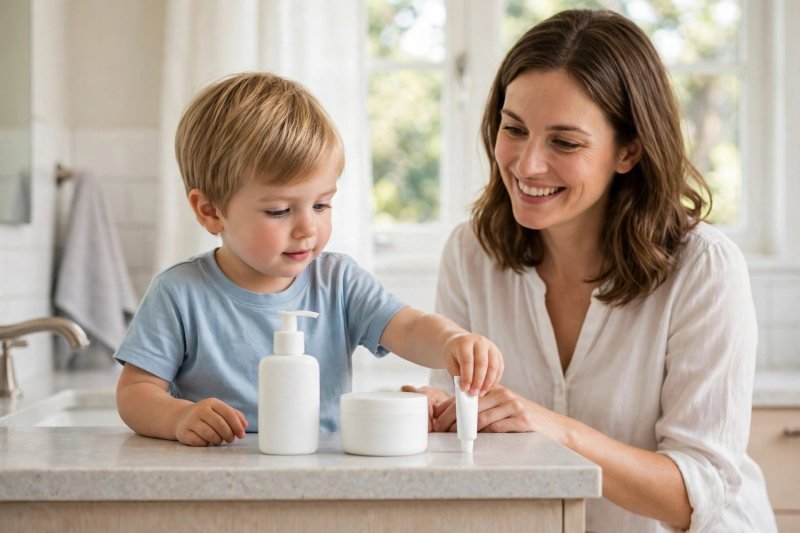
Line up the three textures. Set the pump bottle, cream tub, and ointment tube in a row, let your child point to each as you name it, then give the one-sentence science — lotion has more water in it, while cream and ointment have more oil, which is why they feel so different. Say: "Same job, three different thicknesses — let's find out which one your skin likes best." Your child touches each closed container and guesses which will be runniest; that guess sets up the next step, opening the pump to see.
-
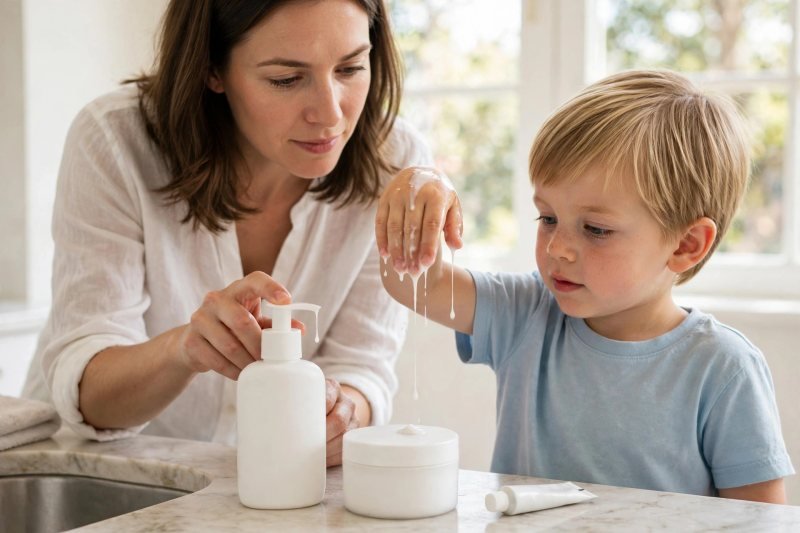
Pump the lotion and watch it run. Press the pump once and place a small pool of lotion on the back of your child's hand, then tilt that hand slowly together and watch — it is thin, it slides and drips toward the wrist, and it spreads almost before anyone touches it. Say: "See how runny it is? That is all the extra water in lotion — it moves fast and feels light." Your child chases the drip with one finger, noticing how far one pump travels; keep that as your lotion hand, because next you find out how quickly it disappears.
-
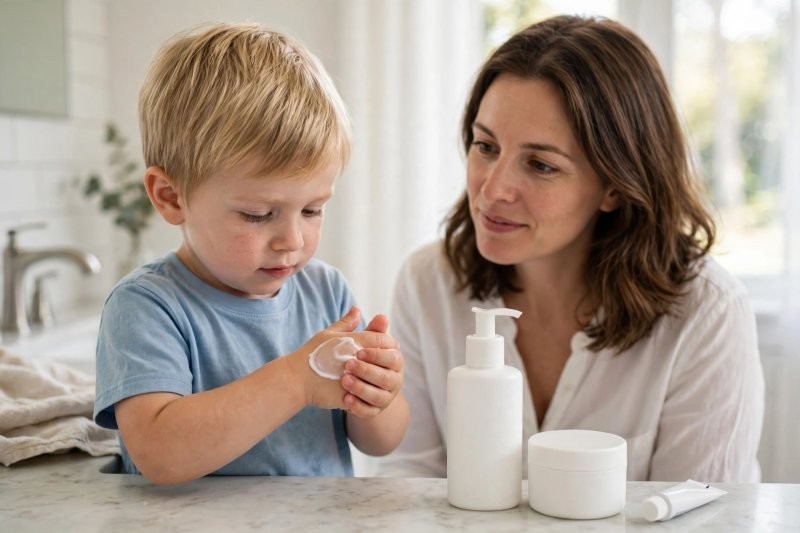
Rub the lotion in. Guide your child to rub the lotion in slow circles, counting to ten together, until the shine fades and skin feels smooth and light, not coated. Say: "Rub, rub — feel how fast it soaks in? Almost gone, and your hand feels soft but not slippery." Your child presses the hand to a cheek to feel the cool, light finish; leave the other hand bare, because a fair test needs an untouched hand waiting for cream.
-
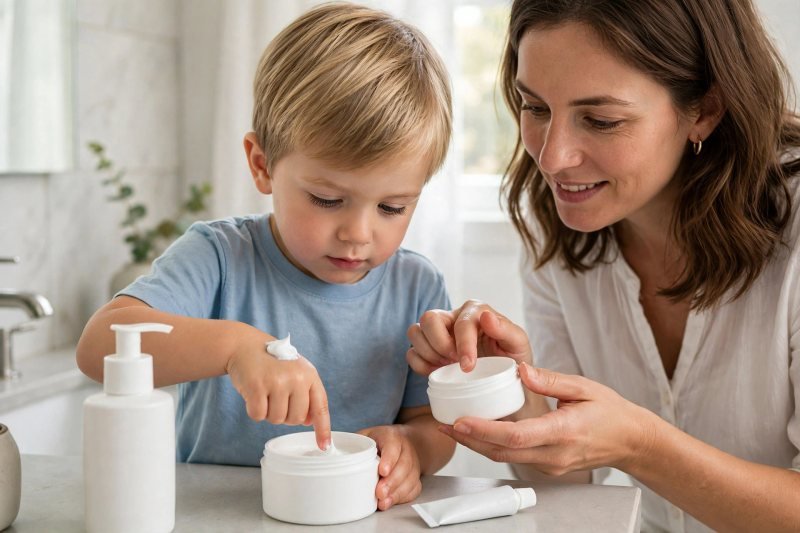
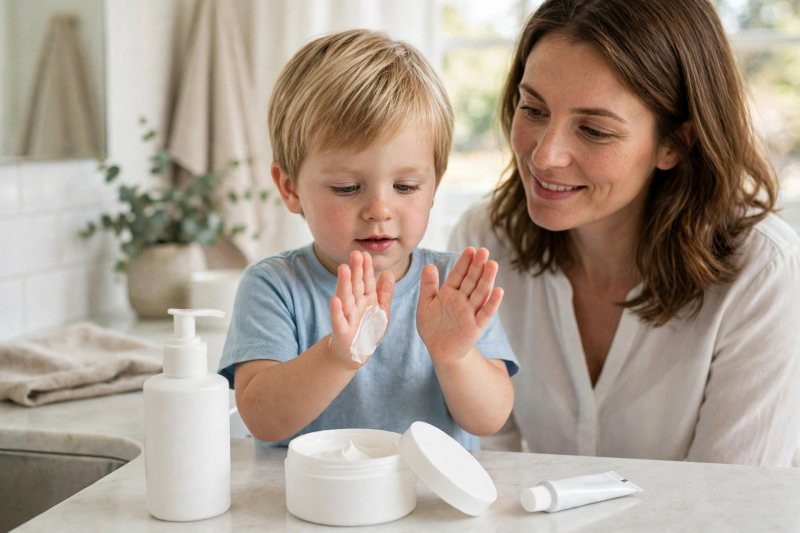
Scoop the cream and watch it stay. Open the tub yourself, let your child dip one clean fingertip in and lift a pea-sized scoop, then place it as a neat peak on the bare hand and tilt that hand — nothing runs, nothing drips, and the peak holds its shape like a tiny snowcap. Say: "Look — it stays right where we put it, because cream is thicker and has more oil to hold it together." Your child pokes the peak, watches it dent instead of slide, and compares it with the lotion hand; next, rub this thicker texture in.
-
Rub the cream in. Help your child spread the cream in slow, firm circles, noticing it takes longer than lotion, covers less area, and leaves a soft, cushioned feeling. Say: "Slower to spread, and feel that soft blanket — that is the cream sealing the moisture in." Your child holds both hands side by side and tells you which feels lighter and which feels more protected; with both compared, you are ready for the third texture, saved for the smallest jobs.
-
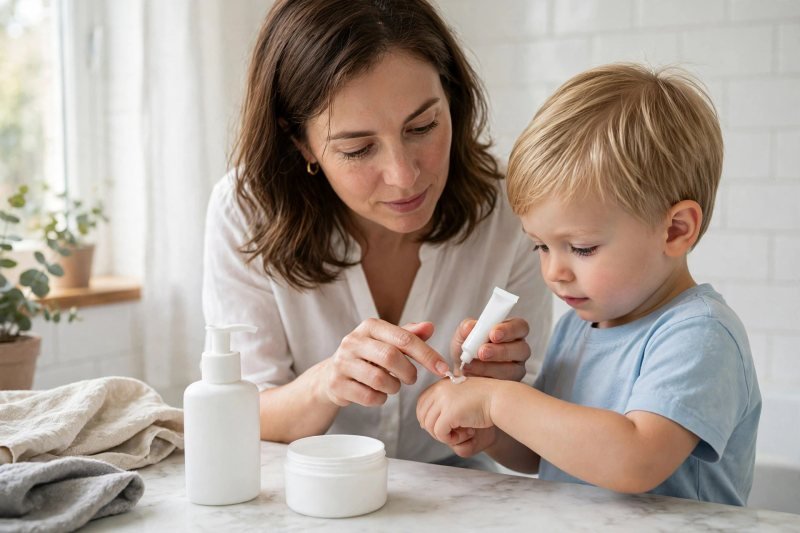
Save ointment for tiny spots. Take the ointment tube yourself — always a parent job — squeeze a rice-grain amount onto your fingertip, and dab it only onto one small dry patch, such as a rough spot on a cheek or wrist, in a thin, shiny layer. Say: "Ointment is the thickest of all, so we use the tiniest bit, and only on a tiny place that needs extra help." Your child touches the edge of the patch to feel how greasy it is — ointment is never for all-over use — and that sets up turning three textures into one way of choosing.
-
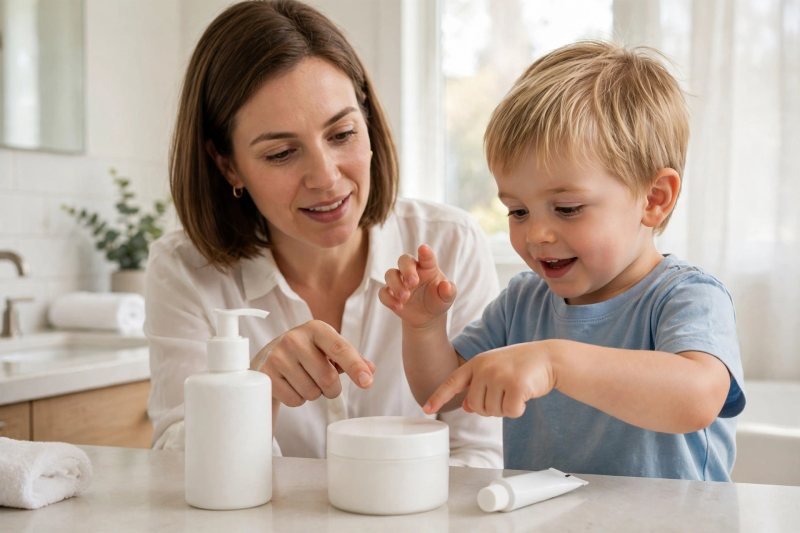
Match the texture to the moment. Leave all three in their row and play the matching game, pointing to each as you name its moment — runny lotion suits warm days and mild, all-over dryness; thicker cream suits after baths and cold, dry days; ointment stays for single small patches. Say: "We don't pick a favorite forever — we pick the right one for today, and damp skin helps every one of them work better." Teach the damp-skin rule in copyable words — moisturizer goes on within a few minutes of washing, while skin is still slightly damp, to lock water in — and let your child point to their pick for a warm day and a cold day; those choices set up the real routine next.
-
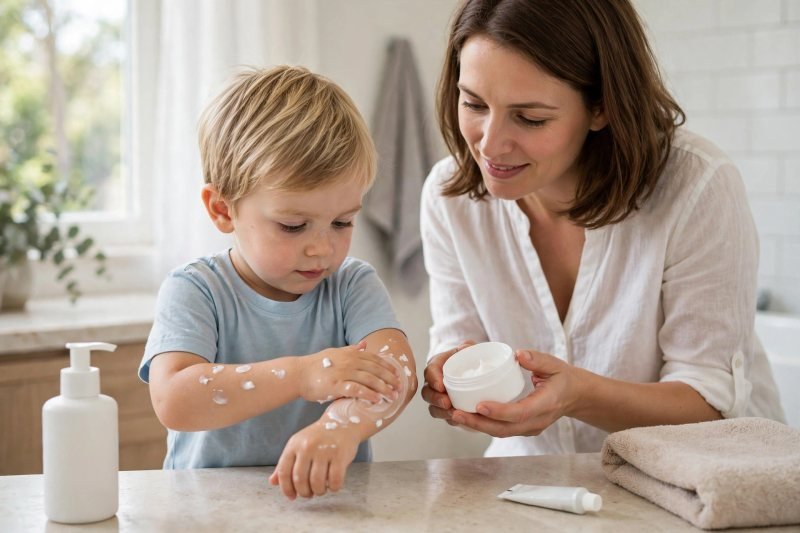
Do the after-bath routine together. Run a short, lukewarm bath or warm wash at the sink, then have your child pat dry — press and lift, never rub — leaving skin slightly damp, and move straight to the counter. Say: "Pat, pat, leave a little damp — now we dot the cream on before the water escapes." Your child dots cream on arms and legs and rubs each in with both hands in big, proud circles while you reach spots little arms cannot; this is the everyday default — cream on damp skin, right after washing — and only the wrap-up rule remains.
-
Use your simple decision rule. Line the three containers back up, caps on, and say the rule slowly together — runny means light days, thick means dry days, and the greasiest one is only for tiny spots. Say: "Runny for light days, thick for dry days — and we always test something new on a small patch first." Remind yourselves as you tidy: patch-test every new product and wait 24 hours, and if skin is cracked, bleeding, oozing, or spreading, that is not a texture question — it is a visit to the pediatrician.


Make it easier
Do the comparison on hands only, twice in one week, before the full after-bath routine. Start with just lotion and cream; introduce ointment later, when a real small dry patch appears. Let your child own one job only — pumping the lotion — while you scoop and dab.
Make it harder
Ask your child to choose the texture each evening and explain it in one sentence: warm day, dry day, or tiny patch. Let them teach the decision rule back to a stuffed animal or a grandparent — teaching it makes it stick. Build this into a full kids' skincare routine so choosing a texture becomes one confident step in the daily sequence.
Other ways to play it
- Winter version: make cream the default after baths, keep baths short and lukewarm, and keep ointment handy for small rough patches. For choosing between products when dryness is stubborn, compare with the best moisturizer for kids with dry skin.
- Summer version: let lotion do most work on warm, mildly dry days, and save cream for after swimming.
- Sensitive-skin version: introduce one new texture a week, patch-test each, and keep everything fragrance-free. For faces, keep it simpler still — see whether kids need a face wash.
How it changes by age
- Ages 3–4: the whole audience here. Threes and fours can pump with help, scoop a pea-sized dab, rub in circles, tilt a hand to watch lotion run, and hold two hands up to compare. Keep amounts parent-controlled and ointment in your hands only; the decision rule may start as a chant before it becomes understanding — exactly right at this age. When a daily routine starts to stick, this guide to when kids should start a skincare routine helps you add steps gradually.
- Younger siblings: a 2-year-old can watch and feel a dot of cream you place and rub in, but should not handle containers or tubes.
- Older siblings: a 5- or 6-year-old can run the comparison for a younger child with you supervising, while product choices stay with the parent.
- When to get help: textures are for everyday dryness, not medical care. See your pediatrician if skin is cracked, bleeding, oozing, or spreading, or if a dry patch does not improve with gentle moisturizing. Never diagnose at home, and never use prescription creams made for someone else.
What they're learning
Comparing and classifying: runny versus thick, light versus greasy — sorting three textures by observation is early science in its simplest form. Cause and effect: more water makes lotion move fast; more oil makes cream and ointment stay put and seal better. Fine motor control: pumping, scooping, and spreading build hand strength and control — for more practice, try these fine-motor activities for preschoolers. Self-care habits: patting dry, moisturizing on damp skin, and choosing a texture turn bath time into a routine your child partly owns. Handwashing dries hands too, so pair this with fixing dry hands after hand washing.
Clearing up
"Thicker is always better." Not always — thicker seals in more moisture, wonderful for dry skin and winter, but light lotion suits mild dryness on a warm day. "Lotion and cream are the same thing." Same job, different strengths: lotion holds more water and feels light; cream holds more oil and protects longer. "Ointment must be best because it is strongest." It seals most, but it is greasy and meant for tiny spots only. "Dry skin means more products." Extra layers can irritate young skin; one plain, fragrance-free moisturizer, in the right texture, on damp skin, is calmer.
Questions parents ask
Is cream or lotion better for kids?
What is the difference between cream and lotion?
When should kids use ointment?
Why does lotion sometimes sting dry skin?
How much moisturizer should I use on my child?

save it for later
Pin this for the next rainy afternoon
Keep it on a board so it is there when you need it, rather than when you happened to find it.
Save to Pinterest


