


Kids' Skincare Routine: Simple Steps for Ages 2–8
A kids' skincare routine doesn't need a shelf of products — just gentle cleansing, moisturizing, and sunscreen. Here is a simple less-is-more daily routine for ages 2–8 that builds healthy habits without the fuss.
A kids' skincare routine needs just three steps: gentle cleansing with lukewarm water and a fragrance-free wash, moisturizing while skin is still damp, and sunscreen before outdoor play. Repeat a quick cleanse-and-moisturize at night. That's the whole routine — children's skin needs less, not more, and consistency matters more than products.

The short version
- Less is more: three gentle steps — cleanse, moisturize, sunscreen — are the entire routine.
- Moisturize within about three minutes of washing, while skin is still damp, to lock water in.
- Sunscreen goes on before outdoor play (reapply after swimming or heavy sweating); skip it on stay-inside days.
- Choose fragrance-free, gentle products; patch-test anything new on the inner forearm for 24 hours.
- Never use adult anti-aging products, retinoids, or exfoliating acids on children's skin.
- See a pediatrician or dermatologist for rashes that spread, ooze, or don't improve — never diagnose at home.
- Age
- Ages 2–8
- Prep
- 5 min
- Play time
- 5 min
- Mess
- Low
- Difficulty
- Easy
- Where
- Indoor
Why kids love this
Kids love jobs that feel grown-up, and a kids' skincare routine is a perfect one — their own bottles, their own towel, a job with a beginning, middle, and end. Add a two-minute song and it stops feeling like a chore and starts feeling like their morning mission.
What you'll need
- A gentle, fragrance-free kids' or baby cleanser (a mild bar works too)
- A fragrance-free moisturizer — cream in a tub or a simple lotion pump
- A broad-spectrum sunscreen, SPF 30+ (mineral formulas with zinc oxide are the classic kid pick)
- One soft towel or washcloth, just for faces
- A sturdy step stool so your child can reach the sink
- A two-minute sand timer or a favorite two-minute song
- A small tray or caddy to keep the three products together
Before you start
Line the tray up in routine order — wash, cream, sun — on a low shelf or the counter. Show your child the right amount of each: a pea-sized dab of cleanser and moisturizer, a grape-sized line of sunscreen for face and neck. Patch-test anything new: a dab on the inner forearm, 24 hours before first full use. Pick your two routine moments — most families do morning after getting dressed, evening after brushing teeth.
How to do it
-
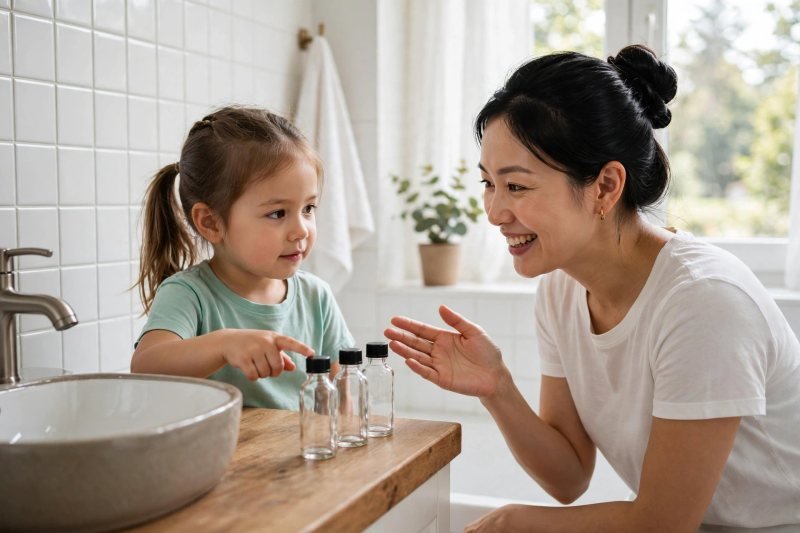
**Start with the less-is-more talk.** Sit with your child and the three products and say something like: "Your skin already knows how to take care of itself — it just needs a little help from us, three small jobs." Name the jobs in kid words, pointing to each bottle — wash the day off; feed the skin a drink; put on the sunshine shield. Let your child pick their face towel and set it on the counter; that small choice makes the routine theirs. Tray set, towel chosen — time for the very first wash together.
-
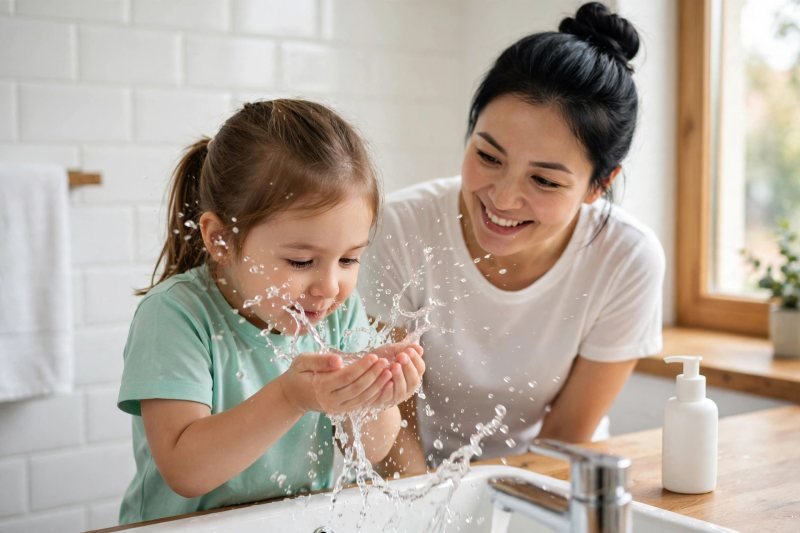
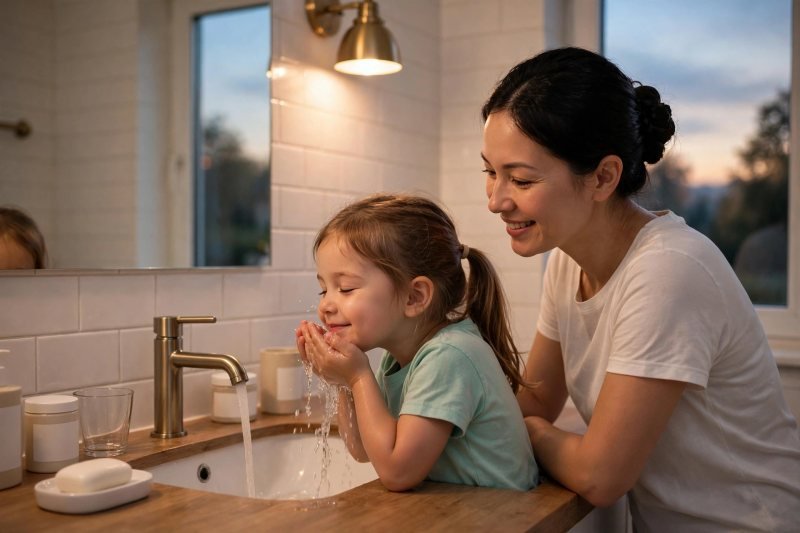
**Wash gently with lukewarm water.** Run the tap until the water feels warm like bathwater, never hot, and let your child cup water to splash their face — two or three splashes is plenty. Say: "Warm water wakes your skin up — hot water would bother it." Help them rub a pea-sized dab of cleanser between their palms and wash in slow circles — forehead, cheeks, nose, chin — counting to ten together keeps it unhurried. Rinse until the skin feels clean, not slippery. The day's dirt comes off here, and the step hands straight into drying.
-
**Pat dry — never rub.** Hand over the soft towel and show the move: press gently against the cheeks, lift, move to the forehead, lift — no rubbing back and forth. Say: "We pat like we're tucking the skin in, nice and gentle." Let them do the whole face themselves, even if it's slow; this is their job now. The skin should feel just barely damp when they finish — that slight dampness is exactly what the next step needs, so move straight to the moisturizer.

-
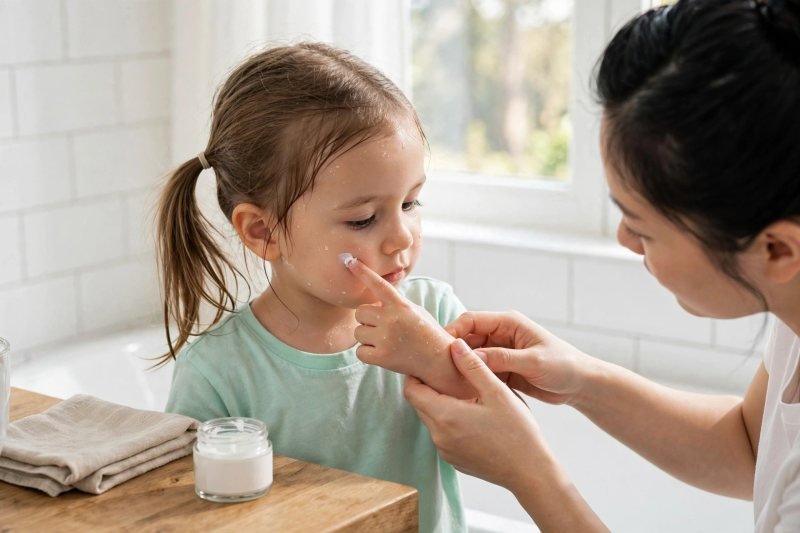
**Moisturize while the skin is still damp.** The golden rule: cream goes on within about three minutes of washing, while the skin is damp, to lock the water in. Say: "The cream is like a lid that keeps the water inside your skin." Help your child dot a pea-sized dab on five spots — forehead, each cheek, nose, chin — then let them spread it outward in gentle strokes. Fingers glide easily on damp skin, and most kids love this step best. Once the face feels soft, one job remains before outdoor play.
-
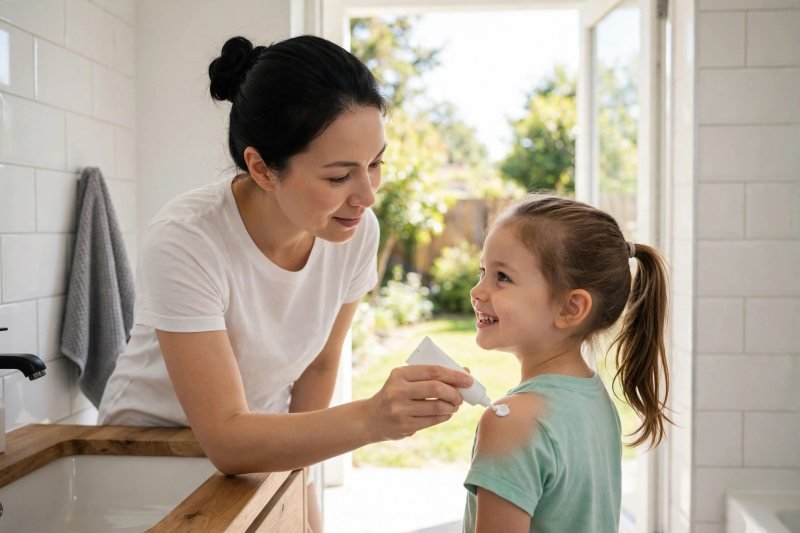
**Add sunscreen before heading outside.** Sunscreen is the final morning job — only needed on outdoor-play days, but then it matters every time. Say: "This is your sunshine shield — it goes on before the sun finds you." Squeeze a grape-sized line onto your own hand first, then let your child dot it on cheeks, nose, and forehead while you cover the trickier spots — ears, back of the neck, tops of hands. Rub in gently until the white cast fades. Let it settle while shoes go on, then head out; reapply after swimming or heavy sweating.
-
**Repeat the quick version at night.** Evenings are the morning routine minus one step: wash, pat, moisturize — no sunscreen after dark. Say: "Nighttime is just two jobs — wash the day off, then the drink for your skin." By now your child knows the moves, so let them lead while you narrate: they splash, they circle, they pat, they dot and spread. Three unhurried minutes and the day is washed off. It doubles as your daily skin check-in — while they moisturize, you naturally see their face, arms, and legs, so spotting anything unusual becomes part of the rhythm, not a worried inspection.
-
**Make it stick with a song or timer.** The routine that survives is the one that runs itself: the same two-minute song every morning, with the rule that the routine finishes when the song does. Say: "Beat the song — can you finish all three jobs before the music stops?" A sand timer works the same magic for kids who like watching time run out. After a week of unbroken routines, add a sticker chart on the bathroom wall — one sticker per routine, no prizes needed beyond the streak. Within a month, most kids start before you remind them, and less-is-more is simply how mornings work.



Make it easier
Start with just cleanser and moisturizer; add sunscreen once the first two feel automatic. For ages 2–3, you do the washing and creaming while they "help" with the towel; it still counts. On stay-inside days, skip the sunscreen without guilt — it's an outdoor-play step, not a daily requirement.
Make it harder
Let your child run the whole routine solo while you watch from the doorway, narrating nothing. Teach label reading: hunt together for "fragrance-free" on the bottle before buying anything new. Once the routine is automatic, build more independence with a [kindergarten readiness checklist](https://brightplaydays.com/activities/kindergarten-readiness-checklist/) — steady morning routines are a big part of being school-ready.
Other ways to play it
- **Winter dry-skin version:** switch to a thicker cream, keep baths short and lukewarm, and never skip the three-minute moisturizer window.
- **Summer sunshine version:** sunscreen becomes the star; keep a bottle by the door and reapply after every swim or sweaty playground hour.
- **Bath-night version:** wash in the tub, then moisturize head-to-toe the moment they step out, while skin is still damp everywhere.
How it changes by age
- **Ages 2–3:** you do nearly everything — they splash, they pat with the towel, they watch. Keep it under two minutes and playful, the way these [toddler learning activities at home](https://brightplaydays.com/activities/toddler-learning-activities-at-home/) keep things short and sweet. Water-only rinses are fine on calm days.
- **Ages 4–5:** the sweet spot. Fours and fives can wash, pat, and dot-and-spread with coaching, and they adore the grown-up feeling of a three-job sequence. Expect to help with sunscreen on ears and neck — fine motor control is still catching up.
- **Ages 6–8:** most can run the whole routine alone, including sunscreen, once you've practiced together. Time for the "why" — damp skin holds cream better; sunscreen shields against sunburn — and for reading the "fragrance-free" label themselves.
- **When to get help:** some skin things are routine-tuning, some need a professional. A rash that spreads, oozes, or doesn't improve in a week or two of gentle care; dry patches that crack or bleed; anything that worries you — see your pediatrician, who can refer you to a dermatologist. Never diagnose a rash yourself, and never use prescription creams meant for someone else.
What they're learning
**Hygiene habits:** washing, drying, and protecting skin become automatic self-care, like brushing teeth. **Sequencing:** first wash, then pat, then cream, then shield — a four-beat sequence they can recite and repeat. **Fine motor control:** pumping bottles, dotting cream, and spreading in circles strengthen the hand skills writing needs — for more practice, try these [fine-motor activities for preschoolers](https://brightplaydays.com/activities/fine-motor-activities-for-preschoolers/). **Body awareness:** noticing how skin feels — damp, dry, sticky, soft — builds the vocabulary of self-care.
Clearing up
Low mess: a little water at the sink and a pea-sized dab of cream. Keep a dry towel on hand for splashes; the tray keeps bottles together and off the floor.
Questions parents ask
What is the best skincare routine for kids?
Do kids need moisturizer every day?
When should kids wear sunscreen?
How do I know if a skincare product is safe for my child?
When should I take my child to a dermatologist?
"Kids need a ten-step routine." No — less-is-more is the whole point; three gentle steps beat ten fancy ones, and piling on products is how irritation starts. "Sunscreen is only for beach days." Sunburn happens on playgrounds, sidewalks, and cloudy days too — the rule is outdoor play, not vacation. "Natural oils are always safer." Some plant oils irritate young skin, and "natural" isn't a safety standard — a simple fragrance-free moisturizer is the more reliable default. "Kids' skin is just tougher." The opposite: children's skin is thinner and loses moisture faster than adult skin, which is exactly why gentle and minimal wins.

save it for later
Pin this for the next rainy afternoon
Keep it on a board so it is there when you need it, rather than when you happened to find it.
Save to Pinterest
