


Split Digraphs Year 1: A Parent's Guide to A-E, I-E, O-E (UK)
A UK parent's guide to split digraphs in Year 1: what the term means, a-e, i-e and o-e words to practise, and a calm 10-step home session.
Split digraphs are the UK phonics term for the a-e, i-e and o-e patterns in words like cake, bike and home: two letters making one sound, split apart by a consonant. Teach it as "the e jumps over one letter and makes the vowel say its name", then spot the team, trace the jump and sort a-e, i-e and o-e words in a 10-step session for ages 6–8.

The short version
- A split digraph is two letters making one sound, split by a consonant: a-e (cake), i-e (bike), o-e (home).
- "Split digraph" is the UK classroom term for what Americans call magic e or silent e.
- Teach one story: the e jumps over the middle letter and makes the vowel say its name.
- Practise one team at a time — a-e first, then i-e, then o-e.
- Ten to fifteen minutes a day, ending on a word your child reads easily.
- Age
- Ages 6–8
- Prep
- 10 min
- Play time
- 10 min
- Mess
- None
- Difficulty
- Easy
- Where
- Indoor
Why kids love this
It turns them into pattern detectives. The split digraph is a puzzle, not a drill: the letters a and e stand either side of a consonant like guards on a bridge — cake, name, game. Once your child sees the two letters are a team across the middle letter, they start spotting split digraphs everywhere: in reading books, on cereal packets, in the shopping list.
What you'll need
- Index cards or paper cut into cards, and a thick marker pen
- Two colours of pen — one for the vowel and the e, one for the middle consonant
- Three small bowls, trays, or sheets of paper for sorting
- One of your child's school reading books
Before you start
Write twelve cards, large and lowercase, one word per card — a-e: cake, name, game, made; i-e: bike, time, like, five; o-e: home, nose, hope, joke. Colour the vowel and the final e one colour, the middle consonant the other. Make three "team cards": a and e with a wavy bridge line drawn between them, then the same for i/e and o/e. Rehearse your one-line story: "These two letters are a team, but a letter stands between them — so the e jumps over it and makes the vowel say its name."
How to do it
-
Name the team. Hold up the a/e card: "Split — the two letters are split by a letter in the middle. Digraph — they make one sound together, like a team."

-
Spot the pattern. Lay out cake: "Can you spot the two team letters?" Guide their finger to the a and the e, with the k between. Repeat with name and game.

-
Jump the letter. Trace a jump from the e, up and over the middle consonant, landing on the a: "The e jumps over one letter and reaches the a." They trace it on game and made.

-
Say the long vowel. Read it: "caaake." Stretch the AY so the long a rings out. They echo you — stretching is the point, not speed.

-
Read down one column. Read the four a-e cards together — cake, name, game, made. You read the first two; they take the last two.

-
Switch teams. Hold up the i/e card: "New team, same trick." Spot the team in bike, trace the jump, say the long I ("biiike"), then read down: bike, time, like, five.

-
One more team. The o/e card: spot the team in home, trace the jump, say the long O ("hooome"), then read down: home, nose, hope, joke.

-
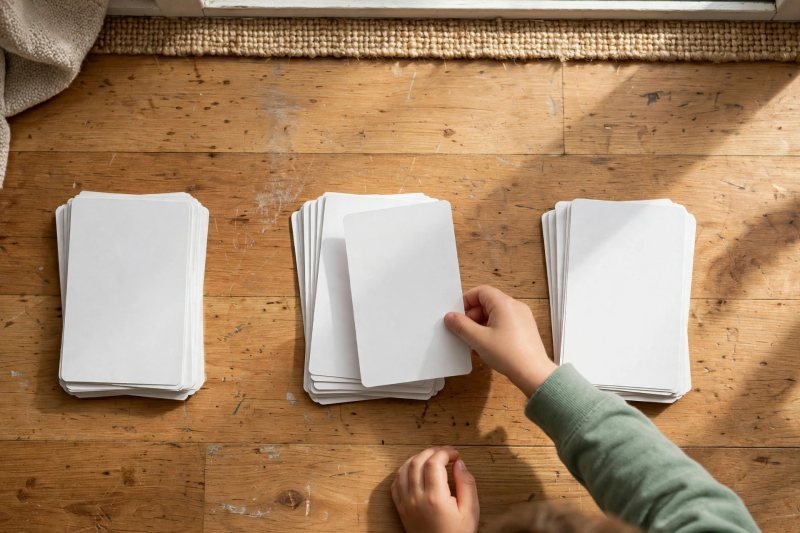
Sort the teams. Shuffle all twelve cards. Your child posts each into the right bowl, reading the word aloud. Sorting proves the ear has the pattern.
-
Hunt in a real book. Open the school reading book and hunt for split digraphs — like, time, home, made turn up constantly. Tally each find.

-
Stop while it's easy. Put the cards away while your child still wants one more word. End on a word they read confidently.



Make it easier
One team for a whole session — just the four a-e cards. You read every card first; your child echoes until they ask to lead. Skip the book hunt until the bowl sort feels easy.
Make it harder
Time the sort — can they beat yesterday's time? Dictate: you say "hope"; your child writes it, spelling the split team from memory. You say "kit"; your child writes "kite". Add the u-e team (cube, cute, tune) and the e-e team (these, theme). For many more words, try our magic e words list. For more a-e reading, our a-e words list gives 25 words to read and chant.
Other ways to play it
- Pavement chalk: you write the stub (cak), your child adds the e and reads the word.
- Tape cards to toys for a treasure hunt — find bike, then find the toy bike.
- "Team of the day" on the fridge: one card your child reads each morning.
How it changes by age
- Ages 6–8 is the target: home practice, catch-up, or consolidation after school.
- First taught in Year 1 (ages 5–6 in England); a confident five-year-old can play with just the a-e team for five minutes.
- If your eight-year-old finds the team story babyish, skip to the bowl sort and dictation.
- If sounding out still feels wobbly, build CVC words first — the split-digraph contrast only clicks once short words feel easy.
What they're learning
The split-digraph pattern: two letters working as one sound across a consonant — a-e, i-e, o-e. UK phonics vocabulary: the term their teacher uses, so school and home speak the same language. Pattern transfer: spotting the team in unfamiliar words — the bridge toward fluent reading. Spelling sense: hearing the long vowel is the first step to writing the split team.
Clearing up
Wipe grubby cards with a damp cloth; store each team's cards in its own bowl. Keep the three team cards in a separate envelope — teaching tool, not practice set.
Questions parents ask
What is a split digraph in Year 1 phonics?
Is a split digraph the same as magic e?
How do I teach split digraphs at home?
What are examples of a-e, i-e and o-e words?
Why doesn't the split digraph work on "have" and "come"?
When should my child learn split digraphs?
Stretch the long vowel crisply — "caaake," "biiike," "hooome" — so your child hears what the jump changed. Stick to one story; a second metaphor will only blur the pattern. End every session on a word your child reads easily. The u-e team is tricky: cube and cute say "yoo," but flute and rule say "oo" — teach it last. For more two-letter-team play, see our digraph activities. A few everyday words — have, come, love, done, one, give, some — never follow the split-digraph pattern; teach them by heart. For the full story, see our silent e rule explained. These split digraph words sit inside the wider Year 1 high-frequency words your child meets every day.

save it for later
Pin this for the next rainy afternoon
Keep it on a board so it is there when you need it, rather than when you happened to find it.
Save to Pinterest


