


Phase 5 Tricky Words: What Year 1–2 Parents Need to Know (UK)
The complete phase 5 tricky words list for Year 1–2 — oh, their, people, Mr, Mrs, looked, called, asked, could — what makes each one tricky, the teaching order, and a simple practice routine that builds reading and spelling.
The phase 5 tricky words are oh, their, people, Mr, Mrs, looked, called, asked and could — the last set in Letters and Sounds, taught across Year 1. Each contains a spelling the phonics code can't explain yet, so children learn them as whole words. Practise two or three a week for ten to twenty minutes a day, with reading and spelling rounds.

The short version
- The nine phase 5 tricky words are oh, their, people, Mr, Mrs, looked, called, asked and could, taught across Year 1 as the final tricky-word set.
- Each contains a spelling the code can't explain yet (their: e-i says "air"; asked: silent e in -ed; Mrs: said "missus"), so children learn them as whole words.
- Practise two or three new words a week in the school's order, ten to twenty playful minutes a day, with spelling rounds from the start.
- Spot the tricky part, say it smoothly, write it (look, say, cover, write, check), then read and write it in real sentences.
- Only their is in this set — sort their/there/they're calmly and let real sentences clear the fog.
- After Phase 5 there are no more tricky words: children move on to the Year 1 and Year 2 common exception word lists.
- Age
- Ages 6–8
- Prep
- 10 min
- Play time
- 20 min
- Mess
- None
- Difficulty
- Easy
- Where
- Indoor
Why kids love this
Phase 5 tricky words feel like graduation. They are longer, meatier words than the little ones from reception, and your child will spot them everywhere — in chapter books, in comics, in the subtitles on the telly. Reading people or asked without stopping feels genuinely grown-up.
What you'll need
- Nine word cards: index cards with one word per card in clear lowercase (Mr and Mrs keep their capitals)
- Sentence strips: short sentences on card, each containing one of the week's words
- A mini whiteboard and pen, or a tray of rice for finger-writing
- Chalk for the patio, coloured pencils and sticky notes
- A magnet for the fridge word wall
Before you start
Ask the teacher which batch your child is learning — start with those words, not all nine. Make cards for this week's two or three words and pull out the older ones for review. Write two or three sentence strips per word, using sentences from your child's real life. Choose a calm ten-to-twenty-minute slot — after-school snack time works well.
How to do it
-
Choose this week's words. Lay out two or three cards; say each word aloud yourself first. A meeting, not a test.

-
Spot the tricky part. Hunt the sneaky bit together: "That e in asked is staying silent — sneaky!"

-
Say it smoothly. Read the word like a word, not like letters: a wobbly "l-oo-k-e-d" becomes a smooth "looked".

-
Trace it big. Trace the word huge in the air, in chalk on the patio or in the rice tray, saying it as you go.

-
Look, say, cover, write, check. Look, say the word, flip the card face-down, write it from memory, flip back and check. Three correct in a row counts as known.

-
Read it in a sentence. "The people called out." Hunt the tricky word, then read the whole sentence smoothly.

-
Write it in a sentence. Read a sentence aloud and your child writes the tricky word, then the whole sentence as confidence grows.

-
Play the confusable corner. Mix their with there and they're; sort into three piles, saying each aloud. Silly voices encouraged.

-
Run a speedy recap relay. Lay the week's cards across the floor like stepping stones; hop from card to card, reading each one. Beat yesterday's time?

-
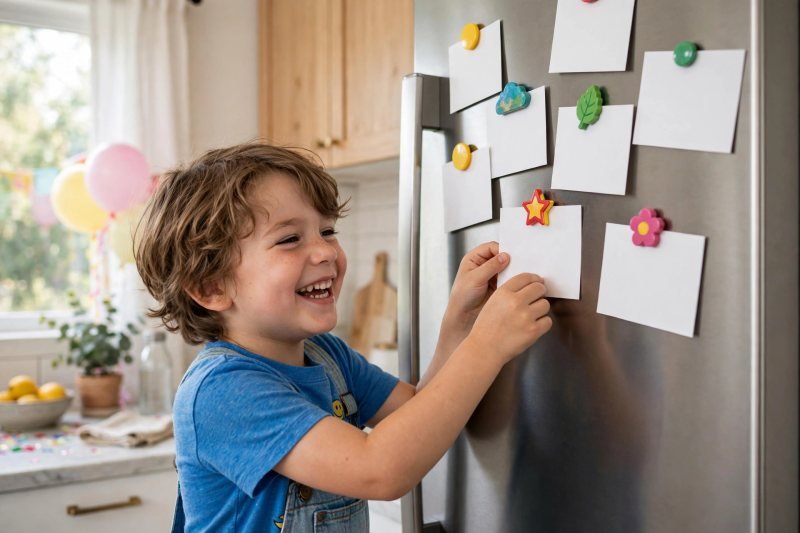
Park them on the word wall. This week's cards go on the fridge with a magnet. Finish with a joyful read-through of the whole wall.


Make it easier
Practise one new word alongside confident old ones — success breeds success. You read every card aloud; your child just points, traces or sorts. Still building the code? Our CVC words list is the on-ramp — come back to tricky words once short words feel easy.
Make it harder
Deal all nine words into a timed "instant read" deck; your child beats their own record. Write a three-sentence mini story using as many tricky words as possible — "Mr Fox asked the people…"
Other ways to play it
- Tricky-word snap: two sets of the week's cards; shout each matching word as it lands.
- Instant-recognition games: for more games beyond tricky words, try our sight word games.
- Silly sentence factory: ridiculous spoken sentences cramming in tricky words — "Mrs Fox looked at the people and asked, 'Oh!'"
- Word hunt in the wild: spot the week's words on cereal packets, shop signs and subtitles.
How it changes by age
- Ages 6–7 (Year 1): the sweet spot — two or three new words a week, ten to twenty playful minutes daily, reading plus spelling. If sounding out is still wobbly, build blending sounds first.
- Ages 7–8 (Year 2): run all nine as a daily warm-up; focus on spelling accuracy and independent writing.
- Ages 5–6: only if the school has moved your child on early — five minutes, no dictation. If the earlier tricky words aren't instant yet, start with our tricky words reception phase 2 guide first.
What they're learning
Instant recognition of all nine phase 5 tricky words — the fast lane to fluent Year 1 reading Accurate spelling through look, say, cover, write, check That tricky spellings are the exception — the phonics code now explains nearly everything Sentence sense: reading and writing these words inside real sentences The confidence of finishing a system — "I know all the tricky words now"
Clearing up
Cards live on the fridge word wall or in a pouch, ready for tomorrow's few minutes. Wobbly after a holiday? Normal — two days of playful review brings words back. When all nine are instant and spellable, celebrate properly — the end of tricky words deserves cake.
Questions parents ask
What are the phase 5 tricky words?
Why are phase 5 tricky words the last set?
Why are Mr and Mrs tricky words?
What's the best way to help my child spell phase 5 tricky words?
What comes after phase 5 tricky words?
What are the phase 5 tricky words?
The phase 5 tricky words are the final set of tricky words in the Letters and Sounds phonics programme, taught across Year 1: oh · their · people · Mr · Mrs · looked · called · asked · could. One honest note: you will sometimes see this set listed as eight words, without could. The original 2007 Letters and Sounds timetable lists eight words for reading, but most current phonics resources — Twinkl, Mrs M Activity, PlanBee — teach all nine together, and that is what most schools send home. We have gone with the nine, because matching the classroom matters more than matching an old document. Schools introduce them in small batches, so ask the teacher which batch is current and match that order at home.
Why are phase 5 tricky words the last set your child will learn?
Because by Phase 5 the phonics code is nearly complete — letter sounds, digraphs, split digraphs and alternative spellings are all in place. These nine are the stragglers: common words whose spellings the code still cannot quite explain, so they are learned as whole words and recognised instantly. After this set, there are no more tricky words. Children move on to the statutory Year 1 and Year 2 common exception words for spelling. Phase 5 is the bridge between learning to read and reading to learn.
What makes each phase 5 tricky word tricky?
Here is where each word's tripwire sits: oh — the o says its name, not the short o of hot. Two letters, one surprise. their — the e-i says "air", and it has two identical-sounding cousins — there and they're. people — the e-o says "ee" and the final e stays silent. One of the most irregular-looking words in early reading. Mr — written as two letters, said as "mister". An abbreviation doing a full word's job. Mrs — written as three letters, said as "missus", with a silent r. Same trick as Mr. looked, called, asked — the -ed ending does not say "ed". The e stays silent and the ending says "t" (lookt, askt) or "d" (calld). could — the oul says "oo", a spelling found in almost nothing else at this level. The fix is the same as ever: notice the tricky part together, say the whole word smoothly, and practise until it is instant.
How many phase 5 tricky words should we practise at a time?
Two or three new ones a week, following the school's batch — never all nine at once. At this age children are expected to spell these words as well as read them, so every session needs a writing round. Ten to twenty minutes a day is plenty; short and daily beats long and weekly.
What should I do when my child keeps mixing up their, there and they're?
Welcome to the club — this one trips up grown-ups too. Only their (belonging to them) is a phase 5 tricky word; there and they're arrive in later spelling work. Sort the three on cards, saying each aloud — "their is the one about people owning something, like their coats." Hearing the difference inside real sentences is what sticks.
Match your school's phonics scheme order — validated schemes such as Little Wandle and Read Write Inc sequence these words slightly differently. Some schools roll could into the core set and some teach a longer list. The teacher's list always wins. These nine sit inside the wider Year 1 high-frequency words list — see the full list. For younger siblings, our sight words for kindergarten list is the gentler starting point. Daily reading aloud together builds more skill than any card game; tricky-word play is the seasoning, not the meal.

save it for later
Pin this for the next rainy afternoon
Keep it on a board so it is there when you need it, rather than when you happened to find it.
Save to Pinterest


