


CVC Words List: 160 Words Your 4–5-Year-Old Can Sound Out
This CVC words list gives you 160 simple, real words your 4–5-year-old can sound out — cat, pen, big, hot, sun and 156 friends — grouped by short-vowel word family so practise feels orderly.
A CVC word is a three-letter word with a consonant, a short vowel and a consonant — like cat, pen or sun. This list gives you 160 of them, grouped by word family, so your 4–5-year-old can practise sounding out words with the stretch-and-blend routine: say each sound slowly, then squash the sounds together into the word.

The short version
- CVC words are the first words children truly read.
- 160 real CVC words grouped by word family.
- Teach with stretch-and-blend.
- One family at a time, ten minutes a day, end on success.
- Four games: robot voice, vowel sort, flip and read, draw the word.
- Blending matters more than word count.
- Age
- Ages 4–5
- Prep
- 5 min
- Play time
- 10 min
- Mess
- None
- Difficulty
- Easy
- Where
- Indoor
Why kids love this
Cracking the code of their first real words — plus playful games like robot voice and flip-and-read that turn sounding out into fun.
What you'll need
- Index cards
- Marker pen
- Magnetic letters
- Sand timer (optional)
Before you start
Choose one word family to start with — short a -at words (cat, hat, mat, sat) work well. Write 8–10 words on index cards, one word per card.
How to do it
-
1. **Pick one word family.** Start with short a -at words: cat, hat, mat, sat.

-
2. **You say it first.** Point to each letter as you stretch the sounds: "c–a–t… cat!" Make the sounds long and smooth, with no gaps between them.

-
3. **They echo.** Your child repeats the stretched sounds, then tries squashing them together. Applaud the effort, not just the result.

-
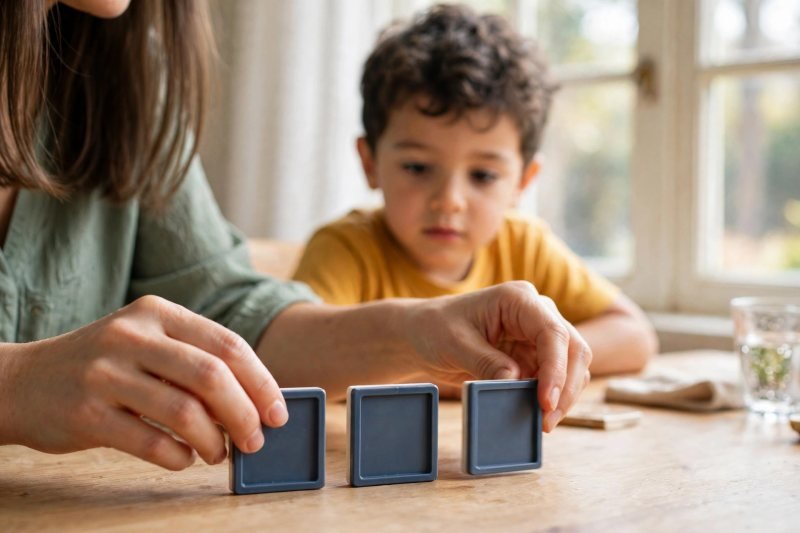
4. **Swap the first letter.** Once "cat" clicks, cover the *c* with your thumb and slide in *h*: "h–a–t… hat!" Same ending, new beginning — the magic of word families.
-
5. **Let them lead.** When they're blending two or three words in a family, hand them the cards and let them be the teacher.

-
This CVC words list gives you 160 simple, real words your 4–5-year-old can sound out — cat, pen, big, hot, sun and 156 friends — grouped by short-vowel word family so practise feels orderly. Write a handful on index cards, sit together for ten minutes, and sound them out with the stretch-and-blend routine below.
-
What are CVC words?
-
A CVC word is a three-letter word made of a consonant, a short vowel and a consonant: cat, pen, big, hot, sun. Every letter says the sound your child already knows — no silent letters, no tricky spellings — which is why CVC words are the first words most children truly read rather than memorise.
-
When should my child start sounding out CVC words?
-
Most children are ready between four and five, once they know most single letter sounds and can hear the separate sounds inside a spoken word. If your child enjoys rhyming games and can clap the syllables in their name, their ears are ready. There is no deadline: follow your child, not the calendar.
-
How do I teach my child to sound out CVC words?
-
With one routine: stretch and blend. Say each sound slowly and stretched — "c–a–t" — then squash the sounds together faster and faster until they become the word. You model it first; your child copies. Ten minutes a day, always ending on a word they can read confidently.
-
Short a — 44 words
-
-at: cat, hat, mat, sat, bat, pat, rat, fat
-
-an: can, pan, man, fan, ran, van, tan, ban
-
-ap: cap, map, tap, nap, lap, gap, yap, sap
-
-ad: bad, dad, had, mad, sad, lad, pad
-
-ag: bag, rag, tag, wag, lag, sag, nag
-
-am: ham, jam, ram, yam, dam, bam
-
Short e — 22 words
-
-et: pet, bet, get, let, met, set, wet, yet
-
-en: pen, ten, hen, men, den
-
-ed: bed, red, fed, led, wed
-
-eg: leg, beg, peg, keg
-
Short i — 41 words
-
-it: sit, hit, bit, fit, kit, lit, pit, wit
-
-in: pin, win, bin, fin, tin, din
-
-ig: pig, big, dig, fig, jig, rig, wig, gig
-
-id: kid, did, lid, rid, hid, bid
-
-ip: lip, hip, dip, sip, tip, rip, nip, zip
-
-ix: fix, mix, six, nix, pix
-
Short o — 28 words
-
-ot: hot, dot, got, not, pot, lot, cot, rot
-
-og: dog, log, fog, hog, jog, bog
-
-op: top, pop, hop, mop, cop, bop
-
-ob: job, rob, cob, lob, sob
-
-ox: fox, box, lox
-
Short u — 25 words
-
-ut: cut, hut, nut, rut
-
-ug: bug, hug, mug, rug, tug, lug, jug, dug
-
-un: sun, fun, run, bun, gun, pun, nun
-
-ub: tub, cub, rub, hub, nub, sub
-
How many CVC words should a preschooler know?
-
There is no official number. What matters is the skill — blending — not the tally. A child who can confidently sound out twenty or thirty words from two or three families has cracked the code.
-
What are the best games to play with this CVC words list?
-
1. Robot voice — speak in stretched speech "c–a–t"; your child blends it back into "cat".
-
2. Vowel sort — mix the cards and sort them by middle sound.
-
3. Flip and read — flip a card, read it to keep it.
-
4. Draw the word — read the word, then draw it fast.
-
For more sound play, try our [phonics activities for preschoolers](/activities/phonics-activities-for-preschoolers/).


Make it easier
Start with just the -at family. You read each word first; your child echoes. Use magnetic letters. Practise orally first, with no letters.
Make it harder
Mix two vowel families. Change one letter to make a new word (cat → hat → hot). Race a sand timer. Next: [first 40 sight words for kindergarten](/activities/sight-words-for-kindergarten/).
Other ways to play it
- Pocket chart word of the day.
- Write the words in chalk outside.
- Treasure hunt with word cards.
- Teach a teddy.
How it changes by age
- Ages 4–5 is the sweet spot.
- Younger threes play orally.
- If they're not interested, wait a month and try again.
What they're learning
Blending sounds into words; short vowel sounds; the alphabetic principle — letters stand for sounds; and the confidence that comes from reading real words.
Clearing up
Wipe the cards clean and store each word family in its own envelope, ready for next time.
Questions parents ask
What is a CVC word?
When should my child start learning CVC words?
Should I teach CVC words or sight words first?
How many CVC words should my preschooler know?
What if my child can't blend?
Say sounds crisply — "mmm", not "muh". Always end on a word they can read confidently.


