


Kids' Face Wash: Do Young Kids Really Need It?
Most young kids don't need face wash — plain water handles everyday faces until sunscreen, sweat, sports, and face paint enter the picture. Here's when a gentle cleanser earns its place, which ingredients to avoid, and the 60-second sink routine.
No — most young kids don't need face wash. A healthy 5- or 6-year-old's face needs lukewarm water and gentle hands on ordinary days; a gentle, fragrance-free cleanser helps only when something water-resistant is on the skin — sunscreen, heavy sweat, face paint, or real grime. Save adult acne and anti-aging products for adults.

The short version
- Water-first: ordinary days need water, fingertips, and a pat dry — nothing else.
- Cleanser days are specific: sunscreen, sweat, face paint, sticky grime.
- If you buy one: gentle, fragrance-free, short ingredient list, made for kids or sensitive skin.
- Never adult actives on young kids — no salicylic acid, benzoyl peroxide, or retinoids without a doctor.
- Persistent rashes, unsettled eczema, or breakouts under age seven mean pediatrician, not products.
- Age
- Ages 5–6
- Mess
- Low
- Difficulty
- Easy
- Where
- Indoor
Why kids love this
Kids love a sink routine that is theirs: their stool, their cloth, their sixty seconds of grown-up-feeling independence. The honest answer behind this guide — that a kids' face wash is a sometimes tool, not a daily obligation — is secretly the kid-friendly answer too. No stingy foams, no scrubbing battles, no ten-step routine stolen from a teenager's shelf. On ordinary days her face wash is warm water and her own two hands, which she can do entirely by herself; on sunscreen-and-soccer days, a pea-sized dab of something gentle joins in. Children who learn face care as "wash what the day put on your face, gently" grow into the habit without the product anxiety — and a 5- or 6-year-old who owns her sink routine walks a little taller to the breakfast table.
What you'll need
- Lukewarm water and a soft face cloth (or just hands) — the default "cleanser" for this age
- One gentle, fragrance-free cleanser chosen by the criteria in step 4 — only for the days in step 2
- A sturdy step stool so she can reach the sink and mirror properly
- A plain, gentle moisturizer for dry days, and her usual morning sunscreen
- A timer she can see or a 30-second song for the wash count (step 7)
- A small hand towel that is hers, changed regularly
Before you start
1. Read steps 1–4 before buying anything: they teach the water-first rule, the exact situations that call for cleanser, and the ingredient list to avoid on young skin. 2. Set the sink up once — stool, her cloth, her towel, the cleanser stored as an "sometimes" tool, not a shrine (step 5). 3. Read the Safety notes: gentle handling around eyes, no adult acne actives on young children, and the skin red flags that route to a pediatrician.
How to do it
-
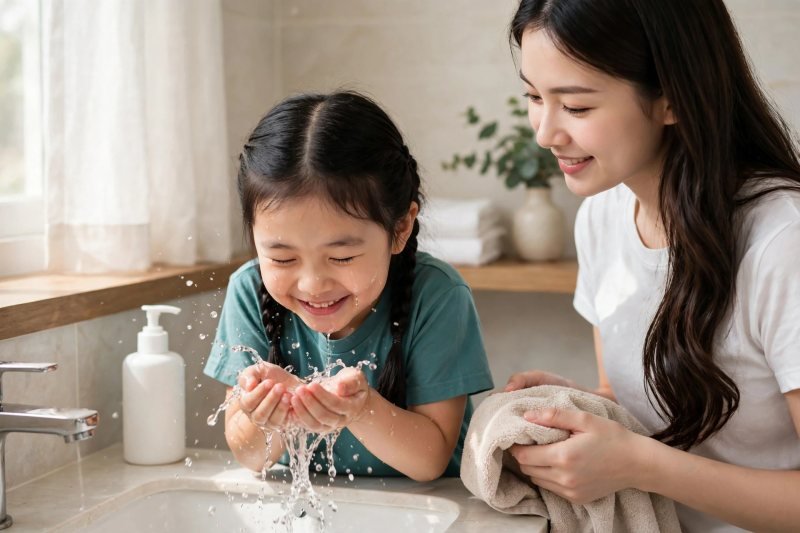
Start with the honest answer: most young kids need only water. Here is the whole article in one breath — a healthy 5- or 6-year-old's face, on an ordinary day, needs warm water and gentle hands, full stop. Young children's skin is not yet producing the oil that puberty will bring, so the grime of a normal day — dust, lunch, playground air — rinses away with water alone, and daily cleanser mostly risks drying skin that was never dirty in an oily way. Say, "Water is your face wash; the bottle is for special days." When you search for face wash for kids, you are mostly being sold a habit your child doesn't need yet — this guide teaches the exceptions instead.
-
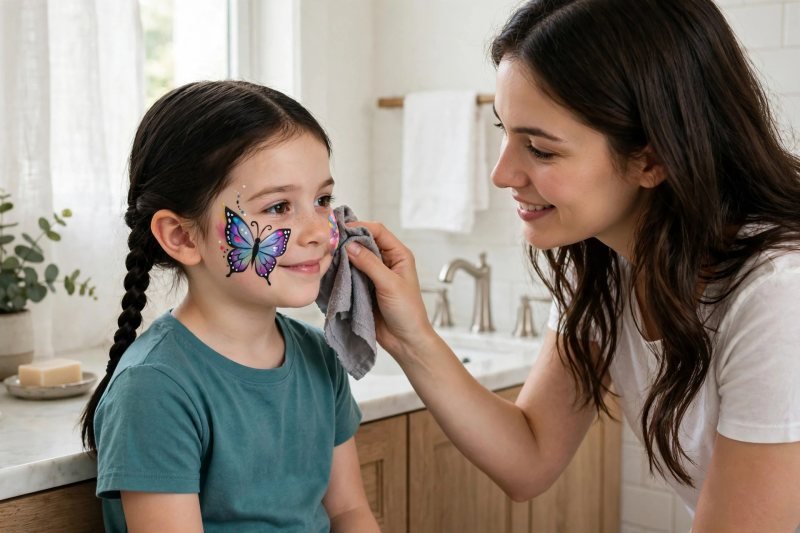
Learn the five times water stops being enough. Cleanser earns its place when something is ON the face that water can't fully remove: sunscreen at day's end (it is made to resist water), heavy sweat and grime after sports or a muddy play day, face paint and stage makeup, sticky food-and-sunscreen combinations after fairs and parties, and genuinely dirty outdoor days — gardening, beach, camping. Say, "Sunscreen, sweat, paint, or real dirt — that's a cleanser day; everything else is a water day." Keeping the list short and concrete lets your 5-year-old judge for herself at the sink, which is the beginning of the habit this article wants to build: reading the day off her own face.
-
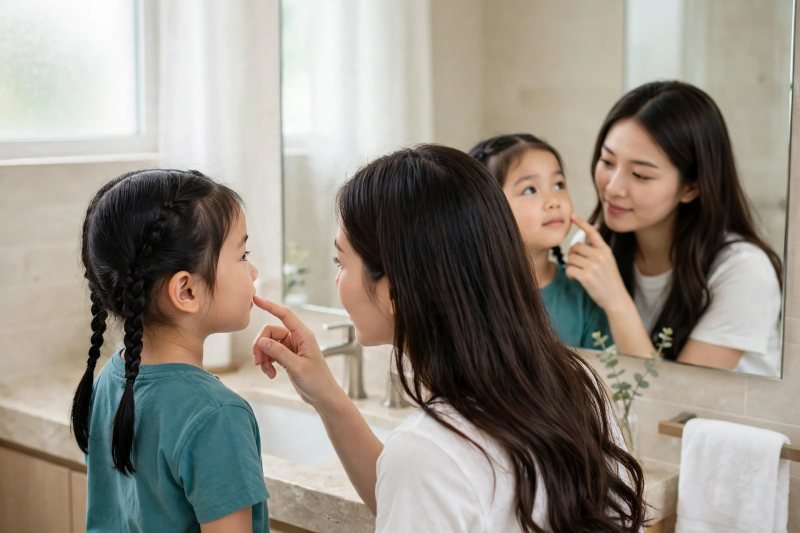
Check her skin type and sensitivities before choosing anything. Look at her face the way step 1 of any good routine demands: is it calm and even, dry and flaky at the cheeks in winter, prone to redness, or dotted with the rough little bumps many young kids get on cheeks and arms? A child with eczema-prone or reactive skin stays on the blandest possible track — water most days, the gentlest cleanser on the step-2 days, moisturizer after — and a child with persistent rashes needs a pediatrician's eyes before any product experiments. Say, "Calm skin, simple care; cranky skin, simpler care and a doctor in the loop." Her skin type, not the store shelf, writes this routine.
-
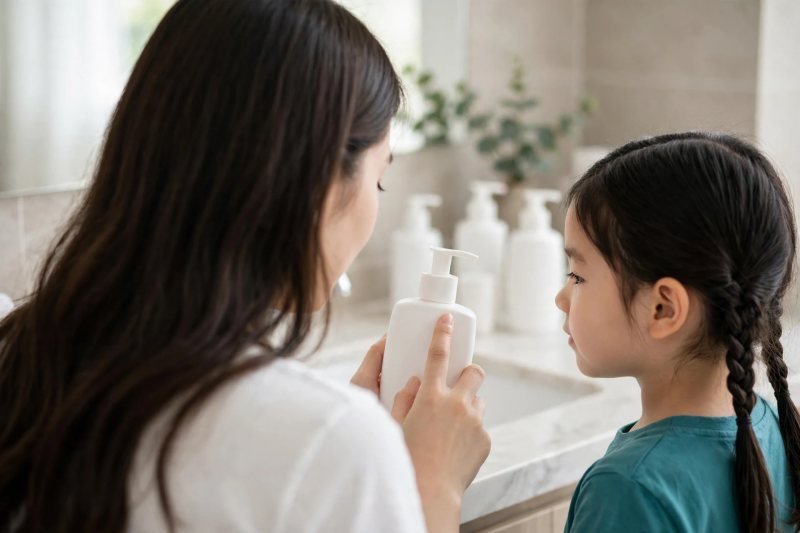
Choose a cleanser by criteria — and keep adult actives off young faces. When you do buy one, the checklist is short: gentle, fragrance-free, made for children or for sensitive skin, with a short ingredient list and no promises beyond cleaning. What must NOT be in it for a 5- or 6-year-old: the acne and anti-aging actives from adult shelves — salicylic acid, benzoyl peroxide, retinoids, strong scrubs and exfoliating beads — unless a doctor has specifically advised one for a diagnosed condition. Say, "If it promises to fight wrinkles or acne, it is not for a kindergartner." This single screen protects young skin from most of the harm the skincare aisle can do, and it pairs with the product logic in this simple skincare routine for kids: the fewest, blandest products that do the job.
-
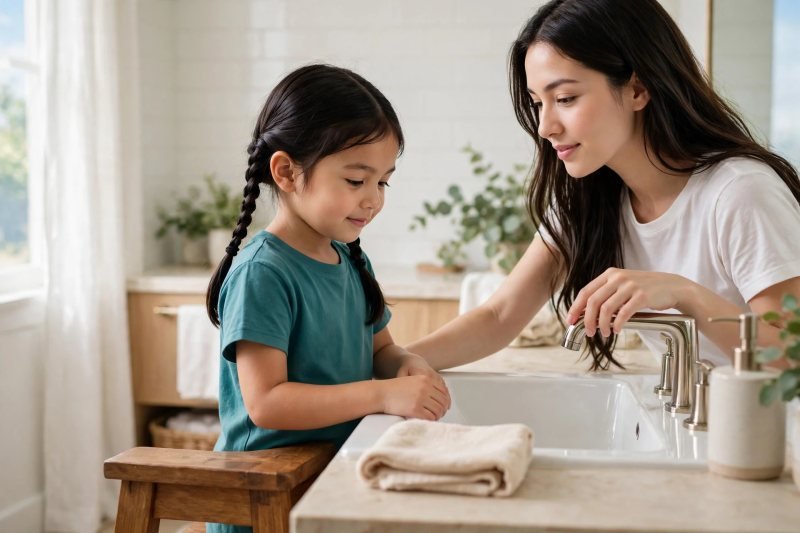
Set up the sink so she can do it herself. Independence is built from furniture: a sturdy step stool that puts her chin comfortably above the basin, lukewarm water she can reach without stretching, her own soft cloth and hand towel on a low hook, and the cleanser placed as a tool she may use on cleanser days — not a trophy she must. Run the water yourself the first times and teach the wrist test from the bath days: comfortable on the inside of the wrist is right for a face. Say, "Your stool, your cloth, your sink — I'll watch the first times, then it's yours." A setup she can run alone is a routine that survives your busy mornings.
-
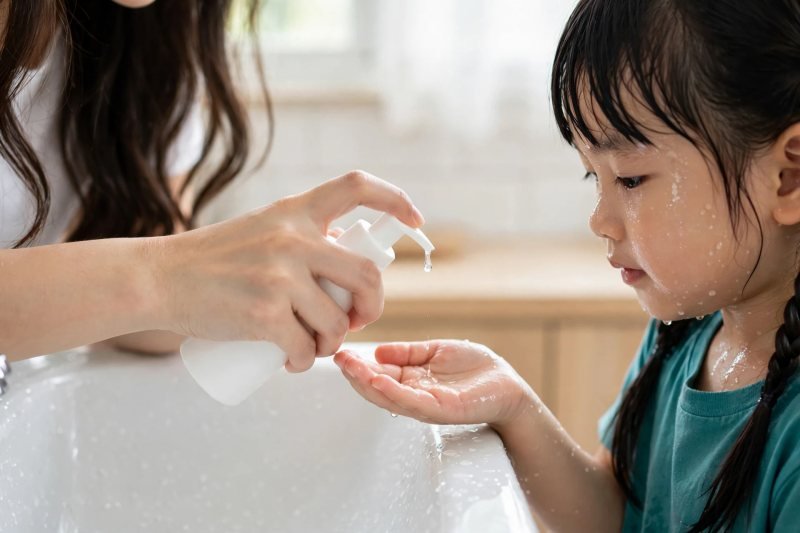
Wet the face first, then use a pea-sized amount — on cleanser days. The order matters: splash lukewarm water over her whole face first (six or seven good handfuls, eyes squeezed happily shut), because cleanser spread on a dry face drags and over-concentrates. Then, if today is a step-2 day, a pea-sized amount worked between her palms or fingertips is genuinely enough for a small face — more foam means more rinsing and more drying, not more clean. Say, "Wet face first; a pea is plenty." On water days, this step is just the splashing — which most 5-year-olds will tell you is the best part, and they are not wrong.
-
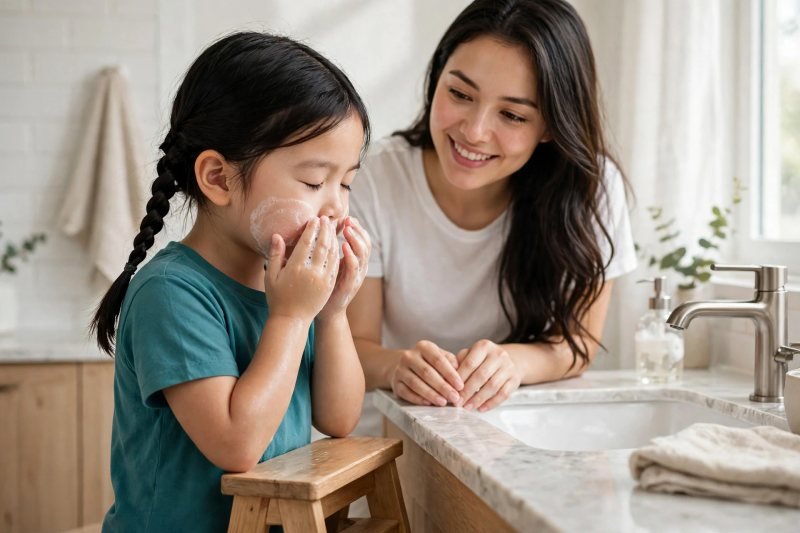
Wash with fingertips in gentle circles for about thirty to sixty seconds. Teach the technique once, properly: fingertips only (no scrubbing with the cloth), small circles, forehead then cheeks then nose then chin, gentle as if the face were a peach she mustn't bruise. Thirty seconds is a real wash; sixty is thorough — sing one verse of a favorite song or watch a little sand timer together until the timing is in her hands. Say, "Fingertips, circles, one whole song." Eyes stay closed, the mouth stays a line, and if cleanser gets near eyes, rinsing with plain water comes first and the lesson second. This minute at the sink is the entire skill — everything else in the article just decides when to use it.
-
Rinse completely and pat — never rub — dry. Residue is the quiet troublemaker: rinse with handfuls of lukewarm water until the skin feels clean rather than slippery, checking the hairline, the sides of the nose, and under the chin, where cleanser likes to hide. Then pat dry with her soft towel — pressing and lifting, not dragging — because rubbing a young face with a towel undoes the gentleness of the whole wash in four seconds. Say, "Rinse till it's just skin, then pat pat pat." On water-only days the same rinse-and-pat applies, which is the point: one technique, two intensities, zero new skills to learn.

-
Moisturize if she's dry, and let mornings belong to sunscreen. If her cheeks run dry — winter air, indoor heating, a cleanser day — smooth a pea-to-walnut amount of plain fragrance-free moisturizer over the slightly damp face right after patting dry; if her skin is comfortable, skip it without guilt. Mornings stay simple: a water splash if she likes one, moisturizer if needed, and her usual sunscreen as the final step before the day — the rhythm this site's kids' skincare routine builds on. Say, "Night is for washing the day off; morning is for protecting the day ahead." Two small anchors, and a young face is genuinely cared for.

-
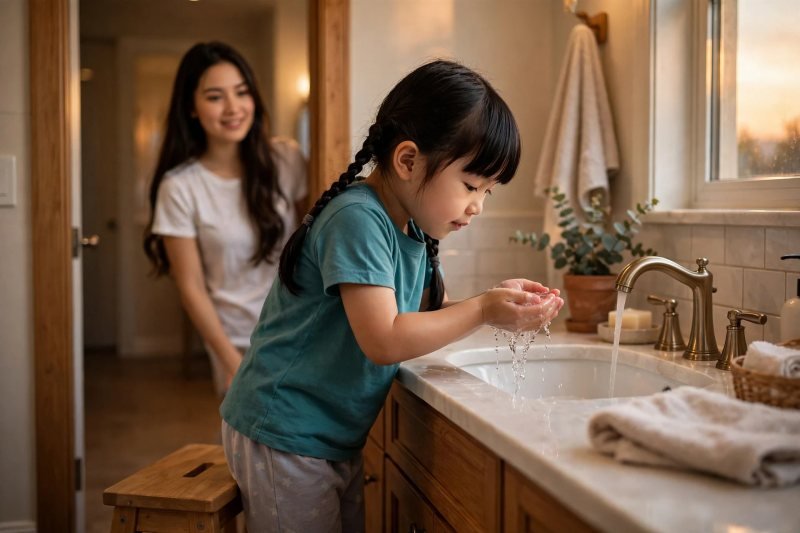
Make it a nightly habit — and know when skin needs a doctor, not a product. Anchor the wash to an existing cue — after pajamas, before the bedtime story — so the sink minute happens on autopilot, water on most nights, cleanser on the step-2 nights. Then hold the line that protects her most: persistent rashes, spreading eczema, itching that disrupts sleep, oozing or crusted patches, or acne-like breakouts appearing well before puberty (in a child under seven, breakouts always warrant a doctor's look) are pediatrician territory, full stop. Say, "Our job is gentle and simple; the doctor's job is anything that doesn't clear." A parent who knows the boundary gives her child better skin care than any bottle in the store.


Make it easier
Water-only, every night, one song long — add the cleanser concept later, when sunscreen season makes it obviously necessary. Give her a dedicated soft cloth and towel in her color so "her" sink kit is unmistakable and laundry rotation is easy. Use the mirror: let her inspect her own face and call "cleanser day" or "water day" by the step-2 list — judgment is the habit. When her cheeks run dry in winter, the same pat-and-seal finish pairs with our best moisturizer for kids with dry skin guide.
Make it harder
Teach her the full self-check: hairline rinse, nose sides, under-chin — the three residue hiding spots — as a game she must pass nightly. Add a simple weekly review together: any dry patches? Any new bumps? — early practice in noticing her own skin and reporting changes. Let her run a complete "spa minute" for a parent volunteer, teaching the technique back — mastery by teaching, fingertips and all. If her skin reacts to many products, read our sensitive skin in children guide before adding any second product to the routine.
Other ways to play it
- Sunscreen-season routine: every camp and swim day becomes a cleanser night by default; a gentle wash at bath time (face last, fingertips only) keeps it to one event.
- Face-paint and performance days: remove paint first with a soft cloth and water (or a gentle cleansing wipe for stubborn color), then the normal minute-long wash; check for irritation the next morning before reapplying anything.
- Eczema-prone track: water-only almost always, cleanser reserved for true grime, moisturizer after every wash, and the family's pediatrician looped in early — the routine shrinks to its gentlest form. For the full home-care pattern, see our eczema care for toddlers guide.
How it changes by age
- Age 5: At five, the parent still runs the water and the judgment: you call cleanser days, you supervise the circles, and the routine is mostly splashing, patting, and pride. The cleanser bottle may legitimately be used only a few times a month — that is success, not neglect.
- Age 6: Sixes can own the sink: stool, water temperature by wrist, pea-sized amount, one song of circles, rinse-pat-moisturize. Your role becomes the weekly review and the red-flag watch. Many pediatric sources suggest regular daily washing becomes genuinely useful somewhere around ages 6–8 as activity, sweat, and early skin changes build — your six-year-old is practicing the skill right on schedule, water-first.
What they're learning
Hygiene as judgment: reading her own face and choosing water or cleanser is decision-making, not just washing. Body knowledge: forehead, cheeks, hairline, residue, moisture — a working vocabulary for her own skin she will use for life. Gentle self-care: the peach-rule (touch your own face kindly) is a small, daily lesson in treating herself well. Routine ownership: a self-run sink minute, anchored to bedtime, is executive function in a step stool.
Clearing up
The sink minute ends with a thirty-second reset: her cloth rinsed, wrung, and hung to dry where air reaches it; the towel on its hook; splashes wiped from the counter and floor (tomorrow's slip is today's puddle); cleanser cap closed and bottle back in its spot. Launder the cloth and towel on the regular rotation — twice a week is a sane rhythm for a daily-used face cloth. And glance at the cleanser bottle monthly: if it has been opened since last summer and barely used, that is the water-first system working exactly as designed. Dry winter cheeks get their own gentle fixes in our dry skin on kids' faces guide.
Questions parents ask
Do kids really need face wash?
At what age should kids start washing their face daily?
Can my child use my face wash?
How should a young child wash her face?
What if my 6-year-old is getting pimples?
Should kids wash their face in the morning too?

save it for later
Pin this for the next rainy afternoon
Keep it on a board so it is there when you need it, rather than when you happened to find it.
Save to Pinterest

