


Matching Uppercase and Lowercase Letters: 10 Fun Games for Preschool
Matching uppercase and lowercase letters starts with your child's name letters, then sorting trays, memory games and movement play. Ten guided steps for ages 3–4. Ten guided matching games that turn "big A" and "little a" into the same letter in your child's eyes — starting with the letters in their name.
Matching uppercase and lowercase letters is a visual-matching game: same letter, two shapes. Start with your child's name letters — the most motivating pairs — then add high-contrast pairs like A/a and B/b before tackling look-alikes like C/c. Keep sessions to 10–20 minutes, say each letter's name as you match, and let games like memory, sorting trays and letter relays do the teaching.

The short version
- Start with the letters of your child's name — motivation beats every other teaching trick.
- Teach it as shape-matching first: "big E has straight lines, little e is curvy — same letter!"
- Add pairs gradually: name letters → high-contrast pairs (A/a, B/b, D/d) → look-alikes (C/c, O/o, S/s).
- Say letter NAMES while matching; save letter sounds for separate phonics play.
- Short, playful sessions (10–20 minutes) repeated through the week beat one long lesson.
- Age
- Ages 3–4
- Prep
- 5 min
- Mess
- Low
- Difficulty
- Easy
- Where
- Indoor
Why kids love this
Every step is a game, never a quiz. Cards get flipped, sorted, posted, hunted and raced — and matching uppercase and lowercase letters feels like collecting treasures, not doing schoolwork.
What you'll need
- 26 pairs of large letter cards (index cards or cardstock — uppercase per card, lowercase partner on another; palm-sized or bigger)
- A muffin tin or small bowls, a shoebox "mailbox" with a lid slot, clothespins
- A tray of dry rice or lentils, masking tape, a timer (phone is fine)
Before you start
Make one set of letter cards and keep it in a zip bag — you'll reuse it all week. Start with ONLY your child's name letters (both cases), plus 5–6 high-contrast pairs like A/a, B/b, D/d. Save look-alikes (C/c, O/o, S/s) for later. Make capitals big and bold, lowercase clearly smaller.
How to do it
-
Matching uppercase and lowercase letters is a visual-discrimination task: same letter, two shapes. Follow the steps in order — name letters first, then table games, movement games, and challenges.

-
The easy wins first: name letters and big-card matching (steps 1–3)

-
1. Match the letters of their own name. Lay out only the UPPERCASE letters of your child's name and hold the lowercase partners. Point to each big letter and say its name: "This is big M. Can you find little m?" Hand them one card at a time to place beside its partner. You're teaching that a letter has TWO forms — and the child already knows both, because the letters are theirs. Finish: "big M, little m — same letter!"

-
- Keep it going: hide the lowercase name cards around the room; your child hunts each one and returns it to its big partner.
-
2. Add big-card matching for high-contrast pairs. Spread 4–5 uppercase cards face-up in a row and hand your child the lowercase partners one at a time: "Here's little e. Which big letter is its partner?" This is SHAPE-matching — they're learning that "tall straight E" and "round curly e" are the same letter. If they guess wrong, compare the cards: "Big E has straight lines, little e is curvy. Same letter, different shape. Try again!" Add one or two new pairs per day; stop while they're winning.

-
3. Sort pairs into trays. Put uppercase cards as "labels" beside each muffin-tin cup and hand your child a shuffled pile of lowercase cards. Their job: drop each little letter into the cup with its big partner. Say the teaching line: "Every little letter is looking for its big brother!" The containers help 3-year-olds who scatter flat cards. When the tin is full, empty each cup and read the pairs back: "big D, little d!" Then swap roles — you sort, and let them catch your one silly mistake.
-
Table games: memory, posting and digging (steps 4–6)

-
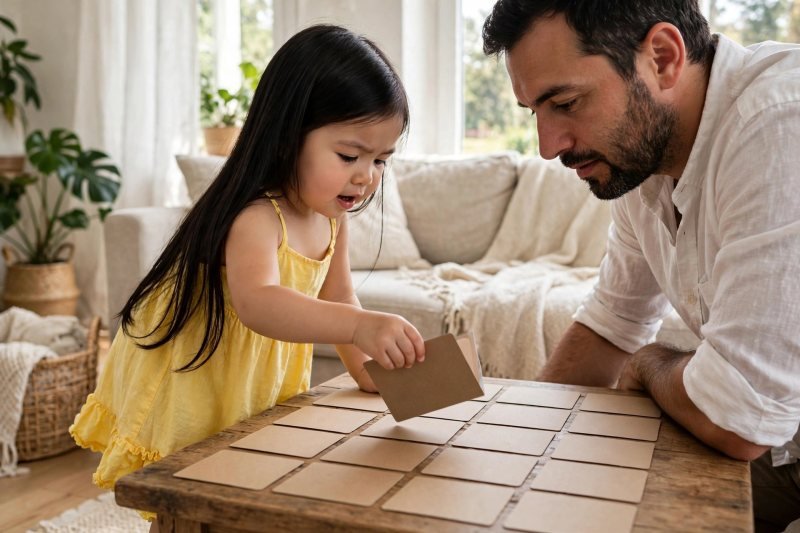
4. Play matching memory with a few pairs. Choose 3–4 pairs they know and lay all cards face-down in a grid — flipping a capital and its lowercase is a match. Model the self-talk first: "I flipped big A… now I need little a. Where did I see it?" Narrating your own searching shows them that remembering WHERE cards are is the skill, not luck. Keep it to 3 pairs at first.

-
- More table games: clip each little letter to its big partner with a clothespin — fingers work while eyes match.

-
5. Post the mail. Stand uppercase cards up like little mailboxes around the room. Hand your child the lowercase cards as "letters": "This letter is for big B — where's big B's mailbox?" They run each little letter to its big-letter home and post it into a shoebox: "little b goes to big B — delivered!" The room-scale search keeps the matching task inside a movement game, so wiggly 4s stay engaged twice as long as at the table.

-
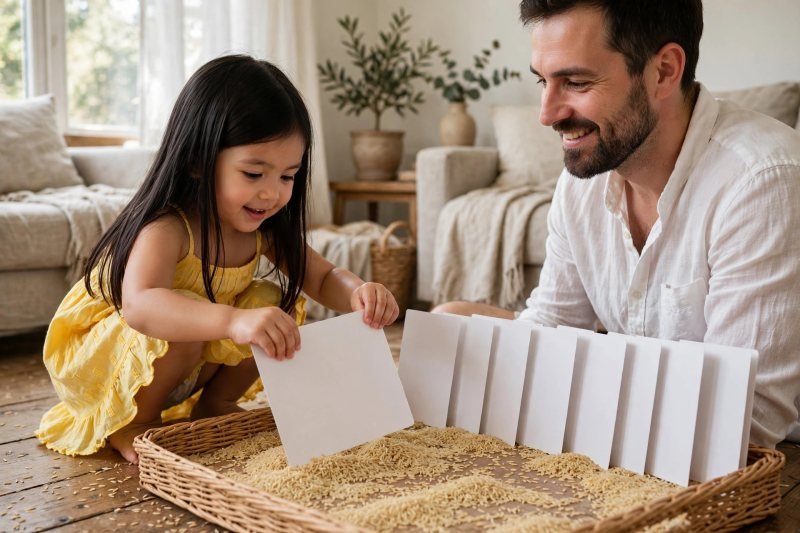
6. Dig matches out of a sensory tray. Bury 5–6 lowercase cards in a tray of dry rice or lentils; line the uppercase cards along the tray's edge. Your child digs for a little letter, brushes it off, and walks it to its big partner: "You found little r — it goes with big R!" The surprise of each dig resets attention every turn. Pour the rice back into its jar when done (built-in tidy-up).
-
Big movement games: match across the room (steps 7–8)
-
7. Run the letter relay. Tape uppercase cards to one wall; line the lowercase cards on the opposite side. Call out: "little g needs big G — GO!" Your child grabs little g, runs across, and sticks it under big G. The run burns energy while the eyes work at the finish line — they must SCAN the wall and discriminate between similar capitals. Take turns: you run one round while they call the letter.
-
- More movement: hide little letters inside plastic eggs; each opened egg gets matched to its big letter (egg hunt match).
-
8. Silly mismatches — YOU get it wrong. Lay out 4 correct pairs, then deliberately "match" one wrong: "Done! little e goes with big B!" Let your child erupt and fix it: "Oh no! My eyes were being silly. Where does little e REALLY go?" Correcting you is the highest form of the skill — they must hold both forms in mind to judge YOUR match. Let them set the trap for you next round.
-
Playful challenges: speed and the full set (steps 9–10)
-
9. Beat-the-clock matching race. Lay out 6–8 pairs they know well. Set a timer for one minute: "How many pairs can you match before the beep?" Speed forces AUTOMATICITY — the moment a child stops thinking hard about B/b and just knows it, the pair is learned. Race only with comfortable pairs, never brand-new ones.
-
10. Graduate to the full set. Add the tricky similar pairs — C/c, O/o, S/s, P/p, V/v, W/w, X/x, Z/z — a few at a time, using the sorting trays from step 3. Name the exact visual difference: "big C and little c look almost the same — but little c is SMALLER." That gives them a strategy instead of a guess. End the week by spreading the whole set and letting them match every pair they can.


Make it easier
Start with just TWO pairs — their first initial plus one more — and match hand-over-hand the first time. Use only the name letters for the whole first week.
Make it harder
Add the look-alike pairs (C/c, O/o, S/s) once easy pairs are automatic. Play memory with 6–8 pairs, or race the clock with a shorter timer.
Other ways to play it
- Bath-time version: foam letters stick to wet tile — uppercase on the wall, lowercase in the water.
- Grocery-list game: write a tiny "list" of lowercase letters; they find each big partner on pantry packaging.
- Sibling mode: an older sibling reads the lowercase "mail" aloud while the younger delivers it to the big-letter mailboxes.
How it changes by age
- Younger 3s: steps 1–3 with just name letters and 2–3 extra pairs, 10-minute sessions.
- Older 4s: try the memory game (step 4), the relay (step 7) and the timed race (step 9); they can handle 6–8 pairs and the look-alike set in step 10.
What they're learning
Visual discrimination — two different shapes, one letter — plus letter-name knowledge, one-to-one matching, memory and scanning skills (steps 4–7), and fine-motor control from sorting, posting and digging (steps 3, 5, 6).
Clearing up
The card set lives in a zip bag — "posting the cards home" (every little letter to its big partner) makes tidy-up the final game. Shake the rice tray back into its jar over the mat. Peel masking tape off walls slowly.
Questions parents ask
How do I teach my preschooler to match uppercase and lowercase letters?
What age should a child match uppercase and lowercase letters?
Why is matching uppercase and lowercase letters hard for preschoolers?
Should I teach letter names or letter sounds when matching uppercase and lowercase?
What letters should I start with for uppercase and lowercase matching?
How long should a letter-matching game last for a 3-year-old?
Three or four favorite games, repeated through the week, teach more than ten played once. Repeat the same pairs until matching feels instant, then add new ones. If a game flops, shelve it and try again next week.
Keep reading: - [Alphabet activities for toddlers](https://brightplaydays.com/activities/alphabet-activities-for-toddlers/) — simple letter play to warm up ABC recognition before matching begins. - [Letter tracing worksheets for pre-K](https://brightplaydays.com/activities/letter-tracing-worksheets-prek/) — the natural next step once your child can match both forms of a letter. - [Phonics activities for preschoolers](https://brightplaydays.com/activities/phonics-activities-for-preschoolers/) — add letter sounds to the letters you can now match.


