


Long E Words: 40+ Words With EE and EA Spellings
A long E words list for ages 6–8: 44 real EE and EA words — tree, beach, read and friends — with a 10-step sort-and-read routine and the four tricky EA rule-breakers.
Long E words are words where the letter E says its name — the long EEE sound. This list gives you 44 real examples: 22 EE words (tree, green, sleep) and 22 EA words (beach, read, dream), each checked to say EEE, plus the four tricky EA rule-breakers (bread, head, great, break) to memorize. Includes a 10-step sort-and-read routine for ages 6–8.

The short version
- Long E has two main spellings here: ee doubled together (tree) and ea paired (beach).
- 44 real long E words — every one verified to say EEE, split into EE and EA teams.
- The sort-and-read routine teaches both patterns side by side in ten steps.
- Four tricky EA rule-breakers (bread, head, great, break) cheat the pattern — memorize those whole.
- Age
- Ages 6–8
- Prep
- 15 min
- Play time
- 18 min
- Mess
- None
- Difficulty
- Easy
- Where
- Indoor
Why kids love this
One sound — the bright, stretchy EEE — but two spellings: ee doubles up in tree and sleep, ea pairs up in beach and read. Sorting the cards into two rival teams turns spelling into a game, and the four red rule-breaker cards (bread, head, great, break) get a dramatic arrest — nothing hooks a six-year-old like catching a word cheating.
What you'll need
- 44 index cards and a thick marker pen
- The 44-word list below (printed or on your phone)
- 4 red index cards: bread, head, great, break
- Star stickers
Before you start
1. Write the 22 EE words large and lowercase in BLACK, one per card: see, bee, tree, three, free, green, sheep, feet, need, week, deep, sleep, sweet, street, keep, seem, feel, queen, between, screen, speed, meet. 2. Write the 22 EA words large and lowercase in BLUE, one word per card: read, team, beach, seat, eat, leaf, clean, dream, sea, teach, reach, each, cheap, cream, stream, meal, please, repeat, season, speak, mean, neat. 3. Write the 4 tricky words on RED cards and keep them hidden for now: bread, head, great, break.
How to do it
-
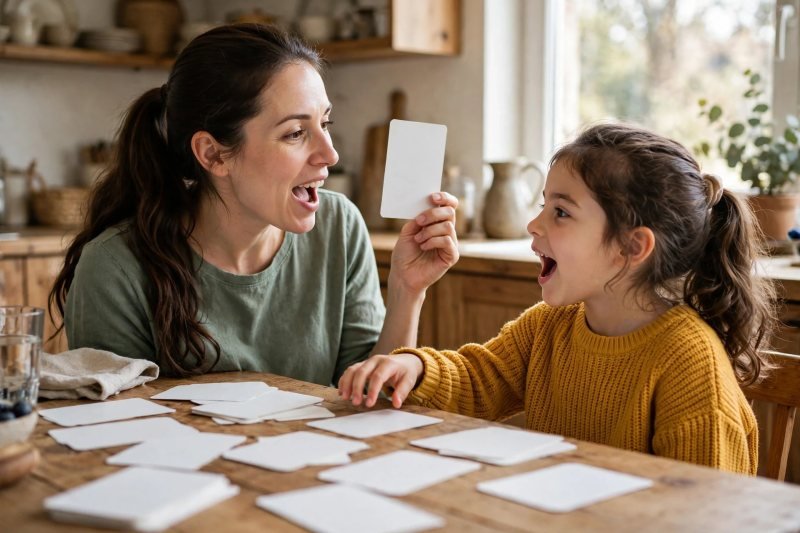
Read the whole list — you lead. Ten steps, about fifteen to twenty minutes. Read each card slowly, stretching the EEEE — "beeee… treeee… beeeach" — while your child echoes. New to long vowels? Start with our magic e words list — or check readiness with our CVC words list.
-
Set up the two teams. Two empty rows, side by side: "EE and EA — same sound, different spelling."

-
Sort and read the EE team. Pull every black card into row one — all 22. "Two Es always stick together, right in the middle." EE and EA are vowel digraphs: two letters, one sound — our digraphs for kids activities build on the idea. Read the row down together.

-
Sort and read the EA team. The 22 blue cards into row two. "EA is a pair too — it loves the middle, just like EE." Read the row down together.

-
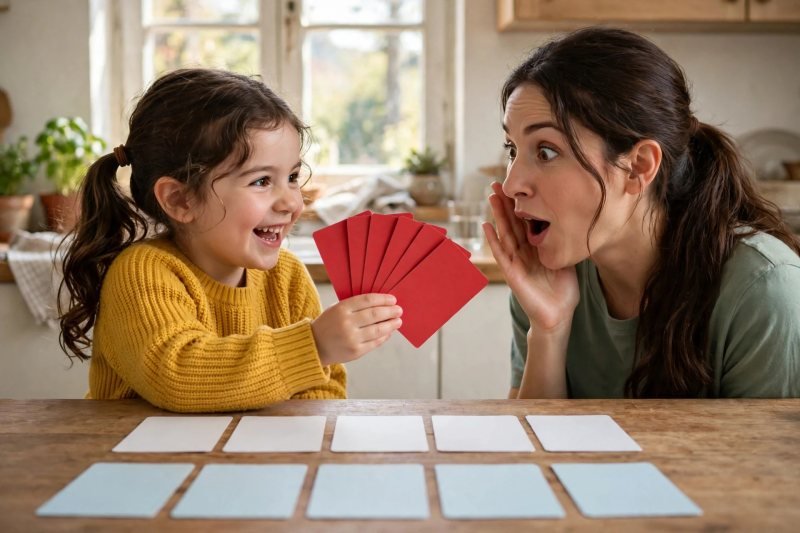
Meet the rule-breakers. "Bread — does it say EEEE?" It says bred. Work through head (hed), great (grAYt — long A!), break (brAYk — also long A!). They cheated, so we memorize them whole.
-
Chant the rhyme chains. Clap on each word: tree, three, free, bee — green, queen, screen, between — beach, teach, reach, each — clean, mean, cream, dream, stream — eat, seat, neat.

-
Build one silly sentence. One EE card plus one EA card: "The green sheep dreamed about a beach." Drawing the scene locks the words in.

-
Quiz round. Shuffle the black and blue cards; read each aloud: "Which team — EE or EA?" For misses, re-read slowly. Turn the quiz into a game — our sight-word games bank has timed rounds that work with any list.

-
Catch the rule-breaker. Shuffle in the red cards and read one by one. Your child shouts "rule-breaker!" first — bread (short E!), great (long A!).

-
Star the favorites. Star every word read without a pause, read the starred cards once more — both teams fast — and put the cards away on a high note. For more ways to teach new words, our how to teach sight words guide walks through the methods.



Make it easier
Work one team per session — EE first, since its spelling is the most predictable. You sort every card while your child just reads and echoes.
Make it harder
Shuffle all 44 cards and time your child sorting them into the two teams alone. Dictate: you say "beach," your child writes it — choosing EA from memory.
Other ways to play it
- Chalk teams: write the EE words on the driveway; your child reads them hopping down the row.
- Board-game quiz: roll a die, move along a team row, read each card you land on.
How it changes by age
- Ages 6–7 is the sweet spot: most children know magic e by six and are ready for both ee and ea.
- Confident five-year-olds can play with just the EE team — ten minutes max.
- When they sound out short-vowel words like cat and map easily, know one long-vowel pattern (usually magic e), and are six or older. Not sure? Our CVC words list (linked in step 1) is a good readiness check.
What they're learning
Two spellings, one sound: ee doubles up, ea pairs up — and both love the middle of the word. Pattern spotting: seeing the spelling before guessing the sound — the core skill of fluent decoding. Honest exceptions: some words cheat, and fluent readers memorize those instead of forcing the rule.
Clearing up
Why do "bread" and "head" look like long E words but sound different? EA used to say EEE almost everywhere, but in a handful of common words the vowel drifted short: bread, head, dead. Great and break kept the long-A sound instead. The old spellings stayed while the sounds moved on — so these four are pure memory words. Wipe grubby cards with a damp cloth and rubber-band each team separately, so next session starts with the sort half done.
Questions parents ask
What are long E words?
What are some examples of long E words with EE?
What are some examples of long E words with EA?
Why doesn't "bread" rhyme with "read"?
How can I help my child spell long E words?
What other letters can make the long E sound?
Stretch the EEEE on every first read — "greeeen" — until the child stretches it unprompted. A card earns the "mastered" pile only after two clean cold reads in a row. Every word below was checked for a genuine long-E /iː/ sound — all 44 say EEE: EE — always two Es together (22): see, bee, tree, three, free, green, sheep, feet, need, week, deep, sleep, sweet, street, keep, seem, feel, queen, between, screen, speed, meet EA — a pair that loves the middle (22): read, team, beach, seat, eat, leaf, clean, dream, sea, teach, reach, each, cheap, cream, stream, meal, please, repeat, season, speak, mean, neat Teach the team shapes: "EE doubles up in the middle; EA pairs up too, and it's the only team that sometimes starts a word — eat, each." Dictate one team at a time. When your child writes "bred" for the food, celebrate first — they heard the right sound. Then: "Rule-breaker! EA cheats here." Four more, once EE and EA feel solid: a lone E at the end (he, she, we, me), IE in the middle (field, chief, believe), Y at the end (happy, funny), and magic-E with E (these, eve, theme). EE and EA cover the words kids meet most often. Stretch the EEEE — "treeee" — then practice one team a day for fifteen to twenty minutes. Reading the whole EE row at speed teaches your child to decode new ee words on sight. EE and EA are vowel digraphs: two letters, one sound (see step 3).

save it for later
Pin this for the next rainy afternoon
Keep it on a board so it is there when you need it, rather than when you happened to find it.
Save to Pinterest


