


Kids Summer Outfits: Cool Looks for Hot Days
Kids summer outfits are easier when a small capsule rack does the thinking: breathable tees, shorts, swim gear, layers and hats, matched to ten everyday summer plans.
Kids summer outfits work best as a small capsule: breathable tees and shorts that mix and match, plus swim gear, a light layer, a rain jacket, a smarter shirt, closed-toe shoes, a sun hat and sunscreen. Match each look to the plan, test that your child can run, climb and bend freely, and finish every day with the hat-and-sunscreen check.

The short version
- Build one small rack grouped by job — everyday, swim, layers, rain, smart — so your child can dress himself.
- Choose breathable, light-colored fabrics and test every look with movement: jumping, squatting, reaching, sitting.
- Cover up smartly: rash guard at the pool, long sleeves at mosquito hour, a light layer for air-conditioning.
- A helmet for every bike ride; closed-toe shoes for biking and climbing — sandals are for water.
- Finish daily with the hat-and-sunscreen check: hat on, sunscreen on ears, neck and hands.
- Age
- Ages 6–8
- Prep
- 15 min
- Mess
- Low
- Difficulty
- Easy
- Where
- Indoor
Why kids love this
Kids summer outfits stop being a morning argument when getting dressed becomes a try-on game. A 6- to 8-year-old who can see his whole wardrobe on one rack makes real choices — park look, pool look, camp look — each with a tiny test he runs himself: jump, zip, pocket, hat. He is not being dressed; he is gearing up for the day's mission.
What you'll need
- Five to seven plain breathable t-shirts that all mix together
- Three or four pairs of shorts — athletic, cargo, chino, quick-dry
- A swim set: trunks, rash guard, sandals, towel
- A light zip hoodie and a light long-sleeve overshirt
- One short-sleeve button shirt for smarter occasions
- A light rain jacket and rain boots
- Closed-toe sneakers, a bike helmet, a cap and a bucket hat
- A low rack or cleared shelf, plus child-manageable hangers
Before you start
1. Pull every summer piece your child actually wears onto the bed; remove anything outgrown, scratchy or never chosen. 2. Group what is left by job — everyday; swim; layers; rain; the one smarter look. 3. Set the rack where your child dresses, at a height he can reach without climbing. 4. Talk through the week ahead — park, pool, camp, a barbecue — so each look has a real occasion. Our summer hub is a useful starting point for the week's plans.
How to do it
-
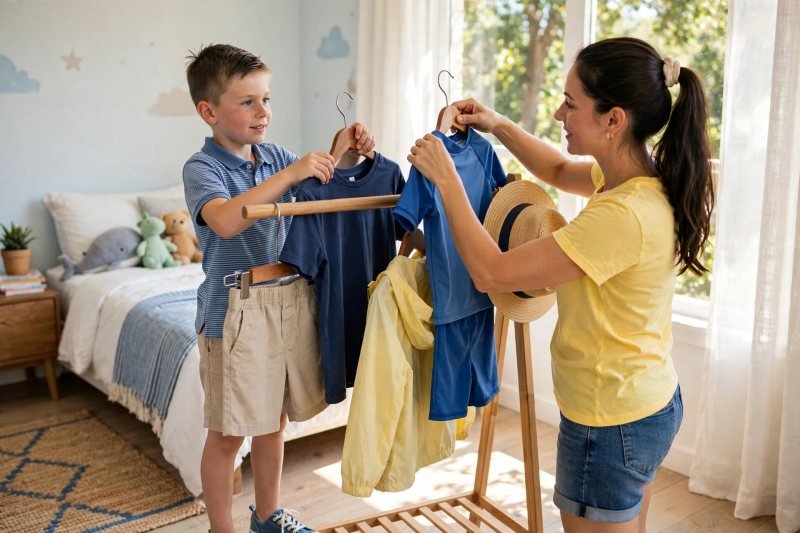
Build the summer rack together. Start at the empty rack with the sorted piles on the bed, and hang the capsule up together — tees first; then shorts; then the swim set; the rain jacket; and a hat on the end hook. Say: "This rack is your whole summer — if a look is not on here, we probably do not need it this week." Let your child hang everything himself while you name what each group is for. Last hanger on, the try-on begins with the look he wears most.
-
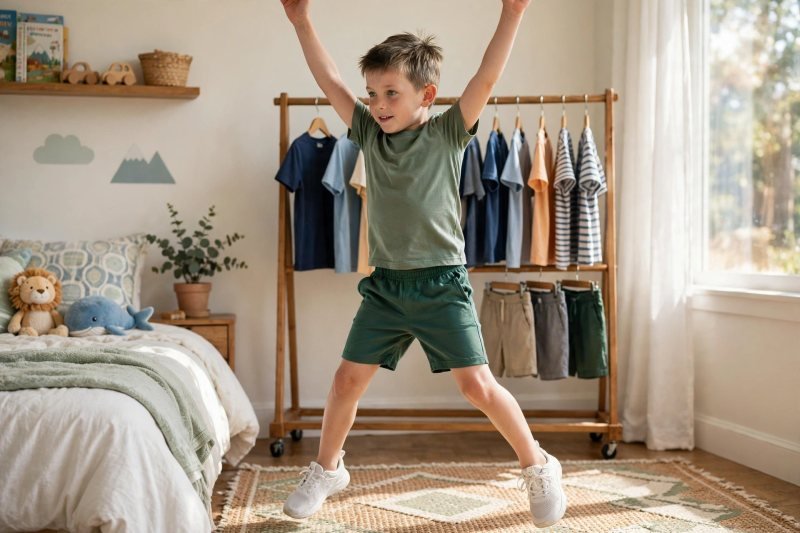
Dress for the park. Pull the first look off the rack — a breathable tee; athletic shorts with room through the leg; and closed-toe sneakers. Say: "Park clothes have one job — nothing can stop you climbing, running or hanging upside down." Dressed, he runs the movement test himself: a jumping jack; a deep squat; a reach overhead; and a pretend slide. He swaps any piece that pulls, rides up or scratches. Hang this passing look back as the everyday template and move on to water.
-
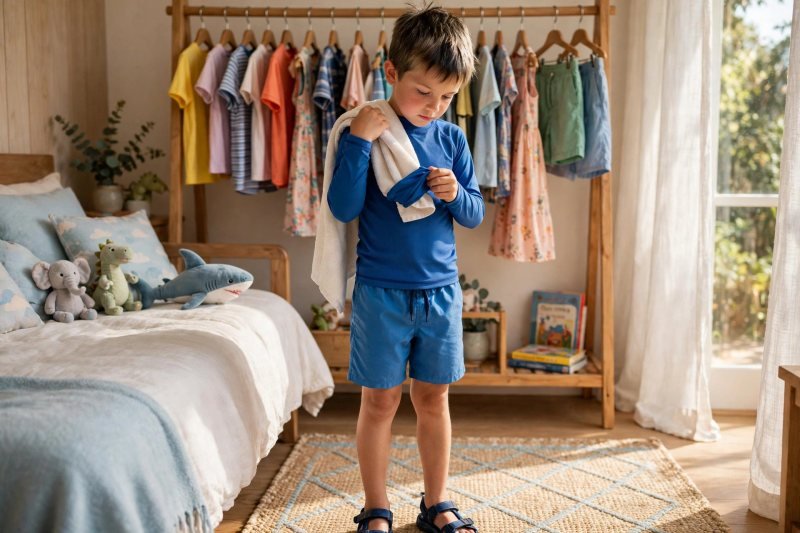
Gear up for the pool. Build the swim look on the bed first — swim trunks; a long-sleeve rash guard; wet-friendly sandals; and a towel. Say: "The rash guard is a shirt that does sunscreen's job on your shoulders and back, even in the water." He dresses fully, drapes the towel over one shoulder, and practices the after-swim sequence: towel first; wet pieces in a pile; dry tee on top. Set the swim set on its own hook and turn to wheels.
-
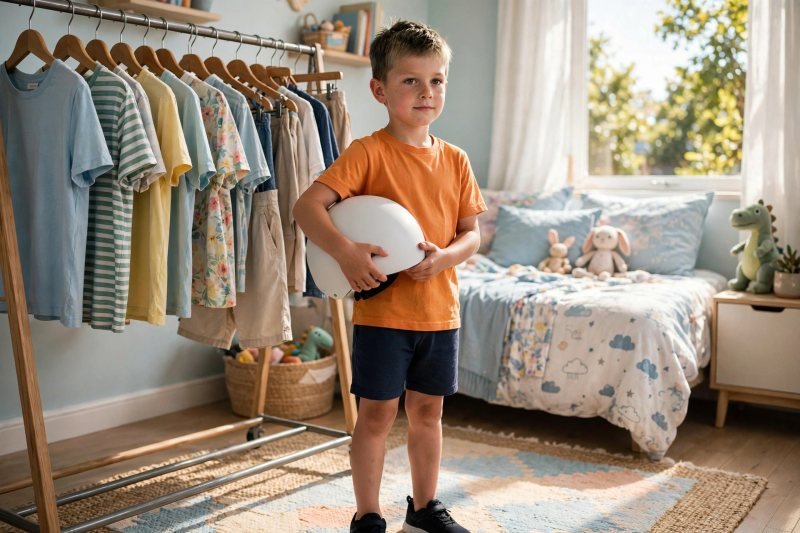
Head out on a bike ride. Choose a tee that will not flap or catch; stretch shorts that let his legs pedal freely; and closed-toe shoes, never sandals. Say: "Bike rules are simple — toes covered, nothing dangling, and a helmet every single ride, even a short one." He dresses, tucks the helmet under his arm, and does a slow pretend pedal to feel whether shorts bunch. Check the helmet together: level, snug, straps in a neat V under each ear. Ready to roll — and for a longer day away next.
-
Cool off at summer camp. Camp needs a look that works without him thinking about it — a light-colored tee; cargo shorts; sturdy shoes; and a cap. Say: "Camp pockets are treasure pockets — but only treasures that fit with the flap closed come home." He dresses, puts the cap on, and tests the pockets with candidates from the rug: a smooth pebble; a leaf; a small toy. Anything sharp, living or too big gets admired and left behind. Cap on and pockets tested, the next problem is the opposite one — too much cold indoors.
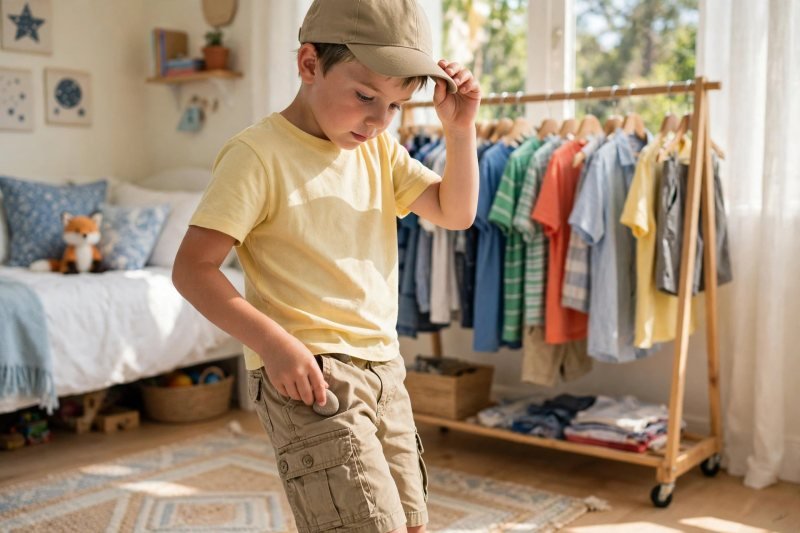
-
Layer for the library. Solve the summer puzzle every parent knows: blazing outside, freezing inside. The base stays simple — a tee and shorts — plus a light zip hoodie he can carry or wear. Say: "Smart summer dressing is a warm layer you can take off, not a warm outfit you are stuck in." He dresses, zips the hoodie up in the warm room, feels how fast he heats up, then unzips and carries it. Practice: hoodie on for library, store or car; off in the heat. With that handled, one non-play look remains.
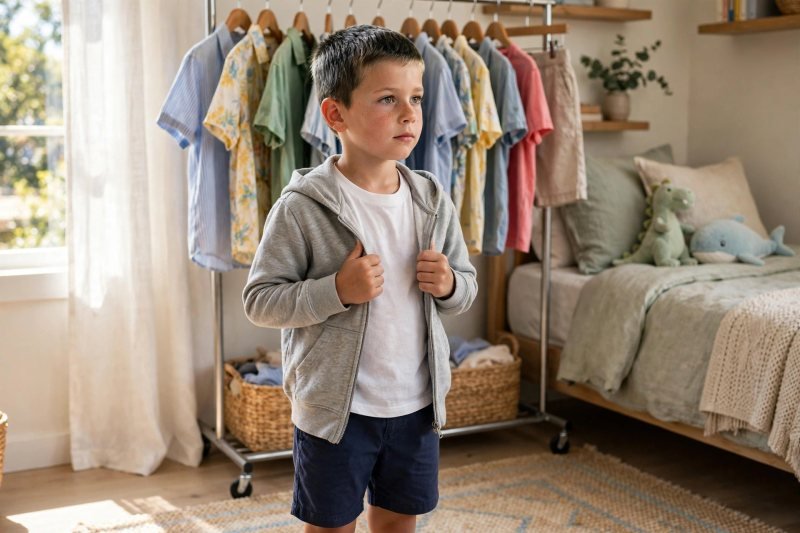
-
Tidy up for picture day. Every capsule needs one smarter look — a short-sleeve button shirt; chino shorts; and clean shoes. Say: "Smart does not mean stiff — if you cannot sit cross-legged in it, it is the wrong smart look." He dresses fully, buttons the shirt himself from the bottom up so the rows line up, and runs the checks: sit down; cross his legs; raise both arms for a photo pose. It should feel like his other clothes, just neater. Hang it at the far end where it stays clean, and turn to unplanned weather.
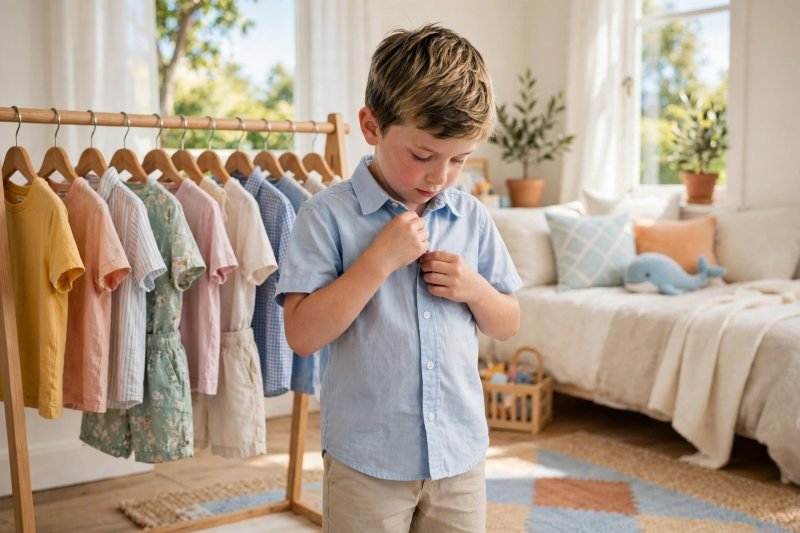
-
Splash through a summer shower. Build the wet-weather look before it is needed — a quick-dry tee; quick-dry shorts; a light rain jacket; and rain boots by the door. Say: "Rain clothes are the ones that dry fast — getting wet is fine, staying soggy is the miserable part." He dresses, zips the jacket right up, and stomps in place to check the boots do not slip at the heel. Talk through a real shower: hood up, keep moving, dry clothes at home. Boots back by the door — and one golden-hour plan remains.
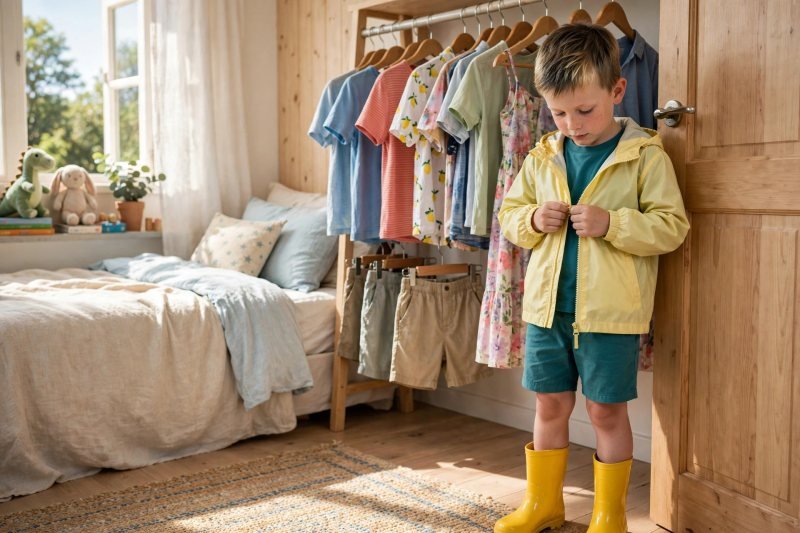
-
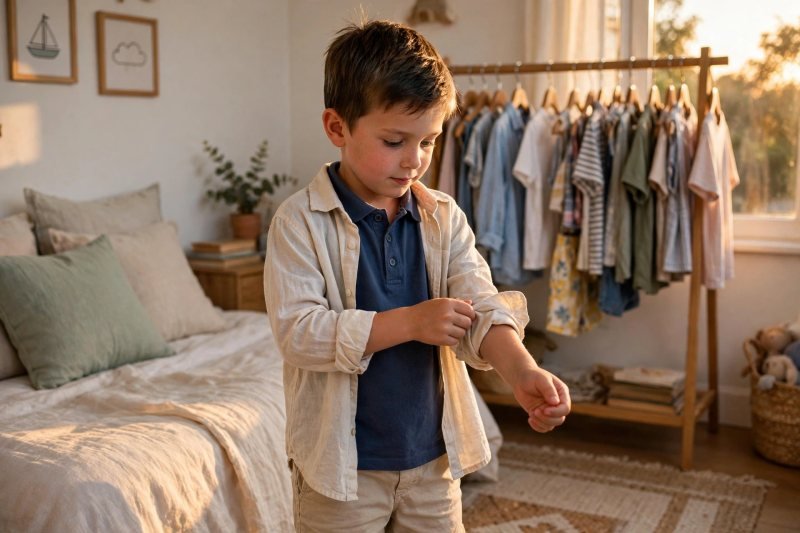
Dress for the evening barbecue. Evenings bring cooler air and mosquitoes, so the last look is a soft polo or henley; comfortable shorts; and a light long-sleeve overshirt to add as light fades. Say: "When the bugs come out, sleeves are our first trick — covered arms and legs get bitten less, and you can always push sleeves up." He dresses, then practices adding the overshirt: sleeves rolled for eating, unrolled for dusk games. That completes the ten plans. One final check remains.
-
Finish with the hat-and-sunscreen check. Close together at the rack, his favorite look of the week back on and the bucket hat on his head. Say: "Every summer day ends the same way it starts — hat on, sunscreen on the spots hats miss." In the sunny window light, help with sunscreen on the back of the neck, the ears and the tops of the hands — spots that burn quietly during play. He names back the ten looks, pointing to each on the rack, then finish with a high-five.



Make it easier
Start with five looks — park, pool, camp, rain and one smart look cover most weeks. The same one-rack idea works younger too, in these toddler summer outfits. Keep one of each type on the rack at first; too many choices slow young dressers more than too few. Add a picture label he draws himself to each hook — a sun, a wave, a bike. Put his name in the hat, the rain jacket, and the swim towel — camp and pool lost-property piles are where unmarked summer kit goes to retire.
Make it harder
Hand over the forecast: each Sunday he checks the weather and hangs the week's likely looks in front. Let the week's plans come from our summer bucket list so the rack matches what you will actually do. Add a laundry loop — he sorts worn clothes into lights and darks and rehangs clean pieces in their groups. When summer ends, the same grouping habit carries into cold weather with this kids winter layering guide. Let him plan an outfit for a new occasion, explaining which pieces he borrows and why.
Other ways to play it
- Beach-day version: swap pool sandals for water shoes, add a second towel, and make the bucket hat non-negotiable — shade is scarce on sand. Pair each beach look with one of these summer activities for children so the outfit is planned around what you will actually do.
- Vacation packing version: roll each look into its own bundle — top, shorts, underwear — so a suitcase works like the rack.
- Younger sibling version: toddlers need the same jobs in simpler clothes — elastic waists and shoes they can pull on alone; the family's cold-weather counterpart for the smallest ones is these toddler winter outfits, built on the same one-rack logic.
How it changes by age
- Ages 6–8: the sweet spot for a capsule try-on. Sixes may need help with buttons, zips and helmet straps; sevens usually dress independently and love the occasion labels; eights can own the whole system, weather check included. Keep choices small and grouped — independence grows when the system, not the parent, does the reminding.
- Younger siblings: preschoolers can join in with a two- or three-look mini rack, and the same grouped-by-job approach works in reverse with preschool winter outfits for cold-weather layers.
- When to adjust: if mornings stay slow after a week, remove the two least-worn pieces. If a child resists a category like hats, offer a choice between two acceptable options rather than dropping the protection.
What they're learning
Independence and planning: matching clothes to weather, activity and occasion is real decision-making he can check himself. Body and sun awareness: noticing heat, indoor cold, damp fabric and exposed skin builds hat and sunscreen instincts. Fine motor skills: buttons in order, zips, helmet straps and rolled sleeves practice the hand work school needs. Sorting and systems: grouping by job, keeping a rack in order and returning laundry are organizing skills in disguise.
Clearing up
"Kids need a new outfit for every summer plan." No — ten looks came off one rack because the same tees and shorts kept recombining; occasions change the pairing, not the wardrobe. "Dark colors are fine because they hide dirt." Dark fabrics absorb more heat at noon; light colors are cooler, and dirt washes out. "A cap is as good as a bucket hat." Caps shade the face but leave ears and the back of the neck exposed — the spots that burn first. "Sunscreen makes hats unnecessary." Sunscreen rubs, sweats and swims off; a hat keeps working all day. They protect together, never instead of each other.
Questions parents ask
What should kids wear in summer?
How many summer outfits does a child need?
What fabrics keep kids coolest in summer?
Should kids wear hats every day in summer?
How do I build a simple summer capsule wardrobe for my child?

save it for later
Pin this for the next rainy afternoon
Keep it on a board so it is there when you need it, rather than when you happened to find it.
Save to Pinterest


