


7th Birthday Party Ideas: Cool Themes for Seven-Year-Olds
These 7th birthday party ideas start with one cool theme your seven-year-old picks — space, science, pirates, detectives — then run real-challenge games, easy party food, and a two-and-a-half-hour plan that ends on a high.
Great 7th birthday party ideas start with one mission-style theme your child picks — space blast-off, detective mystery, pirate treasure hunt, mad science. Plan two and a half to three hours, four or five games with real win conditions, simple party food, and a seven-candle cake moment about two-thirds through.

The short version
- One child-chosen, mission-style theme organizes everything — games, cake, colors, favors.
- Sevens handle a longer party: two and a half to three hours with a clear running order.
- Games need real challenges and fair results — obstacle courses, clue hunts, team battles.
- Ask about food allergies on the invitation; keep allergen food off the table entirely.
- Walk obstacle courses yourself first, station an adult at the biggest element, and brief the boundaries for yard games.
- Age
- Ages 6–8
- Play time
- 150 min
- Where
- Both
Why kids love this
Seven-year-olds are done with babyish parties. The best 7th birthday party ideas treat them like the capable kids they are: a theme with a real mission, games they can actually win or lose, a treasure hunt that takes teamwork, and a cake moment where they blow out seven candles in front of their whole crew. A seven-year-old remembers a party where they felt big — where the obstacle course was genuinely hard, the clues were genuinely tricky, and the adults trusted them with real jobs. Build the party around one theme your child chooses, give the games real stakes and real endings, and turning seven feels like the adventure it should be.
What you'll need
- Plain balloons and paper bunting in your theme's colors (foil balloons are the safest choice — see Safety notes)
- Paper plates, cups, and napkins in theme colors
- A birthday cake with seven candles, plus easy party food (see step 5)
- Game gear from around the house: a speaker for music, soft balls, hula hoops, cones or cushions for an obstacle course, flashlights, small prizes or stickers
- Theme props: toy rockets or astronaut helmets for space, magnifying glasses for detectives, eye patches for pirates, goggles and kitchen science supplies for a science lab
- Party favor bags with one or two age-appropriate items each
- Your phone or camera, charged — and a second adult if you can get one
Before you start
1. Start two to three weeks out with steps 1–3 (theme, guest list, invitations); decorations and station setup can happen in the final days. 2. Seven-year-olds invite real friendship groups now — expect a list that may run to eight to fifteen names, then trim it together to a number your space and sanity can hold. 3. Read the Safety notes before buying anything — the allergy question and the obstacle-course check shape the plan.
How to do it
-
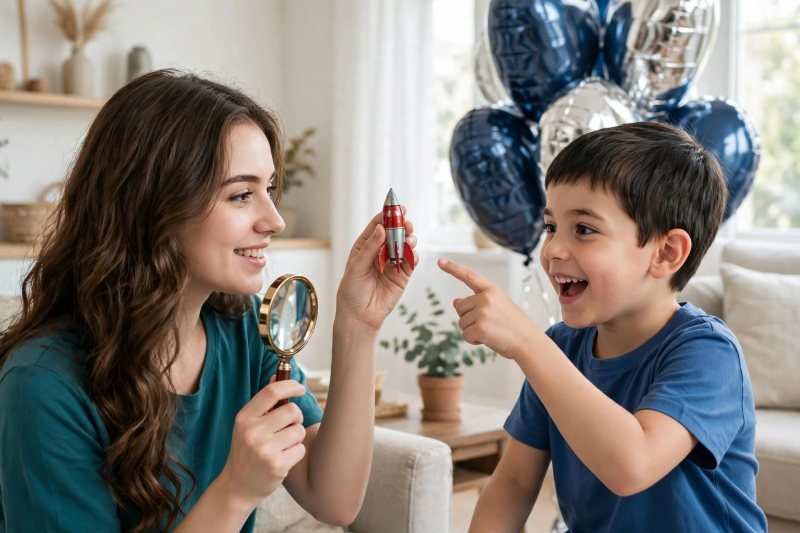
Pick one cool theme together. Sit down with your nearly-seven-year-old and offer themes with real missions in them, then let them choose: a space blast-off party; a mad science lab; a LEGO building championship; a pirate treasure hunt; a detective mystery to solve; an art studio party; a backyard campout with tents and s'mores; an all-sports showdown; a movie premiere night with a red carpet; or a ninja warrior course. Say, "This year your party gets a mission — which one is yours?" Seven is the age where "cool" starts to matter, and a child who chose the theme defends the whole party like it's their own idea — because it is. One theme quietly organizes the colors, the cake, the games, and the favors.
-
Set the guest list, the day, and the longer window. Sevens can handle a longer party than toddlers — plan two and a half to three hours, usually a late morning or afternoon slot that ends before dinner. Write the guest list together and agree on the number your space can hold; seven-year-old friendships run in packs, so expect classmates plus cousins, and plan for a few siblings. Say the running order out loud once — "Free play, big game, hunt, food, cake, quiet game, home" — because a party this length survives on sequence, not stamina. Put the cake about two-thirds through, and brief your helper adult on the order so two people always know what happens next.

-
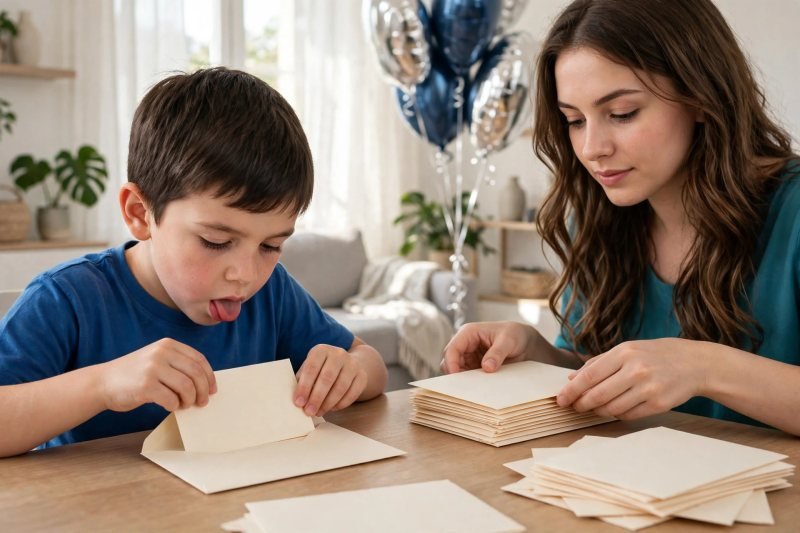
Send invitations — and ask the allergy question. Send paper invites or a message two weeks ahead with the date, the start and end times, your address, the theme (so guests can dress for the mission), and one essential line: "Please tell us about any food allergies." Say it plainly — at a bigger party with more families, this question matters more, not less. Note every answer where you plan the food, because the menu in step 5 gets built around those answers. The bones of a good party don't change with age: the calm, small-party structure in these 2nd birthday party ideas for toddlers is the same skeleton — one theme, games in order, cake in the middle of the back half — scaled up for a crew with longer legs and bigger opinions.
-
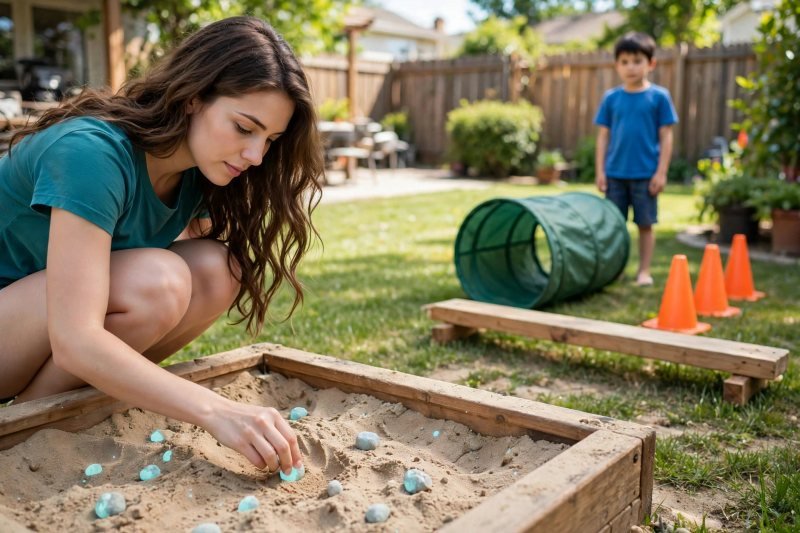
Plan the games inside the theme, with real challenges. Choose four or five games and give each one a clear win condition — sevens are quick to spot a rigged game and usually respect a fair loss. Woven into a space blast-off theme, for example: an astronaut training obstacle course (crawl the tunnel, balance the beam, land the beanbag on the moon); a moon-rock hunt with glow-in-the-dark stones hidden around the yard; a team meteor shower game with soft balls and a timer; a space trivia round with picture-card clues for younger readers; and a quiet mission-control drawing station for anyone who needs a breather. For a detective party, swap in a clue hunt and a fingerprint station; for pirates, a map-and-compass treasure hunt with a buried prize chest. Say the order once — "Train, hunt, battle, snack, draw" — so the party alternates loud and focused instead of climbing to chaos.
-
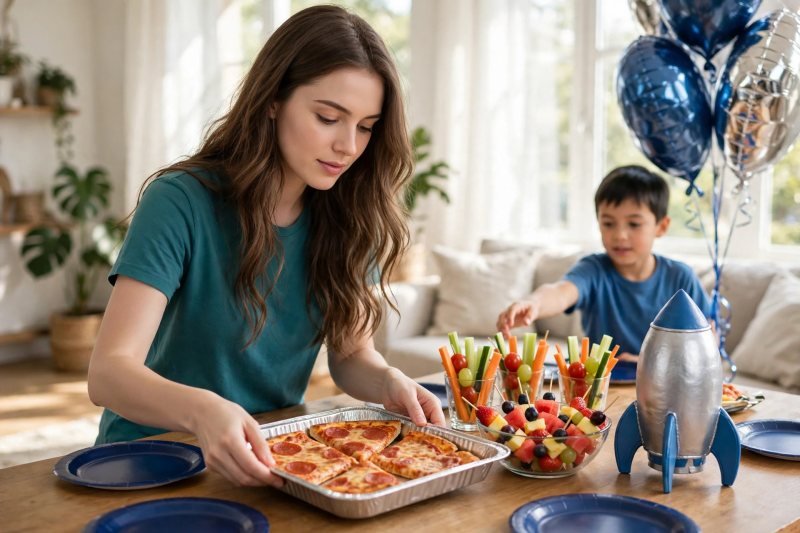
Plan party food and the seven-candle cake. Build the menu from food seven-year-olds actually eat at parties: pizza slices or mini burgers, veggie cups with dip, fruit skewers, popcorn, cheese and crackers, and water plus one fun drink. Read your allergy notes from step 3 before shopping, keep packaging until the party ends so ingredients can be checked, and keep any allergen food entirely off the table rather than in a lonely corner. Order or bake the cake in the theme — a rocket, a volcano, a magnifying glass — with seven candles ready, and say the plan once: "Food once, eaten sitting down, then we're back to the mission." Sitting to eat is still the rule; it is also, at this age, the only quiet five minutes you will get.
-
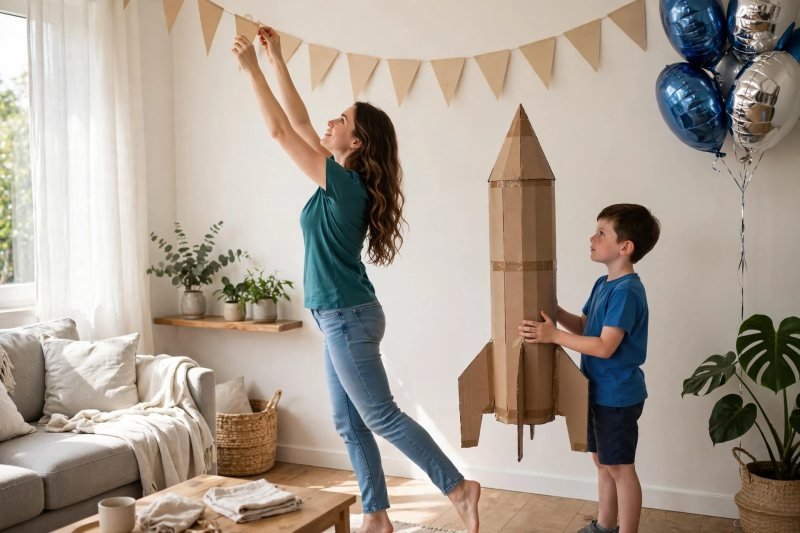
Decorate on the morning of the party. Ninety minutes before guests arrive, decorate with a seven-year-old's eye for drama: balloons in theme colors, bunting across the main room, the table set in theme colors, and one big scene-setting prop — a cardboard rocket, a "lab" table with beakers of colored water, a treasure chest by the door. Foil balloons are still the smart choice: popped latex fragments are a hazard for younger siblings and pets, and any balloon that pops gets binned immediately. Say, "Rocket up, bunting up, table set — headquarters is ready." Sevens read a room fast and judge it honestly; five bold signals in the theme beat a hundred fiddly details, so stop decorating while it is still fun.
-
Set up the game stations before the first guest arrives. Walk the party in order and stage every stop: obstacle course laid out and walked once by you for safety; moon rocks hidden (visible-but-tricky spots, plus spares); trivia cards stacked; the drawing station stocked; prizes counted. Put the cake, candles, and a lighter somewhere only adults reach, and park a trash bag at the food station. Say, "Everything staged means I get to run missions instead of hunting for tape." Then do the two safety passes from the notes below — course check and yard check — before the doorbell rings. Finish ten minutes early and have a coffee; you have earned it before the first astronaut lands.

-
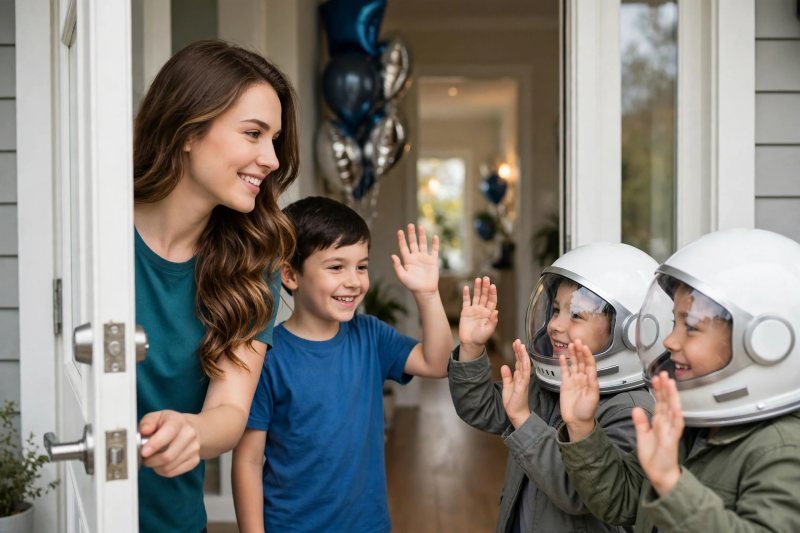
Welcome everyone with free play and the prop box. Open the door with music on, the theme props out, and something to do in the first sixty seconds — helmets to try, a ball to kick, the drawing station open. Seven-year-olds arrive in a pack and read the room in seconds; a party that looks ready gets instant buy-in. Greet your birthday child with their mission briefing — "Commander, your crew is arriving" — and let early guests help with final touches like placing moon rocks; jobs are social glue at this age. Say to the room, "Free play until everyone's here, then training begins!" The welcome sets the contract: this party has a plan, and the plan is fun.
-
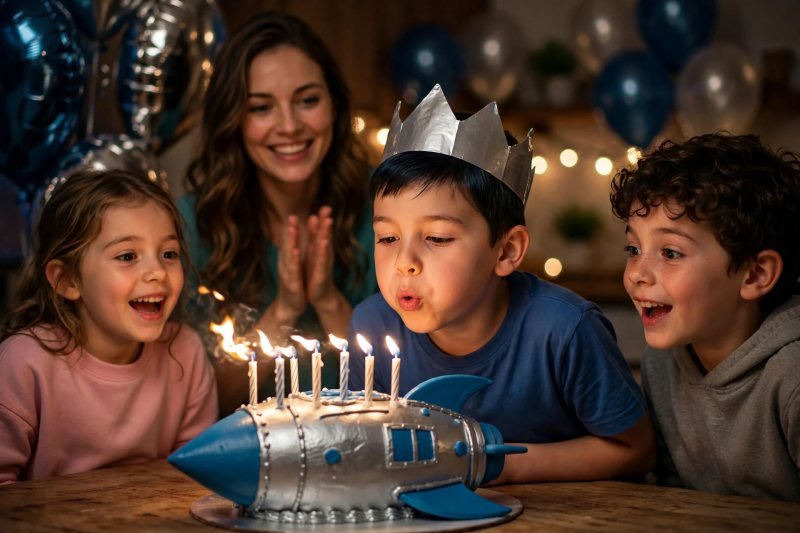
Run the games, then gather everyone for cake. Move through your planned order with big, clear announcements — "Astronauts, training starts NOW!" — and referee cheerfully but firmly; seven-year-olds test rules precisely because rules now matter to them. End each game on its real result and celebrate the winners without consoling the losers too hard — a fair loss at seven is a story, not a tragedy. When energy peaks, call the cake: everyone sitting, lights low, seven candles lit by one adult, song sung at full volume, and let the birthday child make the wish and blow with all the ceremony a seven-candle cake deserves. Say, "Make it a good one — seven candles is serious wishing power." Photos now, while every face is lit by candlelight and triumph.
-
Wind down with the quiet station, favors, and crew goodbyes. Land the party the way planes land — gradually: the drawing station or a calm card game, music lower, lights normal, then favor bags handed out by the birthday child at the door with a real thank-you to each guest. Say, "Mission complete, crew — thanks for flying with us," and mean the gratitude part; sevens are watching how hosts behave because they'll be hosting their own friendships soon. When the last guest leaves, sit down with your seven-year-old, eat the saved slice of cake together, and debrief the mission — favorite moment, funniest moment, what next year's theme might be. The party ends the way it began: with your child feeling bigger than they did this morning.



Make it easier
Buy the cake and the decorations, and keep every game homemade — at seven, the games are the party, the décor is wallpaper. Run three games instead of five; free play plus the big hunt or course fills more time than you expect. Recruit a teenager or grandparent as games referee so you can run food and photos.
Make it harder
Add a team championship layer: crews earn points across every game toward one final prize ceremony. Build a real clue chain — five clues, each hidden by solving the last — for the detective or pirate version. Let the birthday child co-host for real: welcoming guests, announcing games, and handing out prizes, with you as backup.
Other ways to play it
- Science lab party: swap the big game for three kitchen-science stations — a foaming volcano, a density rainbow jar, a static-electricity butterfly — each with an adult or a clear instruction card, ending in a group rocket launch (film canister rockets outside, adults only).
- Backyard campout party: tents or blanket forts, a flashlight scavenger hunt at dusk, s'mores over a supervised fire pit or in the oven, and a "night sky" story to close.
- Small crew party (four to six guests): go deep instead of wide — a full LEGO championship with timed builds and categories, or a movie premiere with popcorn, a red carpet photo wall, and an awards ceremony at the end.
- For a younger crew, the same mission-theme arc scales down in our 5th birthday party ideas.
How it changes by age
- Age 6: Sixes are close but wobblier — shorten the party toward two hours, keep game rules to one sentence each, and expect the birthday child to need one quiet reset with you mid-party. Team games work better than individual elimination at six. For the one-year-younger version of the same party arc, see our 6th birthday party ideas.
- Age 7: This is the design point: two and a half to three hours, real challenges with fair results, jobs and responsibilities welcomed, and opinions about everything. Give sevens choices inside the structure — which game next, which prize first — and their buy-in doubles.
- Age 8: Eights want more independence and more edge: longer clue chains, timed challenges with leaderboards, and games that can be lost properly. Keep the same skeleton, raise the difficulty, and let them run one game entirely themselves.
What they're learning
Sportsmanship: winning fairly, losing without collapse, and refereeing friends are social skills this party practices at full speed. Teamwork and strategy: hunts, courses, and team games reward planning, role-splitting, and cheering for your crew. Sequencing and memory: holding a five-clue chain or a trivia set in mind is working memory doing real labor. Confidence and hosting: briefing guests, announcing games, and thanking each friend are leadership reps a seven-year-old can feel. Problem-solving: a stuck clue, a wobbly course, a disputed call — a good party is a morning of small problems solved socially.
Clearing up
Start with the safety sweep: candle and lighter put away, every balloon fragment found and binned, food scraps up before the family dog audits them. Then prizes-and-favors patrol — small parts off the floor while younger siblings are about. Save the leftover food you would serve again, bin anything that sat out through the party, and let your seven-year-old run one job end-to-end: bunting down, game gear back to its boxes, or the moon rocks collected and counted. Write the thank-you messages together while the day is fresh — at seven, signing their own name to a thank-you is part of the party's real curriculum.
Questions parents ask
What is a good theme for a 7th birthday party?
How long should a 7th birthday party last?
What games do 7-year-olds enjoy at a birthday party?
What food should I serve at a 7-year-old's birthday party?
How many guests should I invite to a 7th birthday party?
Are balloons safe at a 7-year-old's birthday party?
For the calm station, short memory games still work beautifully with harder card sets. For a younger-sibling party version of the same arc, see our 4th birthday party ideas.

save it for later
Pin this for the next rainy afternoon
Keep it on a board so it is there when you need it, rather than when you happened to find it.
Save to Pinterest


