


Baking Soda and Vinegar Volcano for Preschoolers
Build a mini playdough volcano and set it fizzing with baking soda and vinegar — a simple preschool science experiment with a contained eruption and endless replays. Build the volcano, erupt it, then do it all again.
Mould playdough around a small plastic cup on a tray, spoon in bicarbonate of soda, then pour in vinegar mixed with washing-up liquid and red food colouring. It erupts in fizzing foam within seconds. Add more of both to erupt again. Always supervise closely and keep it on a tray.

The short version
- Mould playdough around a small cup on a tray with raised edges.
- Bicarbonate of soda plus vinegar, washing-up liquid and colouring gives maximum foam.
- Each eruption uses up the powder — add more of both to erupt again.
- An adult supervises constantly and handles or guides the pouring.
- The tray is non-negotiable indoors.
- Age
- Ages 3–4
- Prep
- 10 min
- Mess
- Some
- Difficulty
- Easy
- Where
- Both
Why kids love this
The fizz is a genuine surprise — nothing prepares a three-year-old for lava foaming over the top. They build the volcano themselves, lumps and all, and are enormously proud of it. Pour, fizz, erupt: cause and effect they can see, repeated as often as they like.
What you'll need
- Bicarbonate of soda (baking soda), white vinegar, a squirt of washing-up liquid
- Food colouring, red or orange (optional)
- A small plastic cup or bottle, playdough or modelling clay
- A tray with raised edges (or baking tray), a towel, a small jug, a spoon
- Sunglasses or swimming goggles (optional eye protection)
Before you start
Set up on a tray; details in the steps below.
How to do it
-
1. Put the tray on the kitchen floor — your eruption zone.
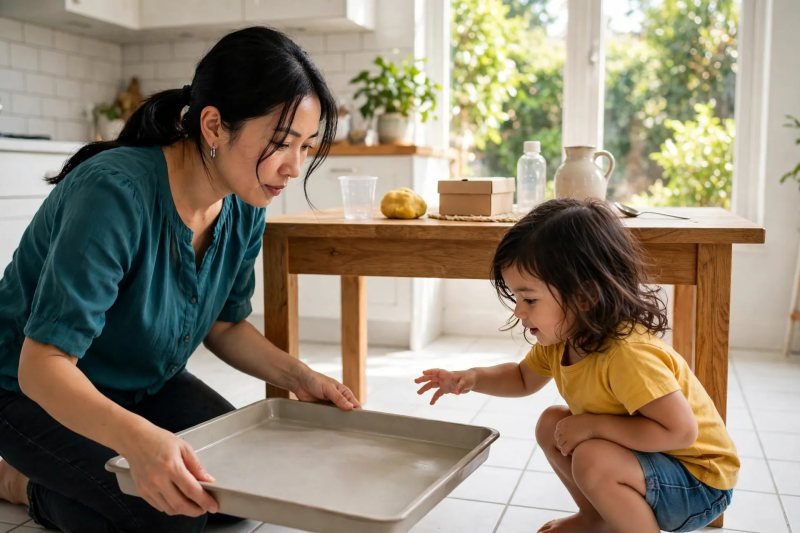
-
2. Mould the playdough around the cup in a cone, leaving the opening clear as the crater.
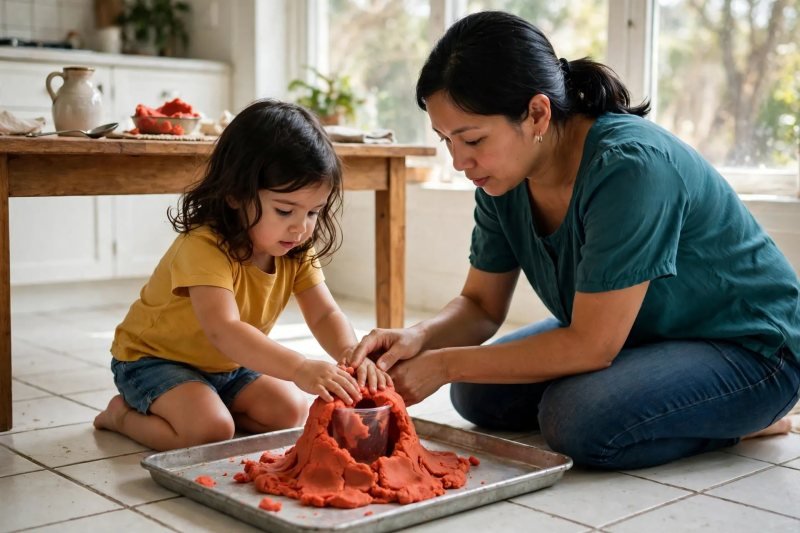
-
3. Pour a little vinegar into the jug; stir in the washing-up liquid and a few drops of colouring.
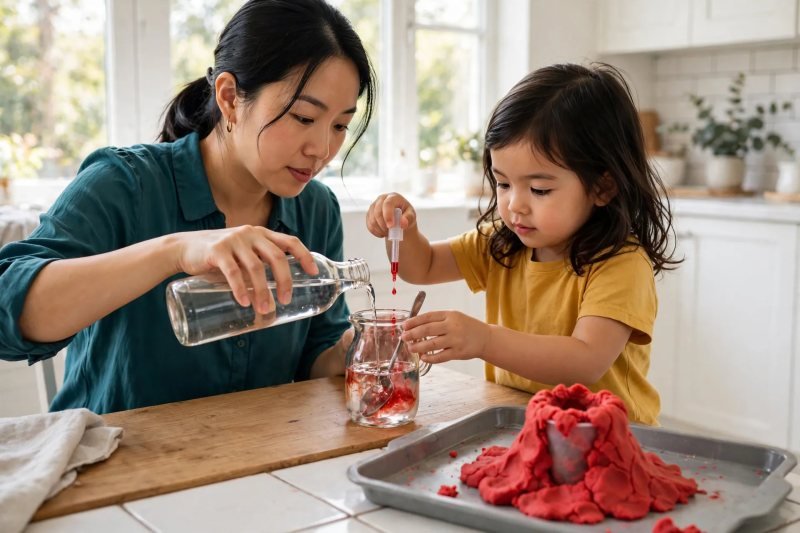
-
If you want a volcano experiment for kids that delivers a genuine wow, this is the one. A playdough volcano, a spoonful of bicarbonate of soda, a splash of vinegar — and fizzing red lava bubbles over the crater. Ten minutes to set up, using things you already own, and it erupts again and again. One honest warning: without a tray, the fizz goes everywhere; with one, clean-up takes two minutes.
-
## How do you make a volcano erupt for a preschooler?
-
Building the volcano: Let it be lumpy — a wobbly volcano they made beats a perfect one. Hand over the playdough and let them squish it around the cup while you chat: Can you make it taller? Where's the hole at the top? That's the crater. Moulding and spooning give little fingers a great workout — for more ideas that build the same skills, try these [fine-motor activities for preschoolers](/activities/fine-motor-activities-for-preschoolers/).
-
The eruption: Spoon one or two spoonfuls of bicarbonate of soda into the cup — a safe, dry job for your child. Count down together (three, two, one), then you pour the vinegar mixture in, or firmly guide your child's hand on the jug. Watch the foam rise, fizz and spill over.
-
## What happens when you mix baking soda and vinegar?
-
The fizz is gas. The two react and make millions of tiny bubbles of carbon dioxide, which push the foamy mixture up and out of the crater — that's the eruption. Real volcanoes erupt because pressure builds up inside them too.
-
## How do you make the volcano erupt more than once?
-
Each eruption uses up the bicarbonate of soda, so spoon in another spoonful or two and pour more vinegar. Most preschoolers happily run through five or six eruptions.
-
## Colour-changing lava
-
Try orange for a sunset volcano, or skip the colouring for a snowy white eruption. Erupt two mini volcanoes side by side in different colours and guess which fizzes higher.


Make it easier
Build the volcano in advance so they arrive to a ready eruption station. Skip the colouring and washing-up liquid — plain bicarbonate of soda and vinegar still fizz. Use a small bottle instead of a cup; the narrow neck shoots the eruption higher.
Make it harder
Let your four-year-old measure: one spoonful versus three — which erupts bigger? Try it without washing-up liquid and compare the lava texture. Ask them to narrate like a news reporter: What can you see, hear, smell?
Other ways to play it
- Mini volcano cups — skip the playdough and erupt in small cups.
- Rainbow volcano — drip different colourings into the crater.
- Sand volcano — bury the cup in a sand mound and erupt.
How it changes by age
- Ages 3–4 are the sweet spot: children can mould, spoon, help pour with guidance, and follow the one big rule — we don't taste the mixture.
- Two-year-olds can watch and point along while the adult does everything.
- Five- and six-year-olds can measure, predict and run the sequence with you nearby.
- For a calmer first experiment with a younger toddler, browse our [toddler learning activities at home](/activities/toddler-learning-activities-at-home/).
What they're learning
Cause and effect — I pour, it erupts. Early science vocabulary: fizz, bubbles, erupt, mixture, crater. Fine motor skills — moulding, spooning and pouring. Loved the fizz? More first experiments in our round-up of [preschool learning activities at home](/activities/preschool-learning-activities-at-home/).
Clearing up
Tip the tray into the sink and rinse — the mixture is water-soluble. Wash hands and the tray with warm soapy water. Two minutes, done.
Questions parents ask
How many times can a baking soda volcano erupt?
Is it safe for toddlers?
What can I use instead of food colouring?
Can you make it without vinegar?
How do you clean up?
Use a plastic cup or bottle, never glass. Red food colouring can stain — use old clothes. The vinegar smell fades within minutes with a window open. Pour steadily for the tallest eruption.


