


Kids Winter Boots: Sizing and Warmth Guide for Parents
Getting kids winter boots right is a sizing job before it's a shopping job. This guide gives you the measure-at-home method, the insole stand test, the thumb's-width growth rule, and how to judge warmth when temperature ratings can't be compared — boots that fit in October and still fit in February.
Measure both feet standing, in winter socks, in the afternoon, and shop by the measurement — not the size label. The right fit leaves about a thumb's width (roughly half an inch) beyond the toes, holds the heel without slipping, and lets toes wiggle. Judge warmth by construction — thick insulation, full lining, tall shaft, rubber shell — because boot temperature ratings follow no shared standard.

The short version
- Measure first, in inches or centimeters, both feet, afternoon, winter socks, full weight — shop for the bigger foot.
- The insole stand test shows growing room directly: about a thumb's width of insole visible past the toes.
- More room is not better: beyond a thumb's width, feet slide, trip, blister, and get cold.
- Temperature ratings aren't standardized between brands — squeeze the insulation, check the lining and shell instead.
- Fit boots with the real winter socks; one good pair beats two bunched pairs.
- Mid-season recheck: kids' feet grow in spurts, and a season is the typical life of a pair.
- Age
- Ages 4–5
- Prep
- 5 min
- Play time
- 10 min
- Mess
- None
- Where
- Both
Why kids love this
Kids care about boots differently than parents: can I stomp, can I run, can I get them on myself before my friend finishes? The tests in this guide — stand on the insole, stomp test, closure race — are games to a five-year-old, and a boot that passes them is a boot they'll actually wear without a daily negotiation.
What you'll need
- Plain paper (bigger than the foot) and a crayon or pen
- A ruler or tape measure
- The actual winter socks your child will wear (bring the pair)
- A removable insole from a current well-fitting shoe (optional reference)
- The candidate boots, tried late in the day if possible
- A phone note for the measurements — feet change; records help
Before you start
1. Measure in the afternoon: feet swell slightly through the day, and boots fitted to morning feet pinch by evening. 2. Measure in winter socks, standing, full weight — never seated with feet dangling. 3. Measure BOTH feet and shop for the bigger one; many people, kids included, often have one foot slightly larger. 4. Write the length down in inches or centimeters — that number travels across brands better than any size label.
How to do it
-
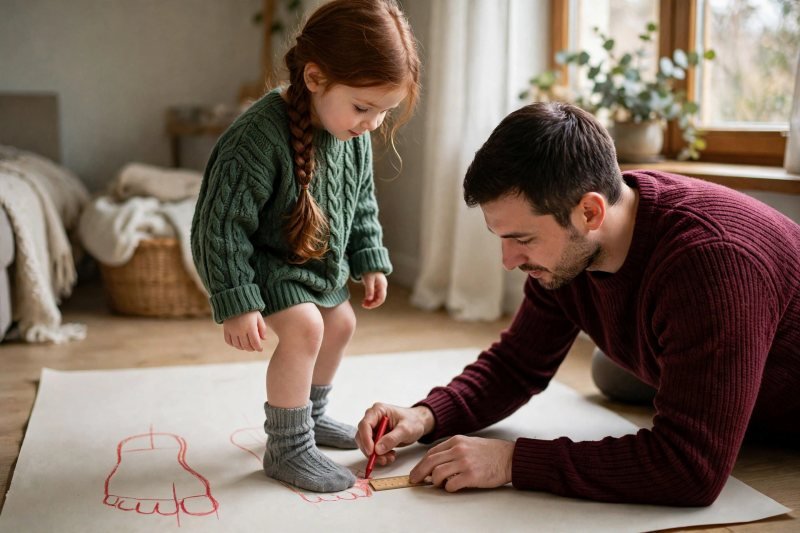
Measure both feet at home before any shopping happens. Stand your child, in winter socks, on the paper and trace each foot (or mark heel and longest toe against a wall), then measure the longest length in a straight line. Say: "First we get your feet's numbers — then the boots have to match them, not the other way around." This ten-minute home job is the whole foundation: kids winter boots are bought by fit, and fit starts with a measurement, not a size guess carried over from sneakers. Note both numbers and the date — you'll reuse them for every shoe conversation this year. Numbers in hand, the store test that settles everything comes next.
-
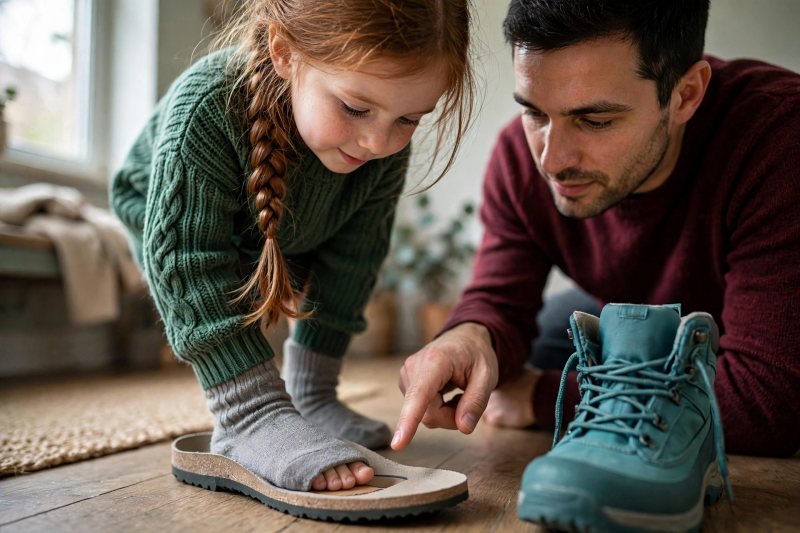
Run the insole stand test — the fitter's secret. If a boot has a removable insole or liner footbed, pull it out and have your child stand on it in their winter sock. Say: "Stand on the boot's footprint and show me your toes." You want the foot centered with about a thumb's width of insole visible beyond the longest toe and no toe hanging off the edge or side. This test removes all guesswork from "does it fit?" — you can literally SEE the growing room instead of trusting a squirmy thumb-press through a stiff toe box. No removable insole? The thumb-press on the worn boot is the backup: toe at the back, press for that same thumb's width in front. Either way, the target you're visualizing is the subject of the next step.
-
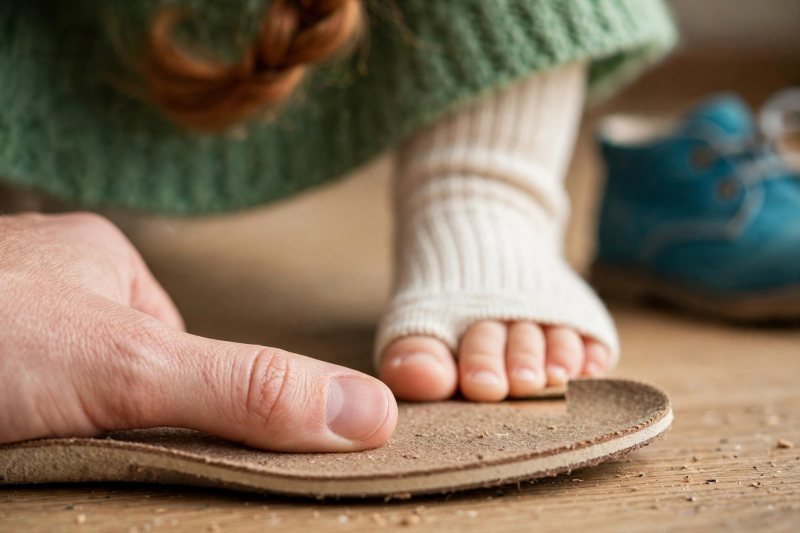
Learn the growth-room rule: about a thumb's width, no more. The sweet spot for kids winter boots is roughly half an inch (about a thumb's width) of space beyond the toes. Say: "Room to grow — not room to swim." Less than that and the boot is outgrown by February, with toes curled against the front (which also makes feet cold — cramped toes can't wiggle, and still air is the insulation). More than that and the foot slides: heels lift, toes jam forward on every downhill, blisters form, and five-year-olds trip over their own equipment. That half-inch is also your clock: it often covers a season of growth at this age, which is why boots are usually a one-season-per-child purchase. Room rule learned — now the labels that pretend to make this simple.
-
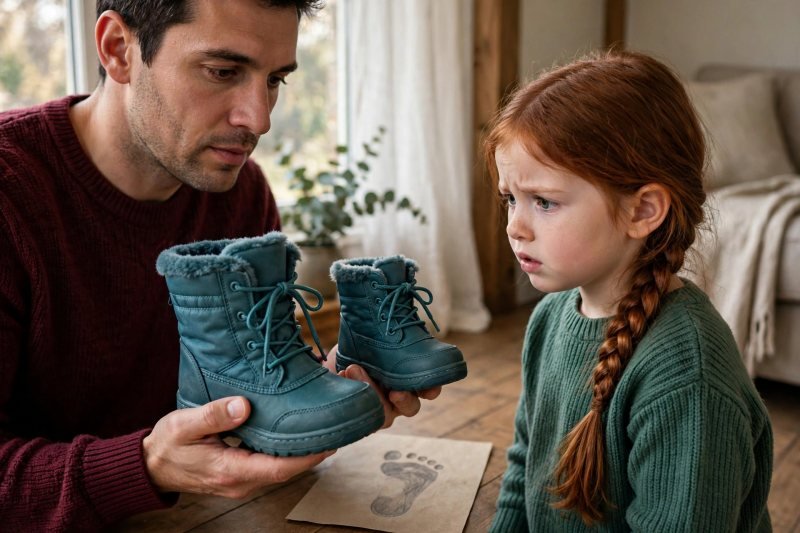
Treat size labels as a rough dialect, not a measurement. Boot sizes vary between makers — one brand's size 11 is another's 12 — and conversions between US, UK, and European sizes are approximations, not exact math. Say: "The number on the box is a nickname. Your foot measurement is the real name." That's why step 1 ended with inches or centimeters: compare your child's foot length to the maker's own size chart (each brand publishes one) and start from THEIR chart, then confirm with the insole test. If you're between the chart's rows, start with the larger candidate and let the tests decide — charts start the conversation, they never finish it. Half sizes and wide fits are not offered by every maker, so if no half size exists for your child's measurement, let the insole test — not the chart row — decide, and expect to try more than one maker before the fit is right. Labels decoded — the other half of this guide's title awaits: warmth.
-
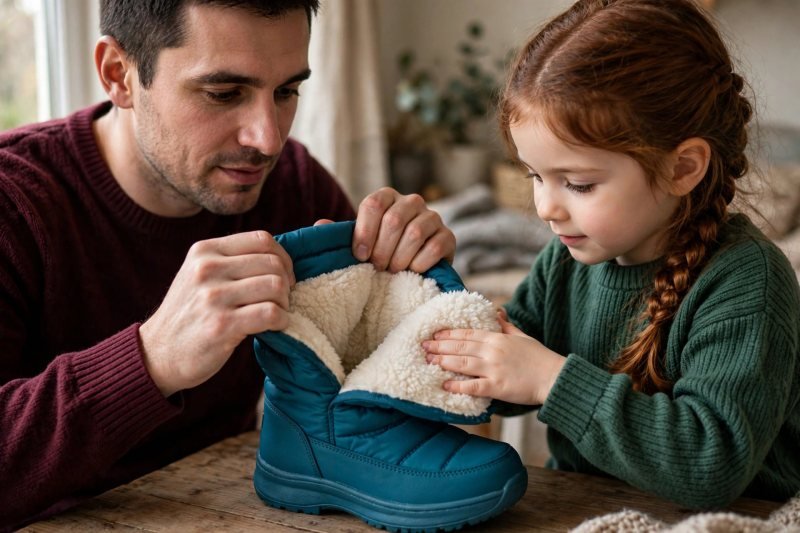
Judge warmth by construction, because temperature ratings have no standard. Many boots carry temperature ratings ("good to -25°!"), but there's no single industry test behind them — one maker's -25 may assume a constantly moving child, another's may assume standing still, so ratings can't be compared across brands. Say: "We read the boot, not the boast." Judge warmth instead by build: thick insulation you can feel when you squeeze the shaft; a plush full-length lining, ideally a removable liner (it dries faster and adds a warm layer); a shaft tall enough to meet snow pants with overlap; and a rubber lower shell that keeps meltwater out of the insulation entirely. Construction read — but the system only works with the right partner inside the boot.
-
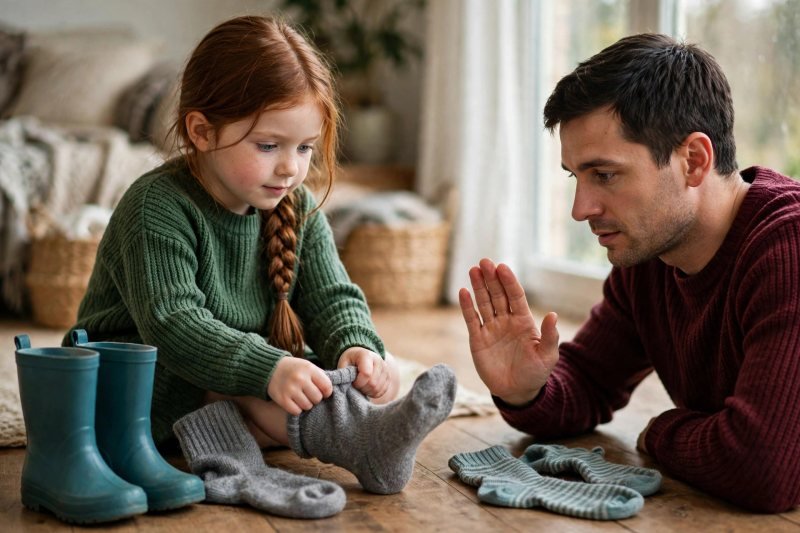
Fit the boots WITH the sock system your child will actually wear. Bring the real winter socks to every fitting and run every test in them. Say: "Boots and socks are a team — we try them as a team." One good pair of wool or wool-blend socks is the system: doubling up socks (a common instinct) usually backfires — two pairs bunch, cut circulation, and squeeze out the air layer that does the insulating, leaving feet colder. If the boot fits perfectly with the winter sock on, the system is right; if you need to add a second sock to fill space, the boot is too big — go back to the growth-room rule rather than padding the problem. Team fitted, the movement tests begin.
-
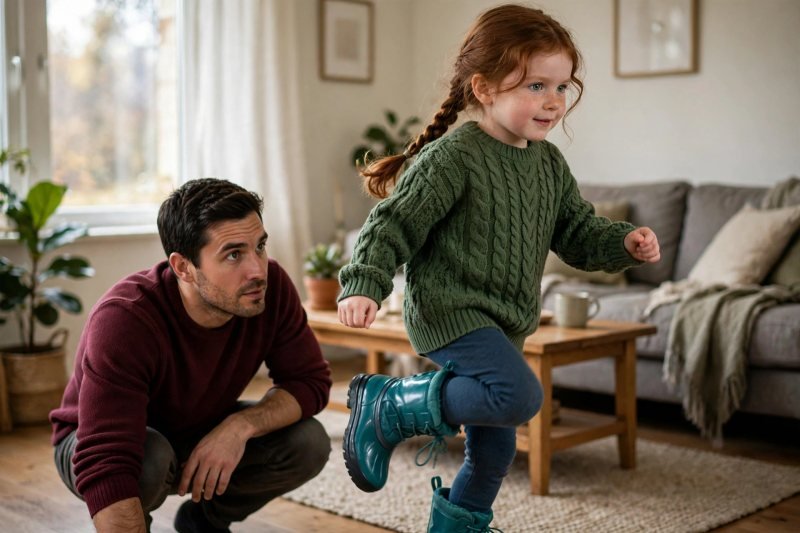
Check heel hold and toe splay on the move. Have your child walk, march, and do a few jumps in the boots on a hard floor. Say: "Show me marching, show me jumping — try to escape from them." Watch the heel: a small amount of movement is normal in a stiff winter boot, but the heel shouldn't pop up and down like a loose slipper, and the foot shouldn't slide forward so toes bang the front on each step. Then toes: inside the boot they should be able to wiggle and spread — ask your child directly, because five-year-olds can report "squished" and "floppy" with surprising precision. A boot that holds the heel and frees the toes has passed the fit final. Next, the independence exam.
-
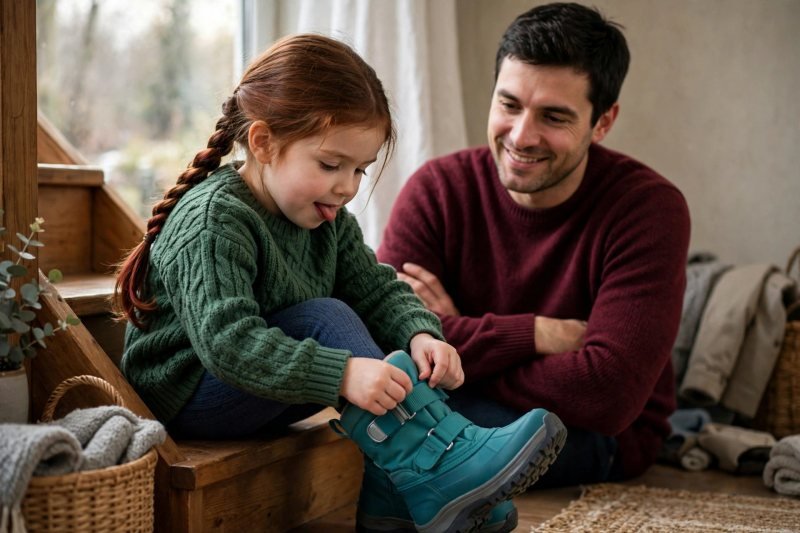
Test the closures for solo operation. At four and five, the right boot is the one your child can fasten alone at school, at a friend's door, at the rink. Say: "Your turn — boots on, all by yourself, go." Wide hook-and-loop straps and big pull loops usually pass; stiff buckles and long laces usually need a year or two more of fingers. Time it loosely and watch for the cheat-signs: straps closed crooked because the reach is hard, or a tongue left twisted because pulling it straight takes two hands. Independence matters beyond pride — a child who can't refasten a boot plays in a half-open boot, and a half-open boot fills with snow. Closures passed — the buying edge cases come last.
-
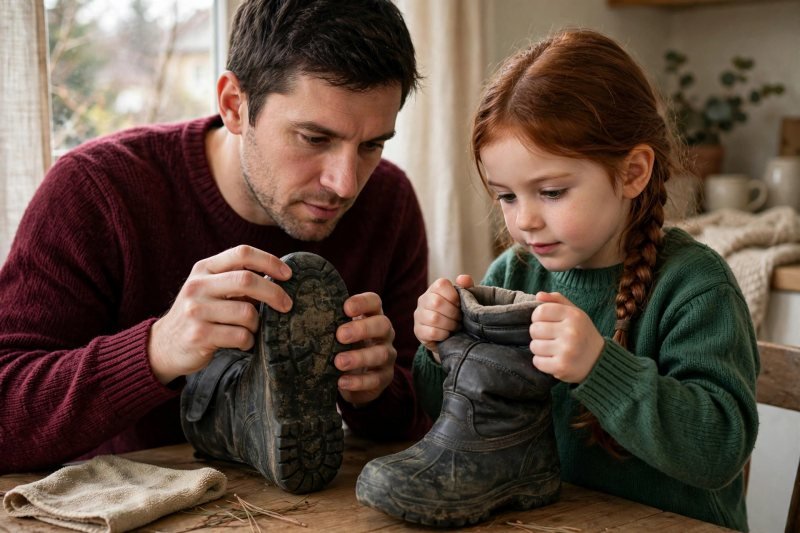
Handle between-sizes and hand-me-downs with the same tests, not hope. Between sizes on the chart? Choose the pair that passes the insole test with closest to a thumb's width — err a touch generous within the rule, never beyond it. Say: "The tests decide, not the deal." That discipline matters doubled for hand-me-downs and resale finds, where the price tempts you to skip inspection: check for compressed, flat insulation (squeeze the shaft — it should spring back), worn-smooth tread, cracked rubber at the flex point, and a liner that smells like it never once dried. A used boot that passes all four checks plus the fit tests is a genuine bargain; one that fails is just cheap. Boots chosen honestly — the last step keeps them honest all season.
-
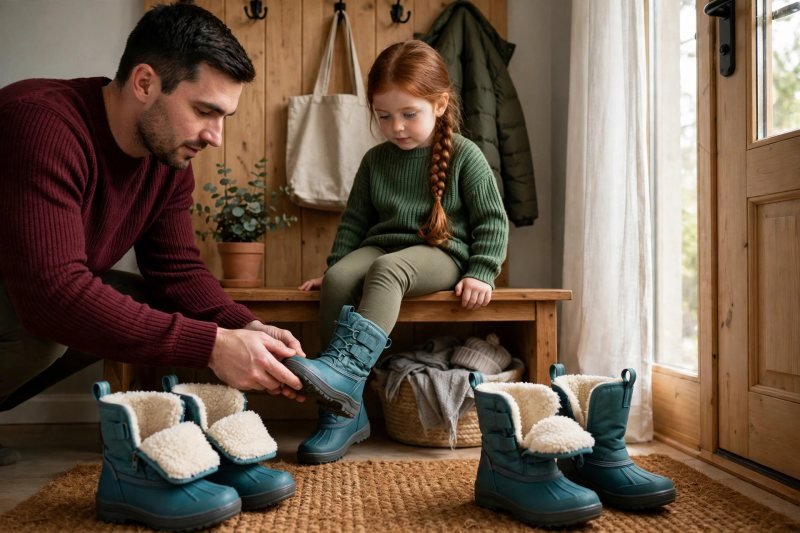
Recheck fit mid-season and store them dry. Kids' feet grow in spurts, not schedules, so put a note on the calendar to redo the toe check every couple of months: thumb's width shrinking toward a quarter inch means start watching for the next size, especially before a ski trip or deep-winter month. Say: "Boots get check-ups too." Between wears, store them open with liners out in moving air — never sealed in a plastic bin still damp — because insulation that dries fully stays lofty and warm, and insulation stored wet stays neither. Treat the pair well and the "next size" conversation, when it comes, is the only surprise left — and by then you'll measure first like a professional.


Make it easier
Shop late in the day when feet are at their biggest — it removes the evening pinch surprise entirely. Bring the current favorite shoe as a fit reference: its insole, laid against the boot's, tells a fast story. If measuring at home is a battle, trace feet during a "drawing our footprints" game — same numbers, zero resistance.
Make it harder
Teach your child to run the insole test themselves: five-year-olds who can check their own growing room become shoe shoppers for life. Add a cold-floor test: stand in the boots on the coldest floor in the house for two minutes and report — a fun proxy for insulation feel — or build the test into an indoor snow and ice play session. Keep a growth chart of foot measurements on the door frame next to the height marks: two growth stories for the price of one. Take the fit tests outside on a real outing from our winter activities for kids — marching, jumping, and stomping in snow tell you more than a hallway test.
Other ways to play it
- Deep-snow families: prioritize shaft height and a gaiter-style top that seals against snow pants — warmth fails fast once snow gets inside.
- Mild-winter families: a lighter insulated boot with a great waterproof shell beats a heavy arctic boot that makes feet sweat, then chill. For the full clothing system, see our kids' winter layering guide.
- Wide or narrow feet: fit the width first (toe splay is the tell) and adjust length expectations — a "long enough" boot that's too narrow fails the only test that matters.
How it changes by age
- Ages 2–3: the same tests apply, but the growth-room rule does more work — toddler feet grow faster, and our toddler winter outfits for ages 2–3 layering sequence shows the boots-on-last order that keeps small feet comfortable. For the toddler version of the same tests, see our best toddler snow boots guide.
- Ages 4–5: this guide's design age — old enough to report fit honestly, march on command, and own their closures.
- Ages 6+: kids can read size charts with you and track their own measurements; winter kits become a system conversation like the one in our winter hub, scaled up — and the preschool winter outfits guide covers the jacket-and-pants half for the younger crowd. For the jacket-and-pants half for older kids, see our kids' snow pants and jackets guide.
What they're learning
For more hands-on ideas that turn everyday jobs into learning, browse the learning activities hub. Measurement literacy: numbers that mean something — a foot becomes 9 inches, a size becomes a comparison, not a guess. Testing over trusting: labels, ratings, and deals all submit to evidence — the scientific habit in a shoe store. Body awareness: reporting "squished," "floppy," and "just right" builds precise self-knowledge. Independence: closures they can run alone are confidence they wear outside.
Clearing up
Boots live by the door, open, liners out, on the mat — never in a sealed bag or bin. Paper goes in the recycling, measurements go in the phone note with today's date, and the calendar gets its mid-season recheck reminder before you forget. If today's fitting ended in a purchase, keep the box and receipt until after the first real snow outing: the snow trial is the final test, and a boot that fails it should still be returnable.
Questions parents ask
How much room should kids have in winter boots?
Should you size up winter boots to fit thick socks?
Are temperature ratings on kids' winter boots reliable?
How do I measure my child's feet for winter boots?
How long do kids' winter boots last?

save it for later
Pin this for the next rainy afternoon
Keep it on a board so it is there when you need it, rather than when you happened to find it.
Save to Pinterest


