


Child Scared of Haircuts? 12 Ways to Ease Haircut Anxiety
Is your child scared of haircuts? These 12 gentle ways ease haircut anxiety for ages 3–4 — pretend salon play, watching a parent's trim, choosing a cape, and a tiny first trim — with no forcing, ever.
If your child is scared of haircuts, go gradual and positive: play pretend salon at home, practice the cape and mist separately, let your child be the stylist first, and let them watch you get a calm trim. Visit the salon just to say hello, book a quiet morning slot, and start with a tiny fringe trim — never force it.

The short version
- Fear of the unknown drives most haircut anxiety — rehearsing the sequence as play removes the surprises.
- Break the haircut into tiny pieces — cape, mist, sounds, chair — and practice each one separately and happily.
- Give control away: let your child choose the cape, hold the mirror, count snips, and use a pause signal you honor instantly.
- Start with the smallest real cut — a fringe trim on your lap — and celebrate the success loudly.
- Never force a haircut on a distressed child; if severe distress persists despite gradual practice, raise it with your pediatrician.
- Age
- Ages 3–4
Why kids love this
When a child scared of haircuts gets to rehearse the whole thing as play first, the real haircut stops being a surprise and becomes a game they already know how to win. Kids love being the stylist before they are the customer, choosing their own cape, holding the mirror, and hearing the applause at the end. Control is the cure for most haircut fear at this age — every way below hands your child a little more of it, and never takes any away.
What you'll need
- A big towel or a simple cape your child can choose and wear in play
- A spray bottle of plain water for pretend (and real) misting practice
- Play scissors and a doll or stuffed animal with "hair" to practice on
- A favorite comfort toy, blanket, or stuffed friend for the real day
- A small hand mirror your child can hold
- A favorite snack saved for the celebration afterward
- Your calmest, most cheerful voice — your child reads your face first
Before you start
1. Start a week or more ahead — anxiety eases with familiar repetition, not with a single big pep talk the night before. 2. Keep every mention of haircuts light and positive; never use a haircut as a threat, a joke about looking scruffy, or a surprise. 3. If fears are brand new to you, our story of a toddler's first haircut and how to make it tear-free shows the calm routine these twelve ways build toward.
How to do it
-
Talk about haircuts like good news, days ahead. Begin a week before any appointment by mentioning haircuts warmly and often in everyday moments — at breakfast, in the bath, while brushing hair. Say, "Your hair is growing so long and strong! Soon we get to visit the salon and sit in the special chair." Name exactly what will happen, in order — cape, mist, snips, mirror, done — because a child scared of haircuts is usually scared of the unknown, not the scissors. Answer questions honestly and briefly, never promise "it won't feel like anything," and let the topic become boring through cheerful repetition.

-
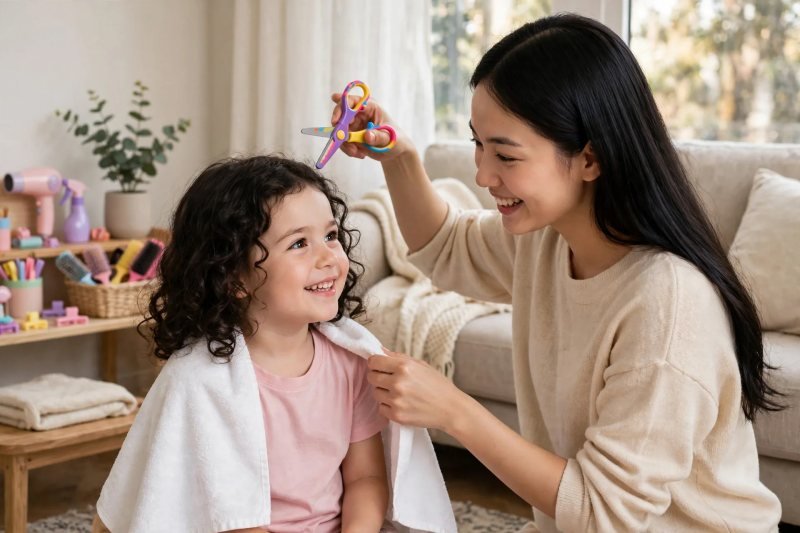
Play pretend salon in the living room. Set up a small pretend salon corner — one of the richest kinds of pretend play — with a chair, the towel cape, the spray bottle, and play scissors, and let your child sit for a full pretend cut. Say, "Welcome to our salon! First the cape — whoosh! Then sprinkle, sprinkle, then tiny snips near your hair." Make the soft snipping sound with your fingers beside — never on — their hair, count to ten together, then swap the cape off with a big "Ta-da!" Short, happy rehearsals teach the whole sequence, and finishing while it is still fun leaves them wanting another round tomorrow.
-
Practice the cape, the mist, and the sounds separately. Break the scary whole into tiny friendly pieces across different days — one day just wearing the cape while watching a favorite show; another day just feeling the cool mist on their neck; another day just listening to you snip play scissors near a doll. Say, "Today we are only doing the sprinkle game. Nothing else — promise." Each piece, mastered alone, removes one surprise from the real day. Children who fear the cape's tightness, the spray's cold, or the scissors' sound each get the exact practice they need.

-
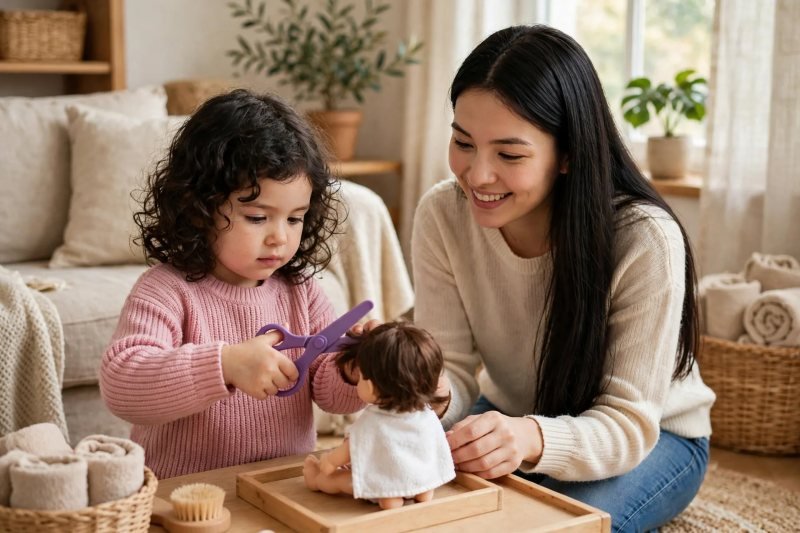
Let your child be the stylist first. Hand over the play scissors and invite your child to give a doll, a stuffed animal, or even you a magnificent pretend haircut — cape on the customer, mist, careful snips in the air, mirror reveal, applause. Say, "You are the stylist today! What style will Bear get?" Being the powerful one with the tools flips the fear completely for many children, and explaining the steps to a teddy — "Hold still, Bear, almost done" — shows you exactly which part still worries them, so you can practice that part next.
-
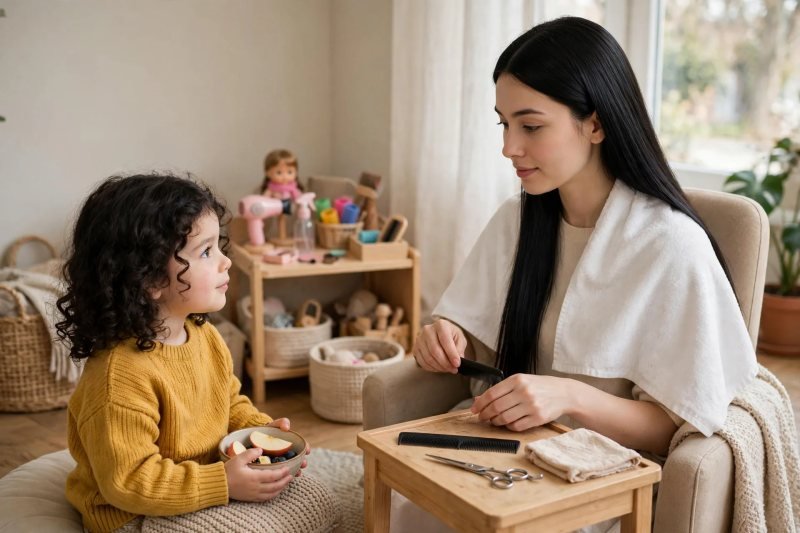
Let them watch you get a trim. Book your own small trim — or a parent's, or an older sibling's — and let your child watch the whole calm performance from a comfy spot with a snack. Narrate what they see in a bright voice: "Look, the cape goes on. Sprinkle, sprinkle. Snip, snip — that doesn't hurt at all. All done, and doesn't Dad look tidy?" Watching a trusted person enjoy the exact sounds, chair, and tools is powerful proof that haircuts are safe and ordinary. Let them ask the stylist one question if they want to — being spoken to kindly by the "scary" person helps enormously.
-
Visit the salon just to say hello. A few days before the real appointment, drop into the kid-friendly salon with no cut planned at all — wave at the stylists, sit in the fun chair for one minute, maybe earn a sticker, then leave while it is still easy. Say, "We are just visiting today. No haircut — we just came to see the chairs and say hi." A salon that smells, sounds, and feels familiar on the big day is a salon half-conquered, and a stylist who is already a friendly face is no longer a stranger.

-
Let your child choose the cape and the details. On the real day, hand over every small choice that is safe to give — the cape or towel from home, which chair, which comfort toy comes along, whether the mirror stays in their lap. Say, "You are in charge of the cape. Which one wins today?" Choices turn a passive patient into an active partner, and partner children cope. Keep choices tiny and real — two capes, two toys — because an overwhelmed child needs a menu of two, not twenty.

-
Book a quiet slot and pack a comfort kit. Call the salon and ask for their quietest time — usually a weekday morning — and book right after breakfast and a good rest, never near a nap or a meal. Pack the comfort kit together the night before — favorite toy, blanket, a familiar snack for after, wipes for itchy clippings — and let your child carry the bag. Say, "We picked the quiet time, and your bear is coming too." Calm timing plus familiar comforts handles the sensory side of fear, while tools like these toddler learning activities at home build the sitting-and-waiting skills the chair asks for.

-
Start tiny — a fringe trim only, mirror in hand. For the first real cut, ask the stylist for the smallest possible job — just the fringe, or just over the ears — with your child on your lap if the salon allows it, holding the hand mirror and counting snips with you. Say, "Today is just the tiny front trim. Ten snips and done — count with me!" Finishing fast and successfully matters far more than a perfect style; a complete, praised success rewires what "haircut" means. Agree the stopping signal in advance — a raised hand means pause — and honor it instantly if it appears.

-
Celebrate loudly and keep the same routine next time. The second the cape comes off, make the celebration the biggest sensory memory of the day — applause, mirror twirl, the saved favorite snack, photos for grandparents, and specific praise — "You sat so bravely and counted every snip!" Then protect the win — return to the same stylist, the same quiet slot, and the same cape-and-counting routine next time, lengthening the cut a little each visit. Familiar people and a predictable ritual keep anxiety from rebuilding between haircuts, and many children who start this way are comfortable in the salon chair within a few visits.



Make it easier
Spread the ten steps over two or three weeks — there is no prize for finishing the plan fast. Stay on your child's lap for the first real trim if the salon allows it; your body is the safest chair they know. End every practice while it is still going well, even if that means a two-minute salon game.
Make it harder
Let a confident four-year-old pick between two simple styles from photos you have pre-approved — the kids' hairstyles hub is a good place to shortlist them. Lengthen the real cut a little each visit — fringe, then ears, then a full tidy — as trust grows. Let them "book" their own pretend appointment in salon play, with a toy phone and a calendar page.
Other ways to play it
- Sensory-sensitive kids: the sensory activities hub has more low-demand calming ideas for this age; at the salon, ask the stylist to skip clippers entirely and use scissors only; bring familiar music on a parent's phone if the salon agrees; a weighted lap pad or their own blanket can help some children settle.
- A past bad haircut: change one big thing — a different salon, a different stylist, or a home fringe trim — so the new experience does not feel like a repeat of the scary one.
- Sibling power: an older sibling who goes first, cheers loudly, and shows off their own trim is the most convincing advertisement a nervous preschooler will ever see.
How it changes by age
- Age 3: threes live in pretend play, so lean hardest on the salon game, being the stylist, and watching you go first. Keep the first real cut to a fringe trim and expect feelings to change day by day — a brave Monday can still be a nervous Friday, and that is normal.
- Age 4: fours can reason, choose, and remember. Give real explanations ("Scissors cut only hair, and the stylist watches your ears the whole time"), real choices, and the pause signal. Most fours can graduate to a full cut in the chair alone within two or three visits on this plan.
What they're learning
Emotional regulation: naming a fear and shrinking it step by step is a skill they will reuse for dentists, doctors, and first days of school. Sequencing: cape, mist, snip, mirror, done — a routine learned in order becomes a routine they can predict and trust. Communication: using a pause signal and having it honored teaches them their words work. Empathy and role play: being the stylist first builds an understanding of the other person's job. Confidence: a feared thing, finished and celebrated, becomes evidence they carry — "I was scared, and I did it."
Clearing up
Tidy the pretend salon corner back into its basket after each game so practice stays a special, contained ritual. After a real haircut, brush clippings off the neck, change an itchy shirt, and wash play capes and towels that caught real clippings. Put real scissors away in a closed drawer the moment you are home — the pretend set is the only one that lives in the play corner. A bath that evening washes off the last itch and closes the day warmly.
Questions parents ask
Is it normal for a child to be scared of haircuts?
How do I prepare a scared child for a haircut?
Should I force my child to finish a haircut if they panic?
What if my child hates the sound of clippers?
How long does haircut anxiety usually last?
Is a home haircut better for a scared child?

save it for later
Pin this for the next rainy afternoon
Keep it on a board so it is there when you need it, rather than when you happened to find it.
Save to Pinterest


