


Addition Worksheets for Kindergarten: Printable Practice Within 10
Ten printable addition worksheets for kindergarten that build real adding skill within 10 — picture addition, ten-frames, dominoes, number lines, word problems and missing addends. Print once, work through them across the week with your 5–6-year-old.
These addition worksheets for kindergarten give 5–6-year-olds printable practice adding within 10: picture counting, ten-frames, domino dots, number lines, word problems and missing addends — ten sheets, one per short sitting. Every total is 10 or less, counters stay on the table, and an adult does the first row of each sheet with the child.

The short version
- - Ten printable sheets, one new representation of addition per sheet — pictures, ten-frames, dominoes, number lines, word problems, missing addends.
- - Every fact hand-checked with sums of 10 or less; order runs concrete to slightly abstract.
- - One sheet per 10–15 minute sitting; do the first row together, keep counters available.
- - Works best as pencil practice after hands-on adding, not as the first introduction.
- - Missing-addend sheets are the stretch goal — save them until adding to 10 feels easy.
- Age
- Ages 5–6
- Prep
- 10 min
- Mess
- None
- Difficulty
- Easy
- Where
- Indoor
Why kids love this
The sheets feel like a mission, not a test. Apples to count, stars to color, dominoes to decode, a mystery number to hunt — and every sheet ends with a star to color in. Watching the pack fill up page by page is the reward.
What you'll need
- - A home printer (black-and-white is fine) and paper
- - 10 printed sheets of the pack, single-sided
- - A thick beginner pencil or short crayons (easier for small hands)
- - A small pile of counters: dried beans, buttons, or wooden blocks
- - A folder or binder clip to keep finished sheets in
- - Crayons or colored pencils for the color-and-count and review sheets
Before you start
Print the full pack single-sided, sheets 1–10. Print two copies of favorite sheet types — repeating a sheet on a different day is one of the best ways to build fluency. Lay out a pencil, crayons, and a bowl of counters at the table before you call your child over; counters stay within reach for every sheet.
How to do it
-
**Print the pack.** Print all ten sheets single-sided into a folder with your child's name on it. Print a spare copy of sheets 1 and 3 — the ones worth repeating.

-
**Set up the workspace.** Clear a table: thick pencil, crayons, a bowl of about 15 counters. Keep sheets face-down; reveal one at a time.

-
**Picture counting (Sheet 1).** Do the first row together: "Two apples here, three there — count them all: 1, 2, 3, 4, 5. So 2 plus 3 makes 5." They do the rest, touching each apple.

-
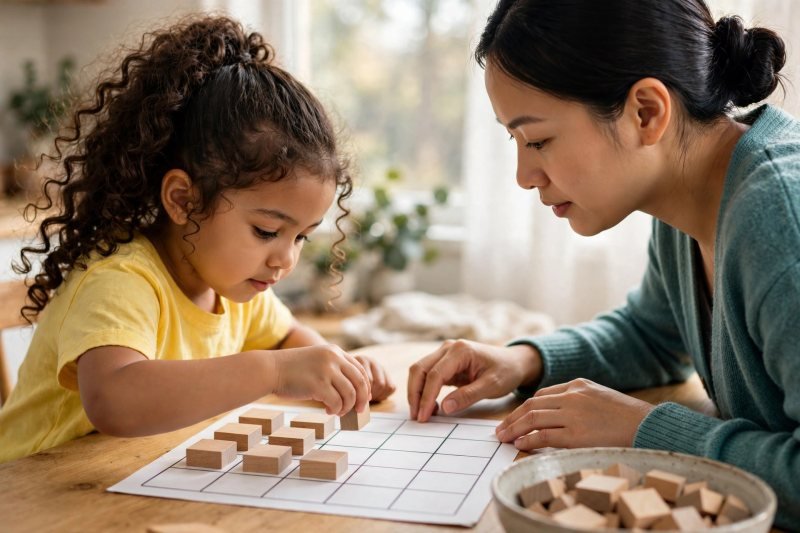
**Ten-frames (Sheet 3).** "Six dots fill most of the box, and 4 more fill it right up — that's 10." Lay counters on the printed frame. Do 7 + 3 = 10 together; they try 5 + 2 = 7.
-
**Dominoes (Sheet 4).** Count each end out loud — "2 on this side, 5 on that side" — then count them all for 7. Flag 3 + 3 = 6 as a "twin fact."

-
**Number line (Sheet 5).** Finger on 3, hop: "4 hops — 4, 5, 6, 7!" They do 5 + 2, then 2 + 5 — and spot the trick (same answer, different start).

-
**Word problems (Sheet 6).** Read each story slowly, pointing at the pictures. Act it out with counters if the numbers feel big.

-
**Missing number (Sheet 7).** "The total is 7, but one number is hiding! Put out 7 counters, take away the 2 we can see — how many are hiding?" (5.) Repeat for 4 + ? = 9 and 3 + ? = 8.

-
**Draw and review (Sheets 8–9).** Quick circles for draw-your-own — they don't need to be pretty. Then the color-the-answer review: they point to the right choice, you color it together.

-
**Celebrate and file (Sheet 10).** Finish with the celebration page, write the date, file every sheet. Next session, flip through the finished ones first — children glow seeing how much they've done, and you'll spot facts worth revisiting.



Print it out
Make it easier
- Cover the written numbers and do each sheet as pure counting first — symbols can wait a day. - You write the totals while your child counts; handwriting and math don't have to happen at once. - Keep counters on every sheet, every time — no shame in concrete help at 5. - Do half a sheet, then the other half after a snack break.
Make it harder
- Ask it in reverse: "We know 2 + 3 = 5 — what's 5 take away 2?" (Subtraction preview.) - Have them invent a word problem for you to solve — and check your answer. - Add a third addend on the number line: 2 + 3 + 4, hopping twice. - Connect the pairs to our number bonds to 10 activities once 6 + 4 = 10 feels automatic.
Other ways to play it
- - **Sticker edition:** swap the color-in parts for small stickers — same math, fresh motivation.
- - **Sidewalk version:** chalk the number line from Sheet 5 big on the driveway and hop it with whole-body jumps.
- - **Sibling race:** two copies of Sheet 9, friendly race to color all twelve answers.
- - **Travel pack:** sheets 4 and 9 plus a pencil fit in a zip bag for restaurants and waiting rooms.
How it changes by age
- Ages 5–6, the kindergarten year. Most 5-year-olds start at Sheet 1 and move through the pack over 2–3 weeks; confident 6-year-olds can do two sheets a sitting and will likely find Sheets 7 and 8 the meatiest. If your 4-year-old is curious, try Sheet 1 only, with you writing and them counting. Skip Sheet 7 until adding to 10 feels easy — missing addends are a real step up.
What they're learning
- **Addition within 10:** the core kindergarten skill, met ten different ways so it sticks. - **Multiple representations:** pictures, ten-frames, dominoes, number lines — the same fact seen four ways builds real understanding, not memorization. - **Commutativity:** 5 + 2 and 2 + 5 landing on the same total (Sheet 5). - **Missing addends:** the first step toward equations (Sheet 7). - **Word-problem sense:** turning a little story into numbers (Sheet 6). - Pencil control and number formation come free with every sheet.
Clearing up
Two minutes: sheets back in the folder in order, crayons in the box, counters in their bowl. Let your child write the date on each finished sheet — the folder becomes a visible record of progress that motivates the next session more than any sticker chart.
Questions parents ask
Are worksheets a good way to teach kindergarteners addition?
How many addition facts should a kindergartner practice at once?
What addition sums should kindergarten worksheets use?
My child counts on their fingers during worksheets. Should I stop them?
When is my child ready for missing-addend worksheets?
Worksheets work when they are the dessert, not the dinner — a few minutes of pencil practice after real, hands-on adding is the combination that builds fluency. If a sheet causes tears, it's the wrong sheet for today, not the wrong child. And keep every finished sheet: nothing convinces a 5-year-old they are "good at math" like a folder full of proof.

save it for later
Pin this for the next rainy afternoon
Keep it on a board so it is there when you need it, rather than when you happened to find it.
Save to Pinterest


