


3D Shapes Activities: Spheres, Cubes and Cones in Real Life
These 3D shapes activities for ages 5–6 turn balls, boxes, dice and cones into a geometry hunt: ten playful steps with real-life objects, no worksheets needed.
The best 3D shapes activities use real objects: balls for spheres, dice and boxes for cubes, cones for cones, cans for cylinders, pyramid blocks for pyramids. Kids hunt, sort, build, and test whether each shape rolls or stacks — learning faces, edges, and corners through play.

The short version
- - 3D shapes hide everywhere at home — balls, boxes, cans, cones — learned by touching, rolling, and stacking
- - A cube has 6 faces, 12 edges, 8 corners; a cone has 1 flat face and 1 point; a cylinder has 2 flat faces
- - The roll-vs-stack test teaches shape properties through prediction and play
- - Naming shapes during everyday routines cements the vocabulary
- Age
- Ages 5–6
- Prep
- 10 min
- Mess
- Low
- Difficulty
- Easy
- Where
- Indoor
Why kids love this
3D shapes are things kids can grab, roll and stack — a sphere is a ball to throw, a cube is a dice to roll, a cone is the ice-cream treat at the end. As a treasure hunt, geometry gets replayed.
What you'll need
- Balls (soccer, tennis, a marble for ages 3+ only, an orange)
- a pillowcase
- two dice
- wooden cubes
- a gift box
- paper and tape
- an ice-cream cone
- a plain tin can or plastic container
- a paper-towel tube
- paper
- crayons
- scissors
- a pyramid block
- a cutting board
- playdough
- a paper bag
Before you start
1. Remove the can label and check the rim. 2. Roll and tape one paper cone as a model. 3. Set out the balls, dice, blocks, cone and can on a low table. 4. Prop a cutting board on books for the ramp.
How to do it
-
**Sphere roundup.** Gather every ball — a ball is a **sphere**. "This shape is called a sphere." Roll each one: spheres roll every direction — no edges, no corners, no flat faces. Two or three steps at a time is plenty; finish the rest tomorrow.

-
**Mystery-feel bag.** Drop a sphere and a cube into a pillowcase. Without peeking, your child finds the sphere by touch — no flat sides gives it away. Feeling the difference teaches what a curved surface means better than any picture can.

-
**Discover the cube with dice.** A die is a cube: six square faces, twelve edges, eight corners. Roll one to pick each next step. Dice addition games.

-
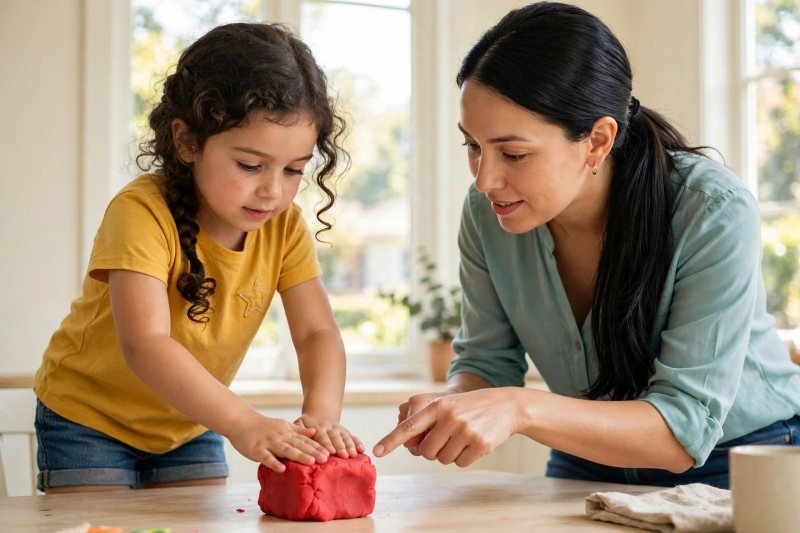
**Build a cube from playdough.** Press a playdough ball flat on all sides into a rough box and count its six faces together — a cube is six squares folded into a solid. Shapes activities for preschoolers.
-
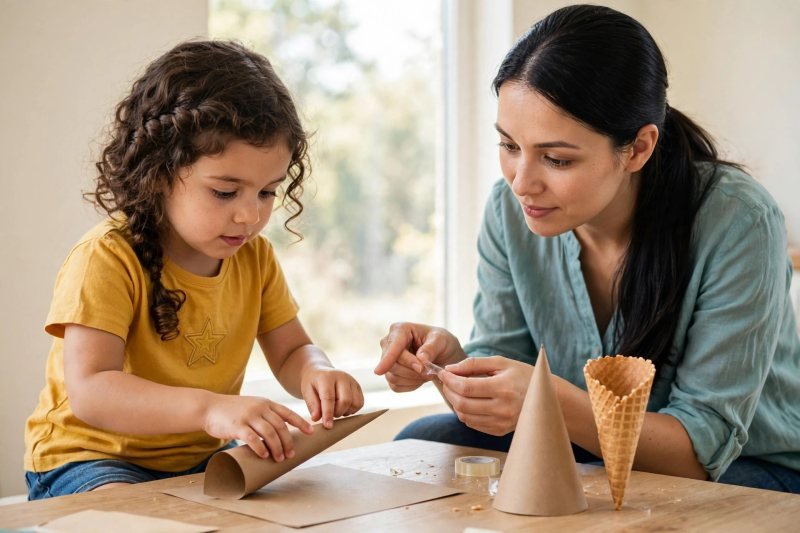
**Make the ice-cream cone.** Roll a paper square into a cone and tape it: one flat circular face, one curved side, one sharp point (the apex) on top. Point to each part on a real cone, too.
-
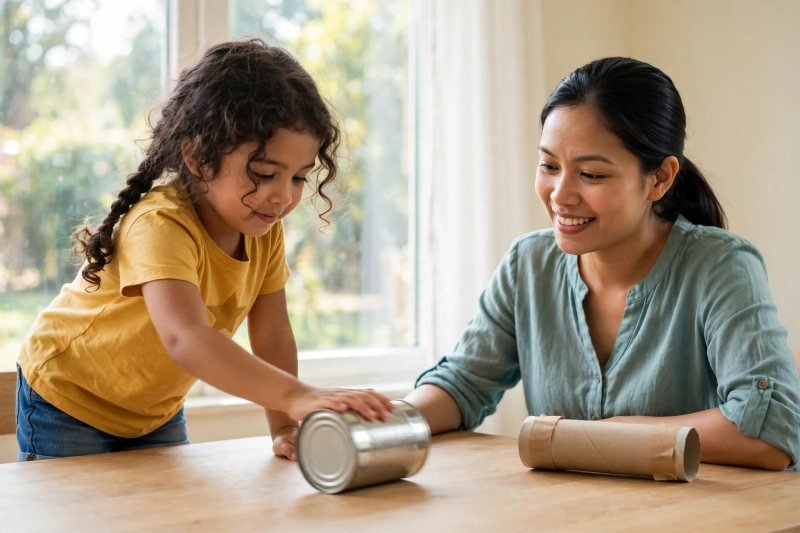
**Meet the cylinder.** The plain can: two flat faces, one curved surface between. It rolls one way, not the other. Cap a paper-towel tube with paper circles — a homemade cylinder.
-
**Stack the pyramid block.** The square pyramid block: five faces (four triangles, one square), eight edges, five corners. Stack cubes into a stepped pyramid, crowned with the pyramid block on top.

-
**Run the roll-and-stack test.** Line up one of each shape at the top of the ramp. Predict first — roll, stack, or both? — then test. Sphere rolls, cone circles, cylinder rolls straight, cube and pyramid stack.

-
**Hunt for shapes at home.** "Find three spheres!" Oranges and marbles (spheres); cans (cylinders); dice and boxes (cubes); party hats (cones). Name each find out loud as it lands in the basket.

-
**Open a 3D shape museum.** Arrange the finds on a low shelf. Your child curates the tour: "This is a cylinder — two flat faces!" Stuffed animals make a fine audience.



Make it easier
- Start with sphere, cube and cone only. - Use big objects (soccer ball, cereal box, party hat). - Do one step a day as a five-minute game.
Make it harder
- Count faces, edges, vertices: cube (6, 12, 8), square pyramid (5, 8, 5). - "How are these two the same, and how are they different?" — try cone vs. cylinder. - Find a real object with more than six faces.
Other ways to play it
- 1. **Shape picnic.** Snacks by shape: orange slices (spheres), cheese cubes, cone snacks, banana rounds.
- 2. **Bathtub geometry.** Which bath toys float as spheres, which sink as cubes?
- 3. **Shape walk.** Hunt outside: tires, trash cans, traffic cones!
- 4. **Build-a-city.** A block city of cubes and cylinders with a cone roof and pyramid monument.
How it changes by age
- - **Ages 2–3:** Name shapes as they play ("ball, that's a sphere!") and roll everything. Skip counting.
- - **Ages 4–5:** Sort and hunt with two or three shapes; count the cube's faces with help. (See counting activities.)
- - **Ages 5–6:** Full hunts, roll-versus-stack predictions, first face/edge/corner counting.
- - **Ages 7–8:** Use faces, edges and vertices; hunt for objects with more than six faces.
What they're learning
- Naming five 3D shapes — sphere, cube, cone, cylinder, pyramid — and matching each to real objects - Describing shapes: flat faces, curved surfaces, edges, corners - Predicting whether a shape rolls, stacks, or both — then testing - Counting faces on real objects
Clearing up
Kids often call every round thing a "circle," but a circle is flat while a sphere is its 3D big sibling — a drawing of a ball versus a ball you can throw. Likewise a square is flat, while a cube is six squares folded into a box.
Questions parents ask
What are 3D shapes activities for kindergarten?
How do you explain 3D shapes to a 5 year old?
What is the difference between 2D and 3D shapes for kids?
What objects are good examples of 3D shapes?
At what age should kids learn 3D shapes?
Why do some 3D shapes roll and others stack?
- Keep a small basket of the five shapes on a low shelf — children revisit it alone, and that replay cements learning. - If your child invents a name ("pointy ball"), celebrate it, then add: "mathematicians call it a cone." - The shape-naming games here line up with the kindergarten geometry standard (Common Core K.G.A.2): correctly naming solid shapes — sphere, cube, cone, cylinder — regardless of size or orientation, which is exactly why the hunt sends kids looking beyond the toy shelf.

save it for later
Pin this for the next rainy afternoon
Keep it on a board so it is there when you need it, rather than when you happened to find it.
Save to Pinterest


