


Subtraction Activities for Kindergarten: Taking Away Made Visual
Ten hands-on subtraction activities for kindergarten that make "taking away" visual: snack math, ten-frame take-away, backward number-line hops, bowling knock-down and toy story problems — all within 10, no worksheets.
The best subtraction activities for kindergarten make "taking away" something children can see: slide counters off a tray, eat 2 of 5 blueberries and count what's left, or knock down bowling pins and count the standing ones. Keep every problem within 10, say the sentence out loud ("6 take away 2 leaves 4"), and play in short 10–15 minute rounds.

The short version
- Start physical: children must watch objects disappear before written subtraction means anything.
- Always say the full sentence — "6 take away 2 leaves 4" — so the language becomes automatic.
- Keep every problem within 10; begin by taking away just 1 or 2.
- Count what's left, not what was removed.
- When they get it wrong, recount together; never just supply the answer.
- Short sessions beat long ones: stop while the disappearing is still delightful.
- Age
- Ages 5–6
- Prep
- 5 min
- Play time
- 10 min
- Mess
- Low
- Difficulty
- Easy
- Where
- Indoor
Why kids love this
Taking away is dramatic. Snacks get eaten, pins crash down, counters vanish under a cup. Every game ends with a "where did they go?!" moment — children beg for another round because the disappearing act is thrilling, and the subtraction comes along for the ride.
What you'll need
- Large counting counters: pom-poms, dried pasta, large buttons, or wooden discs
- A shallow tray or baking sheet, a snack (blueberries, cereal, apple slices)
- A homemade ten-frame (10 squares on card, 2 rows of 5)
- A floor number line: 11 large paper squares taped in a row
- Small toys (dinosaurs, cars), 6–10 plastic bottles, a soft ball
- A small opaque cup, paper, chunky crayons, painter's tape
Before you start
Pour counters into a bowl, lay out the ten-frame, and tape the paper squares into a number line from 0 to 10 — build it together so your child owns it. Line up the bottles for bowling. Five minutes, tops.
How to do it
-
Take-away tray demo. Line up 6 counters and count them. Slide 2 off the tray's edge with great drama. "Oh no — 2 ran away! 6 take away 2 leaves…?" Count what's left together: "6 take away 2 leaves 4." The tray's edge gives "taken away" a place to go, so removal is something they watch happen.

-
Snack math — eat the subtrahend. Put 5 blueberries on a plate and count them. "You may eat 2." "5 take away 2 leaves…?" Eating the taken-away group cements that subtraction means gone — not hiding, gone. Let your child pick what gets eaten next.

-
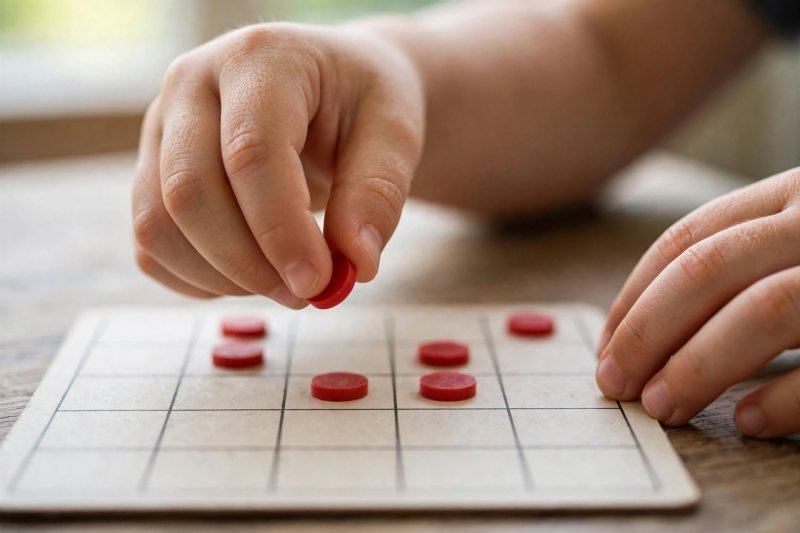
Ten-frame take-away. Fill the ten-frame with 8 counters, take 3 off and set them aside. "How many did we take away? How many are left?" For more ten-frame practice, see our addition with ten frames. The empty squares show the missing amount as holes — the 3 gone and the 5 remaining, visible at once.
-
Hop backward down the number line. Stand your child on 7. "Hop back 3 — each hop is one taken away." They hop 6… 5… 4, calling each landing number. "7 take away 3 leaves 4!" Our counting to 10 activities build the same number-line fluency. Backward motion is the lesson: subtraction runs opposite to the counting they know.

-
Toy story problems. Line up 6 dinosaurs. "Six are picnicking. Two get sleepy and stomp off to bed." Move 2 away. "How many are still picnicking?" Then let your child invent the next story — cars, ducks, teddies. Stories turn subtraction from a procedure into a way of thinking.

-
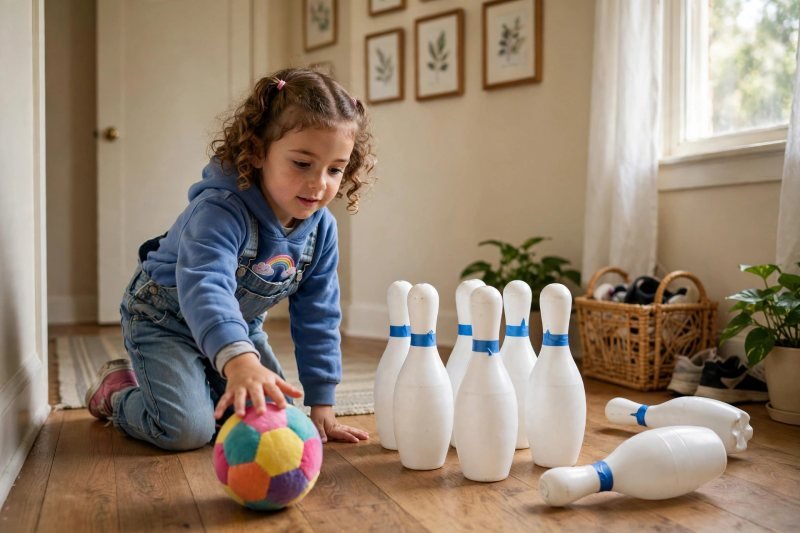
Bowling knock-down. Set up 8 bottles, roll the ball — crash! "8 pins, 3 down. How many still standing?" Count only the upright ones. If they count the fallen pins, redirect: "Those fell down. We count the ones still standing."
-
Hide counters under the cup. Count 7 pom-poms out. "Close your eyes!" Slide 2 under the cup. "Open! 7 take away 2 leaves…?" They count the 5 visible, then lift the cup to check. The reveal proves the math worked. Swap roles next round.

-
Cross-out drawing game. Draw 9 big stars. "Cross out 4! Big X's!" "9 take away 4 leaves…?" Count only the uncrossed ones. Crossing out bridges physical taking away and written math: crossed stars are visible but "gone."

-
"What's missing?" tray game. More counting play lives in our counting games for preschoolers. Lay out 6 crackers. "Look carefully… close your eyes." Remove 2 behind your back. "Open! 6 take away… how many? How many are left?" Start by removing just 1 — children love catching you sneaking crackers.

-
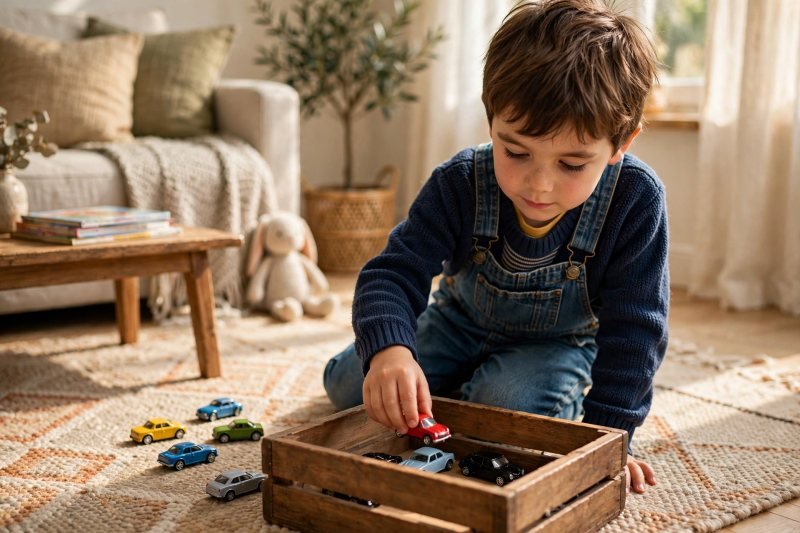
Real-life take-away moments. Subtraction is everywhere: 5 apple slices, your child eats 2 — "how many left?" 10 cars on the rug, 4 drive into the toy box — "how many still out?" Narrate each in the full sentence: "5 take away 2 leaves 3."


Make it easier
Keep totals at 5 or below; take away only 1 or 2. Use big, chunky objects that are satisfying to move. Do the removing yourself while they watch and count what's left. Team up against a stuffed toy so there's no pressure to be right alone.
Make it harder
Push totals to 10; take away bigger chunks (10 take away 6). Flip it: "I have 8 and want 3 left — how many should I take away?" Chain two take-aways: "8 take away 2… take away 3 more." Introduce numerals (7 − 2 = 5) only once the physical version is fluent.
Other ways to play it
- Outdoor bowling: knock down pinecones or cups on the patio.
- Water take-away: scoop foam shapes from a bowl with a net.
- Sibling version: an older child writes the subtraction sentence each round.
- Quiet version: ten-frame and pom-poms at the table.
- Bedtime version: 5 stuffed animals, 2 "go to sleep" — who's still awake?
How it changes by age
- Ages 5–6. Start by taking away 1 or 2 from totals under 6, with you narrating. Once adding feels easy, our addition games for kindergarten make the natural next step. Most 6-year-olds can take away from 10 and say the full sentence themselves. Introduce numerals only when the physical taking away is fluent and easy.
What they're learning
Subtraction as taking away within 10, through visible removals. Counting back: backward hops build the "count back" strategy. Remaining vs. removed: counting what's left, not what was taken. Part–part–whole intuition: the ten-frame shows both parts at once. Math language: "take away," "leaves," "how many left." More math: see our math learning hub for the counting, addition, and subtraction games in one place. Story problems: turning real situations into subtraction thinking.
Clearing up
Two minutes: counters get counted back into their jar, bottles restack, the cup goes back to the kitchen. Let your child sort — putting 10 pom-poms back is subtraction's friendly opposite.
Questions parents ask
When should my child start learning subtraction?
My child can add but struggles with taking away. Is that normal?
Should I teach subtraction with worksheets first?
How do I explain "take away" without confusing my child?
What if my child counts the removed objects as the answer?
When is my child ready for written subtraction like 7 − 2 = 5?
Subtraction is genuinely harder than addition — it asks children to track what isn't there anymore. If taking away feels wobbly while adding felt instant, that's normal development. Stay with the disappearing games; fluency arrives on its own schedule.

save it for later
Pin this for the next rainy afternoon
Keep it on a board so it is there when you need it, rather than when you happened to find it.
Save to Pinterest


