


Sink or Float: Easy Water Experiment for Toddlers
A sink or float activity for toddlers done right: a shallow tub of warm water, 8–10 big household objects, and a simple prediction game that turns everyday splashing into a toddler's first science lesson.
A sink or float activity for toddlers needs just a shallow tub of lukewarm water and 8–10 big household objects. Hold each object up, ask "sink or float?", let your toddler guess, then drop it in and narrate what happens. Keep water shallow, stay within arm's reach, and never leave a toddler alone with water.

The short version
- Written specifically for ages 2–3: big objects only, simple two-word vocabulary, short sessions.
- The prediction game ("what do you think?") is the learning — guessing matters more than being right.
- Heavy supervision framing throughout: shallow lukewarm water, adult within arm's reach, tub emptied after.
- One clear demo first (ball floats, stone sinks), then the toddler does all the dropping.
- Ends with sorting (early math) plus free splash play and a tidy-up game.
- Age
- Ages 2–3
- Prep
- 5 min
- Play time
- 15 min
- Mess
- Some
- Difficulty
- Easy
- Where
- Indoor
Why kids love this
Water is a toddler's happy place, and this game gives all that splashing a purpose: a guessing game they can't lose. Drop a thing in — does it sit on top or dive to the bottom? Your 2-year-old calls it first, and being wrong is just as exciting as being right. Everything is big, chunky, and familiar, so there's nothing fiddly, no waiting, and no wrong answers. Just drop, watch, gasp, repeat. Most toddlers beg to play again tomorrow — and the same age group has plenty more in activities for 2-year-olds at home.
What do I say when my toddler guesses wrong? Celebrate it — loudly. Being wrong is where the learning lives. Try: "You said SINK — and it FLOATED! Surprise! Good guessing!" Never correct with "no, that's wrong." Just narrate what happened and invite the next guess.
What you'll need
- A large, shallow tub or washing-up bowl — wide, not deep
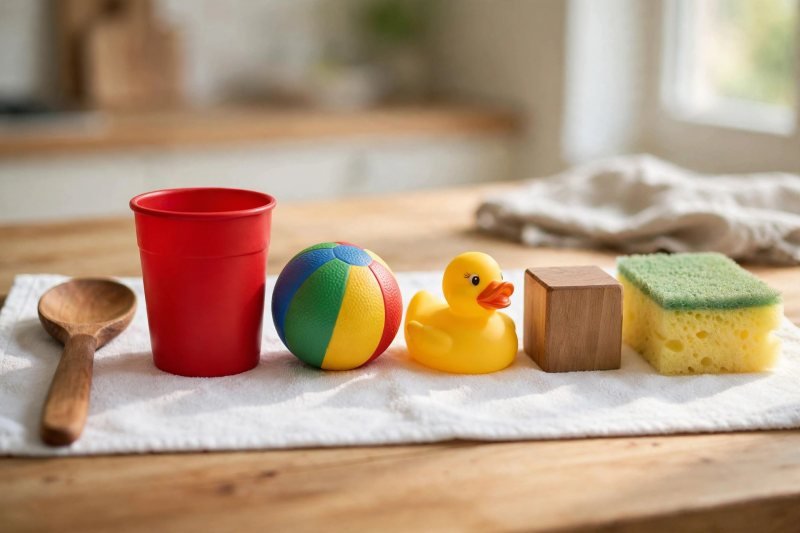
- 8–10 BIG household objects, each far too large to fit through a toilet roll tube: a wooden spoon, a big plastic cup, a rubber ball, a rubber duck, a chunky wooden block, a large sponge, an apple, an orange, a big plastic lid, and one smooth stone larger than a golf ball
- 2 bath towels (one under the tub, one spare) plus a small dry hand towel
- A splash bib or old clothes for your toddler
- Two small trays or folded towels for sorting (optional)
Before you start
Run the water lukewarm — wrist-test it like a bottle; warm, never hot. Pour 2–3 inches (5–8 cm) into the tub: enough to float things in, shallow enough to be safe. Set it on a towel on the kitchen floor or a low table, and lay the objects on a second towel nearby — visible but out of grabbing range. Bib on, dry towel within your reach. Five minutes, no shopping, nothing to print.
How to do it
-
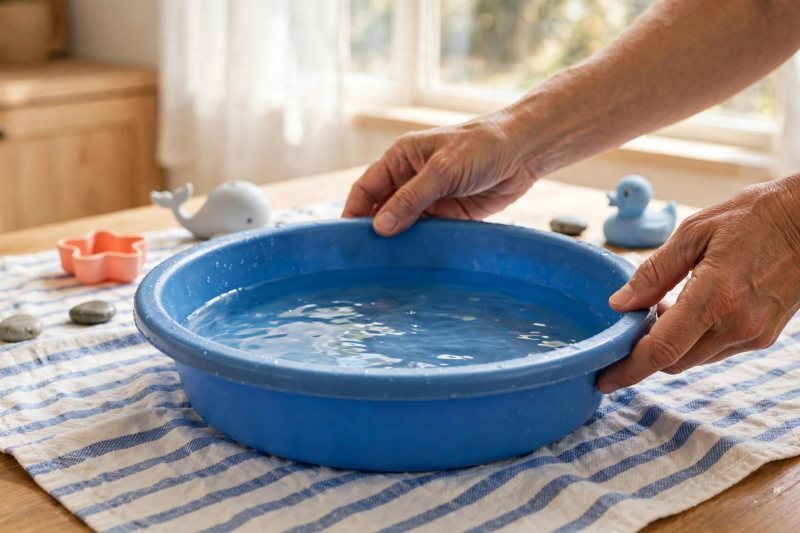
Set up the water station together. Carry the tub to its spot while your toddler "helps" — they can carry a towel. Set it on its towel, let them pat the water with one hand, and say the magic words slowly: "Water. Shall we see what sinks… and what floats?"
-
Gather your 8–10 big household objects. Line the objects up like a little shop and let your toddler pick each one up, feel its weight, and name it — "spoon… ball… duck." Then run the safety test: anything that fits through a toilet roll tube goes back in the drawer.
-
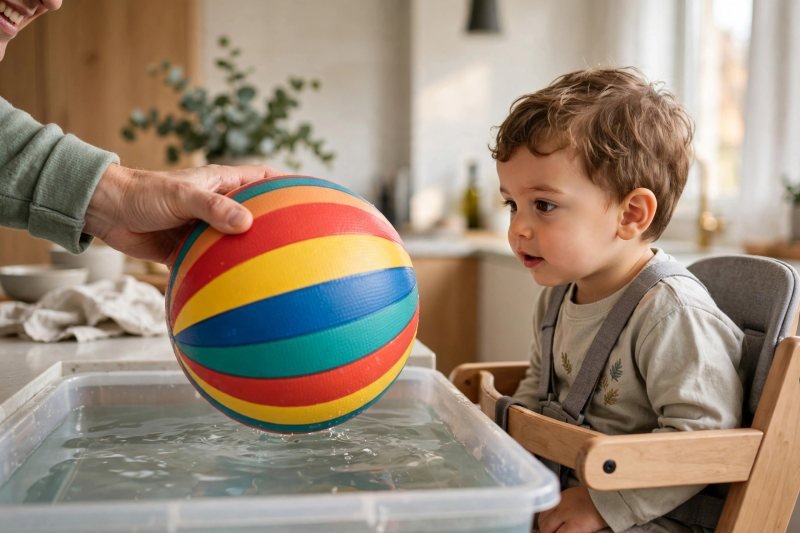
Introduce "sink" and "float" with your own demo. Hold the rubber ball above the water: "Watch! The ball… FLOATS!" Then the stone: "And the stone… SINKS!" Do it once more, slowly. You've taught two new words with zero explaining and one very impressed audience.
-
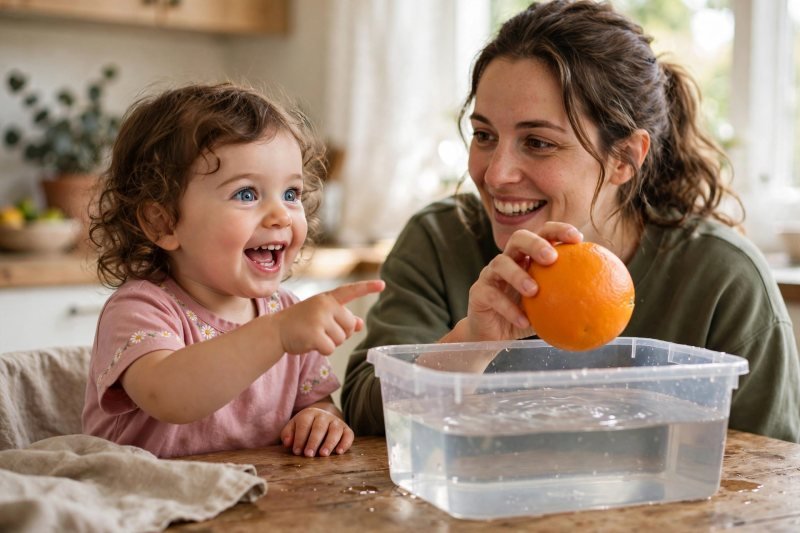
Play the prediction game: "What do you think?" Hold up the apple: "Hmm… what do you think? Will it SINK or FLOAT?" Pointing or shouting "fwoat!" counts as an answer. Cheer the guess no matter what: "You said FLOAT! Let's see!" The guess is the game; being right is optional.
-
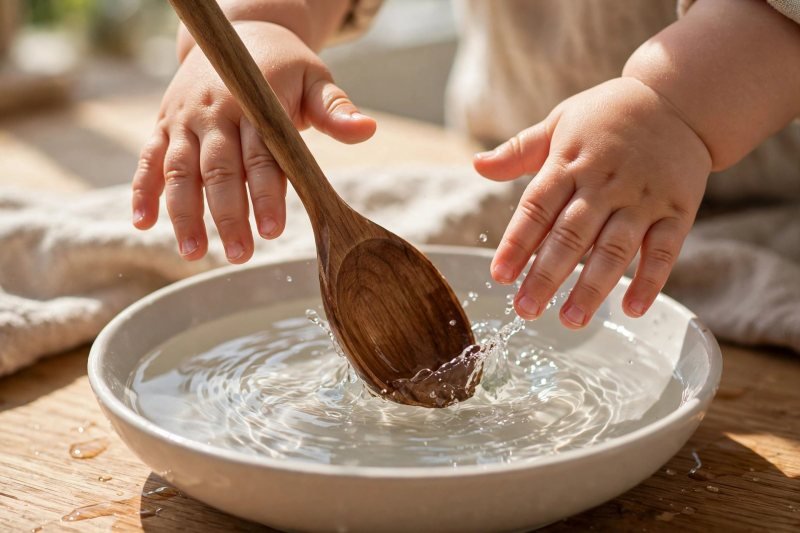
Test the first batch and narrate what happens. Hand objects over one at a time — your toddler does the dropping. Narrate exactly what you see: "The spoon… sank! Down, down, down." "The ball floats! It's on top!" Repeat sink and float every time; toddlers learn words through repetition.
-
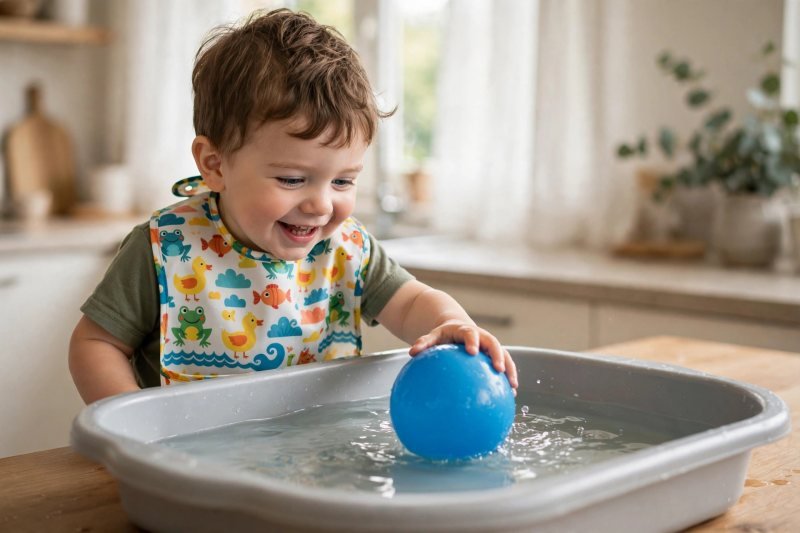
Test the light, bouncy things. The duck, the sponge, the big cup — a prediction before each. Toddlers love being right about these. The sponge is a sneaky delight: it floats first, then soaks and sinks. "Oh! It was floating… and now it's sinking!"
-
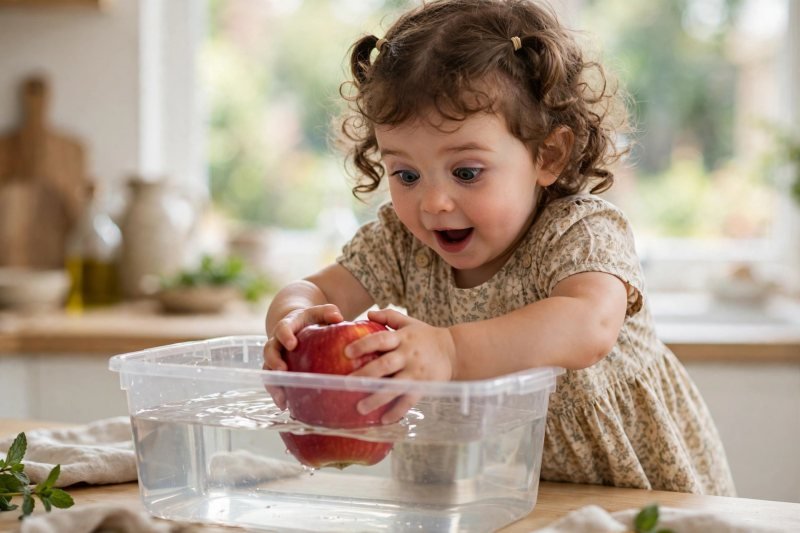
Test a tricky one: the big things that float. Hold up the apple. It's big — so surely it sinks? Drop it in… it floats! Your toddler's rule ("big things sink") just broke — this is real science. "It's BIG… but it FLOATS! Surprise!" Then let them test it again. And again.
-
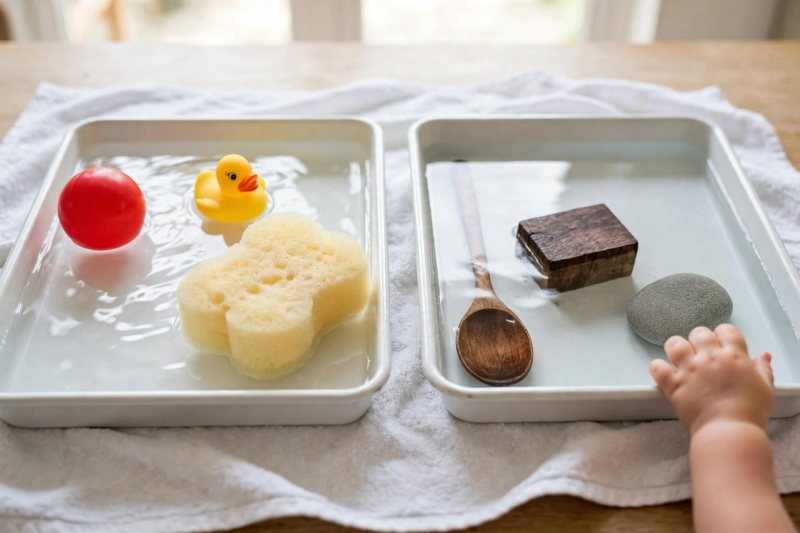
Test the heavy things, then sort the results. Test the stone, the chunky block, and anything left — one prediction each. Then sort: "The floaters go HERE. The sinkers go HERE." Sorting sneaks early math into a science game. Let your toddler place each object themselves.
-
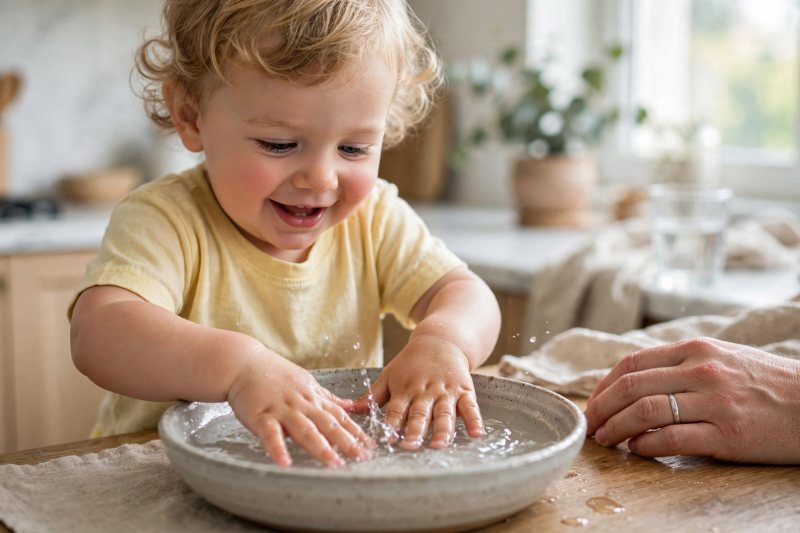
Let them have a glorious free-splash play. Hand the tub over: splashing, pouring, dunking the floaters, rescuing the sinkers. Stay right beside them — supervision doesn't pause for free play — but stop narrating and just enjoy it. "Just splashing" still practices prediction, vocabulary, and motor control.
-
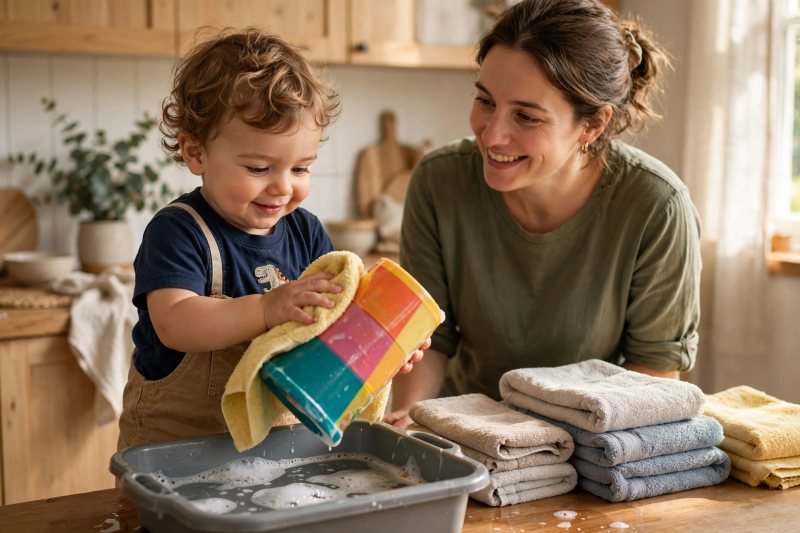
Dry off and tidy up together. Hand them the dry towel: "Can you dry the cup?" Wring out the sponge together and let them drop each object back on its towel with a plop. You tip the water out. Finish with the words: "The duck floated. The stone sank. We did science!"


Make it easier
Skip the prediction game at first and just let a young 2-year-old drop and watch — "sink" and "float" stick through narration alone. Use four or five obvious objects and run it with the tub on the floor so they can wander in and out.
Make it harder
Add the why-whisper for older threes: "The stone is heavy — that's why it sank!" Let them fetch their own test objects ("find something you think will float"), or play a sorting race: you say a word, they find a match. When older threes are ready for a second first experiment, the dancing raisins experiment for preschoolers keeps the prediction game going.
Other ways to play it
- Bath-time version: Same objects, same guessing game, zero extra setup. A mesh bath bag holds the "test kit."
- Outdoor tub: On a warm day, set the tub on the patio — bigger splashes, easier cleanup, plus leaves and petals from the garden.
- Melting ice cubes: Add two big ice cubes. They float… then shrink and vanish. "Where did it go?" is a wonderful wondering question. Once sink and float is familiar, color mixing in water play adds a second surprise to the same tub.
- Pouring station: A small jug and a second empty tub. Transferring water between tubs buys another ten happy minutes — the same idea, scaled up, in a Montessori pouring station.
How it changes by age
- Younger twos will mostly drop, splash, and echo the words — that's exactly right; keep the prediction game optional and sessions short. Older threes predict confidently and spot patterns ("the heavy ones sink!") — let them lead and fetch their own objects. Heavy mouthing phase? Double-check every object's size.
What they're learning
First science words (sink, float, heavy, light); cause and effect ("I dropped it — it sank!"); early prediction and the courage to guess; sorting and classifying; fine-motor control from dropping, placing, wringing, and drying; and the habit of curiosity itself — wondering what happens next.
Clearing up
Tip the water into the sink or onto the garden, wring the towels into the tub, wipe the floor — two minutes, done. Objects dry on their towel and go back in the toy basket. Rinse and eat the apple or orange — floaters that double as a snack are the best kind.
Questions parents ask
Is a sink or float activity safe for a 2-year-old?
What objects work best for a toddler sink or float activity?
How do I play the prediction game with a toddler who barely talks?
My toddler just wants to splash — is the activity ruined?
How long should a sink or float activity last for toddlers?
Do it once and your toddler will ask for it again — so vary the objects, not the game. Swap in a lemon, a toy boat, a big shell, or a wooden car. Repetition with small changes builds real understanding at two. For more ideas at this age, browse toddler learning activities at home.

save it for later
Pin this for the next rainy afternoon
Keep it on a board so it is there when you need it, rather than when you happened to find it.
Save to Pinterest

