


Itsy Bitsy Spider Lyrics and Fingerplay: A Toddler Rhyming Favorite
Learn the itsy bitsy spider lyrics and the simple fingerplay moves step by step. A sweet rhyming song for ages 2–3 that builds finger control, sequencing, and weather words — no props needed, just hands.
The itsy bitsy spider lyrics tell a tiny story: a spider climbs a waterspout, rain washes it out, the sun dries everything up, and the spider climbs again. Pair each line with a simple hand move — wiggling fingers climbing up, fluttering fingers for rain, a big arm circle for the sun — and toddlers ages 2–3 learn rhymes, sequencing, and finger control while they sing.

The short version
- A traditional public-domain nursery rhyme with four natural hand moves
- Teaches rhyming pairs (spout/out, rain/again), sequencing, and finger isolation
- Zero materials — playable anywhere, anytime
- Slow first, then faster; let your toddler lead once they know it
- Eight playful variations including whisper, puppet, chalk spout, and whole-body versions
- Age
- Ages 2–3
- Play time
- 5 min
- Mess
- None
- Difficulty
- Easy
- Where
- Both
Why kids love this
Some songs are just built for toddlers. "Itsy Bitsy Spider" has a tiny hero, a little drama, a happy ending, and its own built-in hand dance. The minute your fingers start wiggling upward like a climbing spider, your toddler's eyes lock on. The rain part gets a giggle nearly every time, the big sun circle gets both arms waving, and the spider's comeback earns the satisfied "again!" that puts a song straight into the daily rotation. Parents love it because it fits anywhere — traffic, waiting rooms, nap wind-downs. Portable, free, screen-free — and quietly building rhyming, sequencing, and finger control while everyone is too busy having fun to notice.
What you'll need
- None — just your hands and your toddler's.
- Optional extras for the variations: a sock puppet, sidewalk chalk, or a spider picture, but the song works perfectly with zero supplies.
Before you start
No prep needed. Sit facing each other — floor, couch, or little one in your lap — where your toddler can see your hands clearly. Warm your fingers up with a quick wiggle, then announce the fun: "I'm going to teach you the itsy bitsy spider song. Watch my hands!"
How to do it
-
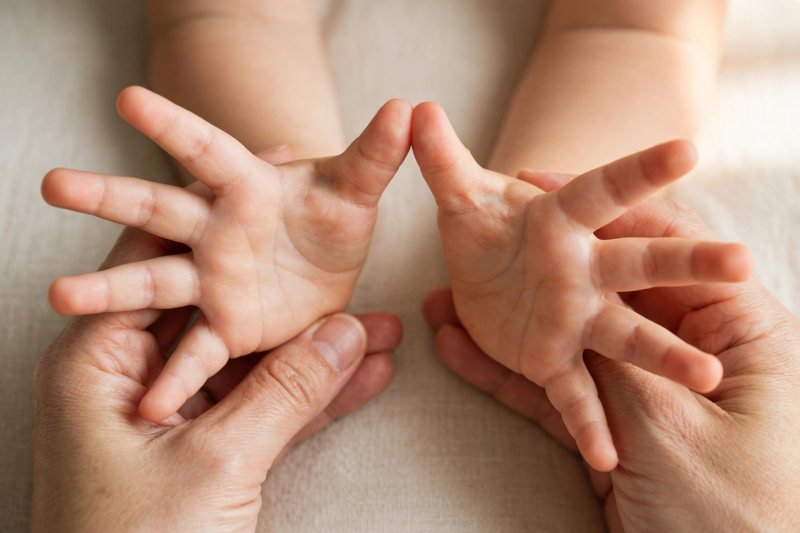
**Build the spider body with your thumbs.** Sit facing your toddler so little eyes can copy you exactly, and take this first move slowly, bigger than feels natural. Touch the tips of your thumbs together and spread the rest of your fingers wide — that is the spider's body with its eight little legs — then invite your toddler to copy: "Can you touch your thumbs together, like this? That's our spider!" Their hands will look like the ones in the picture above, little thumbs meeting in the middle while a grown-up's hands steady them from below. Do not worry if it takes a few tries; finger isolation is genuinely tricky at this age, so cheer every wobble and keep your own spider big and clear beside theirs, ready to climb in the next step.
-
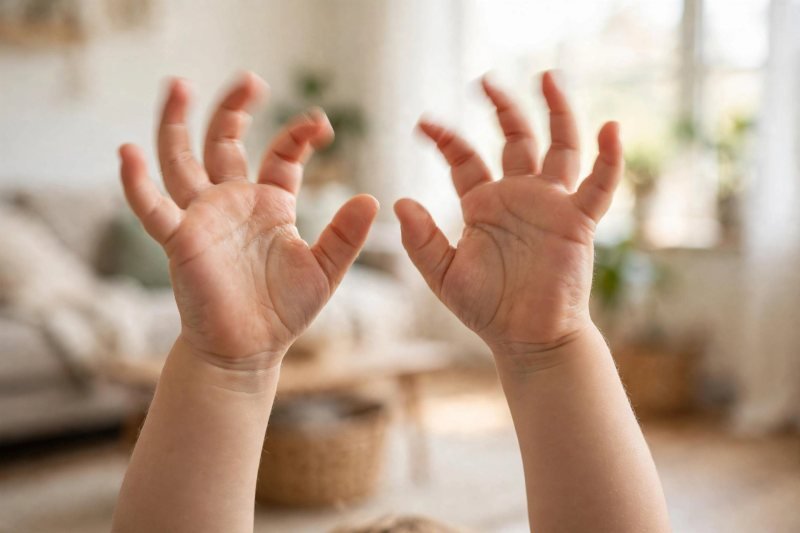
**Climb the waterspout with wiggling fingers.** With your thumbs still touching, start down near your lap and wiggle your fingers upward one by one, travelling slowly from knees to chin so the spider visibly climbs — just like the raised, wiggling hands in the picture. Say the first line as you go, at walking pace: "The itsy bitsy spider climbed up the waterspout." Exaggerate the wiggle and finish with your hands high overhead. Your toddler will often manage the climb before they can manage the thumb-spider itself, which is fine — narrate what you see: "Look, your spider is climbing! Up, up, up!" — and when both spiders are at the top, you are ready for the weather to turn.
-
**Wash the spider out with finger rain.** Now comes the drama: flip your hands so the fingers point down and flutter all ten fingertips from head height right down to your lap, a soft falling shower like the picture shows. Say the next line as the fingers fall: "Down came the rain and washed the spider out," and add a gentle "pitter-patter, pitter-patter" if giggles start. The rain flutter is the move most twos master first — and quickly becomes a favourite — so let your toddler lead the fluttering while you make the exaggerated fall alongside them. When the last drop lands, shrug together: the spider has tumbled, and that is exactly what the song wants.

-
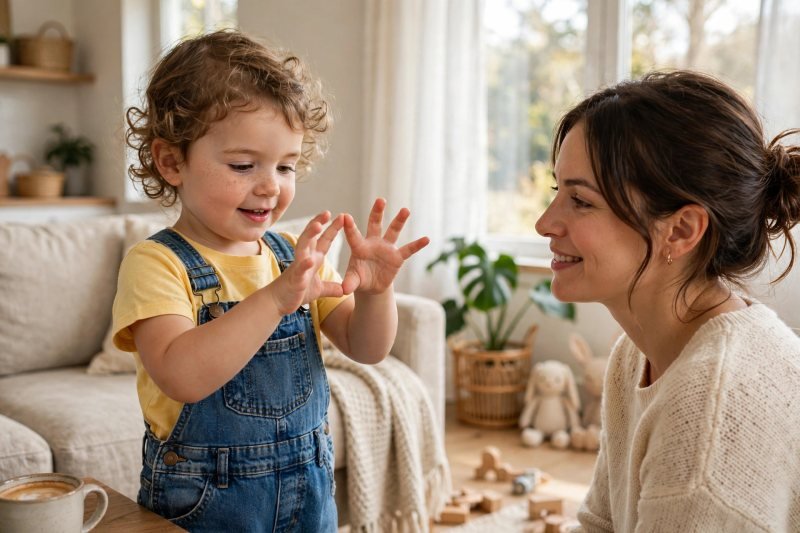
**Open the big sunshine overhead.** Throw both arms up and out into a huge circle above your head, making the biggest, warmest sun you can — just like the mum and toddler in the picture — and hold it for a full beat with a wide smile. Sing the line as you open the sun: "Out came the sun and dried up all the rain," sweeping your hands in a slow, warm arc on the words "dried up," because this is where the weather vocabulary sticks. Some toddlers throw their whole bodies into the sun arms; join them, and let this be the loud, joyful centre of the song before the spider's brave return.

-
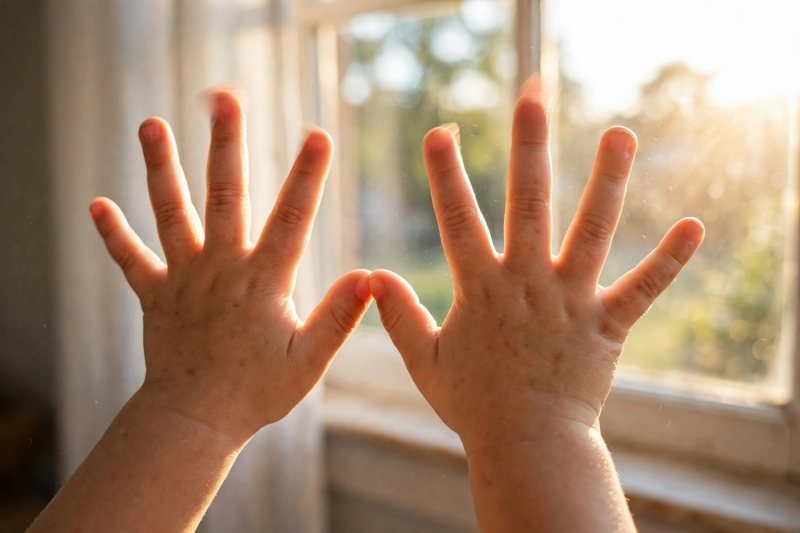
**Climb the brave spider back up again.** Make the thumb-spider once more and repeat the upward wiggle-climb, this time a little quicker and a little braver, finishing with the spider held high in the sunshine by the window, exactly as the picture shows. Sing the last line with a grin: "And the itsy bitsy spider climbed up the spout again," then end with a celebratory wiggle of all the fingers — a tiny spider victory dance. Cheer it properly — "She did it! He climbed all the way back up!" — because that happy ending is the moment toddlers remember, and it is the cue for the inevitable "again!".
-
**Sing the whole song through together, slowly.** Now put the four moves in order — climb, rain, sun, climb again — and sing the verse straight through at a gentle, steady pace, carrying the words while your toddler carries the moves, the way the pair in the picture are doing it. The full lyrics are quoted in the FAQ below if you need a refresher, so this step is all about flow: pause a breath between each line so little fingers can catch up, and keep your own moves slightly bigger than your toddler's so they always have something clear to follow. Two or three slow rounds is plenty before the tempo play begins.
-
**Speed the song up for a giggly fast round.** Run the whole song again, noticeably quicker, letting everyone's fingers trip over each other — that is the point, and the pair laughing mid-wiggle in the picture is exactly what it looks like. Toddlers adore the contrast, so once the fast round lands you can play with more extremes — a slow-motion sleepy verse; a whispered verse for quiet time; a giant dramatic verse followed by the tiniest fingertip verse. By the second and third rounds most twos start anticipating the next move themselves, and that anticipation is where the sequencing learning happens.

-
**Hand the moves over to your toddler.** On the third or fourth round, keep singing but quiet your own hands and let your toddler do the moves alone, following their pace even if the sun circle arrives before the rain — the picture above shows this beautifully, with the toddler leading the spider hands while the parent simply sings alongside. Leading the sequence from memory builds ordering skills and confidence in one go, so resist correcting the order and praise the performance instead: "You did the whole spider all by yourself!" End with a bow — spider bows too — and when the encore request comes, as it will, you know exactly how to begin.



Make it easier
If your toddler cannot manage the thumb-touch spider yet, skip it and just do the rain part — fluttering fingers downward is the easiest move. Many toddlers learn fingerplays by watching for several rounds before their fingers cooperate, and singing with no moves at all still teaches the rhymes and the sequence.
Make it harder
For toddlers who have the basic moves down, try doing the moves without singing — you sing, they gesture from memory. Or ask what comes next: "The rain washed the spider out… what happens next?" Confident twos can try the moves with just one hand, a real finger-isolation challenge.
Other ways to play it
- **Slow and fast:** First verse at a sleepy crawl, second verse at a ridiculous zoom. Toddlers adore the contrast.
- **Whisper verse:** The whole song in a whisper for bedtime or quiet time. Tiny voices, tiny spider, big calm.
- **Spider puppet:** A sock or pom-pom spider that climbs your arm as you sing.
- **Chalk spout:** Draw a big waterspout with sidewalk chalk; your toddler walks their fingers up the line.
- **Whole-body acting:** Your toddler IS the spider — crouch low and crawl-climb, flop down for the rain, stand tall with arms wide for the sun.
- **Change the weather:** Swap in snow, wind, or a thunderstorm and invent new moves for each.
- **Big spider, little spider:** One verse huge and dramatic, one verse the tiniest fingertip moves. Great for opposites.
- **Bedtime wind-down:** Lying down together, moves in the air above you, slower and softer each round until the spider falls asleep.
How it changes by age
- At **2 years**, expect watching and partial participation — most two-year-olds nail the rain flutter and sun circle before the thumb-touch spider. At **2½**, many do all four moves in order, though timing may lag the song. By **3 years**, most perform the full fingerplay independently and request favorite variations. No rush: the song is fun at every stage, and pressure to "do it right" kills the joy fast.
What they're learning
- **Rhyming pairs:** Tidy rhymes — spout/out, rain/again — in a beloved song train little ears to notice matching word endings, the foundation of phonological awareness. - **Sequencing:** Climb, rain, sun, climb again. Performing four steps in order is early sequencing practice, the same skill behind retelling stories and following instructions. - **Finger isolation and fine motor control:** Touching thumbs while wiggling the other fingers independently is demanding handwork for a two-year-old, and each round strengthens the small muscles and brain-hand connection that writing will need later. - **Weather vocabulary:** Rain, sun, washing, drying — the song attaches vivid actions to weather words, so the vocabulary sticks through the body, not just the ears.
Clearing up
Wipe nothing — there is no mess. If you drew the chalk spout outdoors, the next rain will take care of it. Park the sock puppet somewhere findable, because there will be an encore.
Questions parents ask
What are the itsy bitsy spider lyrics?
How do you do the itsy bitsy spider hand motions?
What age can toddlers do the fingerplay?
What does the itsy bitsy spider teach toddlers?
How can I make the itsy bitsy spider more fun?
Can I sing the itsy bitsy spider at bedtime?
If you do not know the tune, listen to any classic children's recording once and you will have it. Keep sessions short: three to five rounds is plenty. And take a video the first time your toddler does the whole fingerplay solo — grandparents will watch it approximately four hundred times.

save it for later
Pin this for the next rainy afternoon
Keep it on a board so it is there when you need it, rather than when you happened to find it.
Save to Pinterest