


Capacity Activities for Kids: Pour, Fill and Compare
Pour, fill, and compare! These capacity activities for kids turn your kitchen into a water lab where 4- and 5-year-olds explore full versus empty, discover which container holds more, and learn why the tall glass and the wide bowl can hold the exact same amount.
Capacity activities for kids teach how much a container holds. Set out different-sized containers, let your child guess which holds the most, then fill each with cupfuls of water to check. Say full, empty, holds more, and holds less as you pour. Ages 4–5 love the surprise when a tall, thin glass and a short, wide bowl turn out to hold the same amount.

The short version
- Capacity is how much a container can hold — the size of the "inside."
- Guess first, pour second: the prediction is where the learning happens.
- Tall does not mean more — the pour-back test proves it.
- Kitchen math for life: 1 cup holds about 8 ounces, and 2 cups fill a pint.
- You hold the big water jug; your child does all the small pouring.
- Age
- Ages 4–5
- Prep
- 10 min
- Play time
- 25 min
- Mess
- Some
- Difficulty
- Easy
- Where
- Both
Why kids love this
Water obeys them here. They pour, and the water level answers. Step 6 delivers a genuine "whoa!" no worksheet can fake — and at the end they become the scientist who explains it. ## Why do kids love pouring and filling things? Hand a 4-year-old a cup of water and a row of empty containers, and you have twenty minutes of concentration. Pouring is sensory, powerful, and just risky enough to feel grown-up — and these capacity activities for kids give that urge a job: find out how much each container holds. Guess, pour, check. Your child does the science; the water does the convincing. ## What does capacity mean for a 4-year-old? "Capacity" is a fancy word for "how much fits inside" — the full cereal bowl, the empty juice box, the bathtub that holds more than the sink. Give those instincts real words: full, empty, half full, holds more, holds less, holds the most. Have your child fit a fist inside a bowl, then try the cup — "the bowl has more room inside." Capacity completes the big three measuring ideas with length and weight; our measurement activities for preschoolers explore all three together. ## Which pour-and-fill games teach capacity best? **Kitchen safari.** A scoop of dry rice and three containers: "Which one can hold ALL the rice?" They fill, they check, they are usually wrong once — and the surprise sticks. **Half-full hotel.** Four identical cups; you call the orders: half-full, full, almost-empty, empty. **Funnel race.** Two funnels, two bottles, one cup of water each — which fills first? It is a tie, but let your child argue it out first. "Which holds more?" is comparing in disguise — our more and less activities build that same judgment with groups of objects. ## When should I introduce cups, pints, and ounces? Right now — in the kitchen, not on a worksheet. A cup is the perfect first unit: a word and an object at once. In US kitchens a cup holds about 8 fluid ounces, and two cups fill a pint (16 ounces); step 8 turns that into a pour they will remember. Treat "8 ounces" as the cup's name tag, not a number to memorize — metric units can wait for school. Before cups, children measure in scoops and handfuls; our non-standard measurement activities come first.
What you'll need
- A large tray or baking sheet (to catch every spill)
- A big plastic pitcher of water — the grown-up's pouring supply
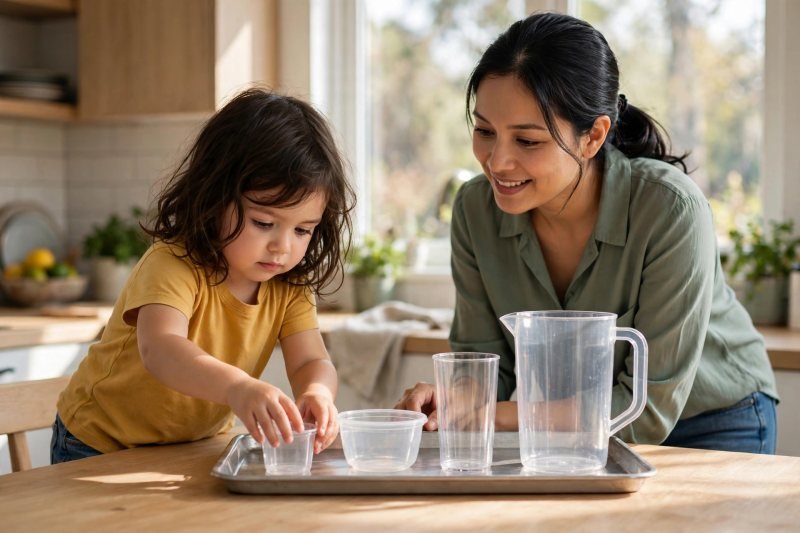
- One tall, thin plastic tumbler; one short, wide bowl; one small cup
- One 1-cup measuring cup and one pint-size pitcher (about 2 cups)
- A funnel (optional), towels, and one drop of food coloring (optional)
Before you start
Choose plastic containers — no glass near little hands or hard floors. Set the tray near the sink or on the patio, with a towel underneath. Fill the big pitcher three-quarters full. Only you lift it. Lay the four test containers out in a row, empty. Under ten minutes, done.
How to do it
-
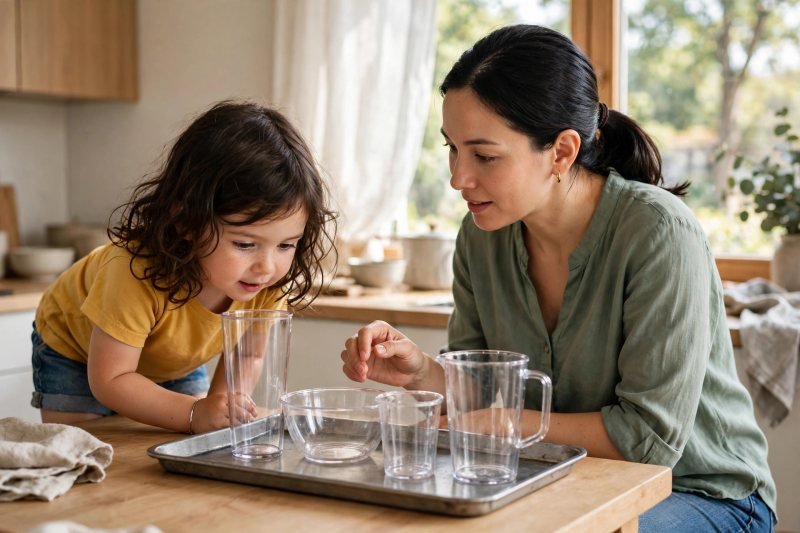
**Line up the lab.** Set the tall tumbler, wide bowl, small cup, and pint pitcher in a row. Let your child peer inside each one. "We will find out how much water each holds — that is its capacity."
-
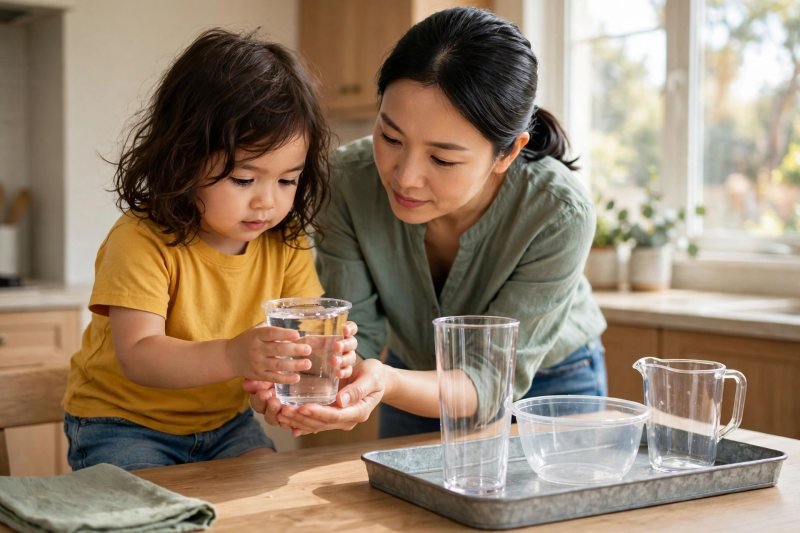
**Feel "full."** Fill the small cup to the very brim. Let your child hold it with both hands. "This cup is FULL. It cannot hold one more drop."
-
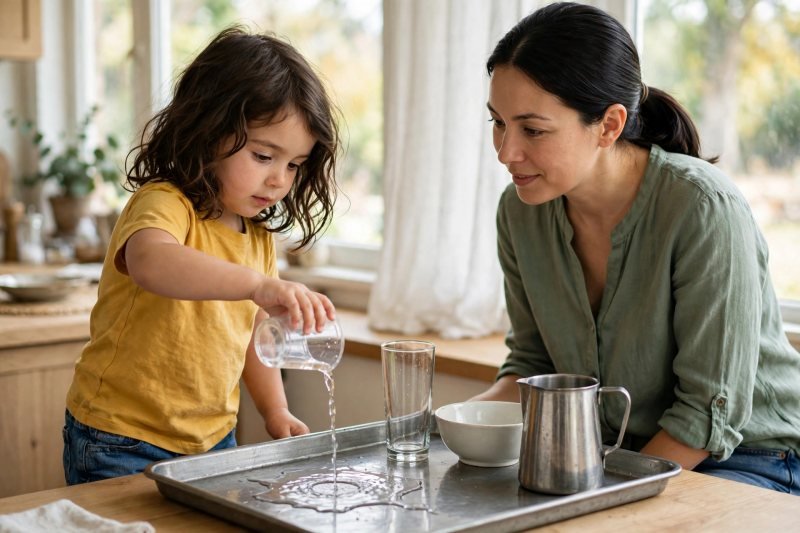
**Feel "empty."** Dump the cup out and tip it upside down. "Now it is EMPTY. Full… empty." Let them say both words.
-
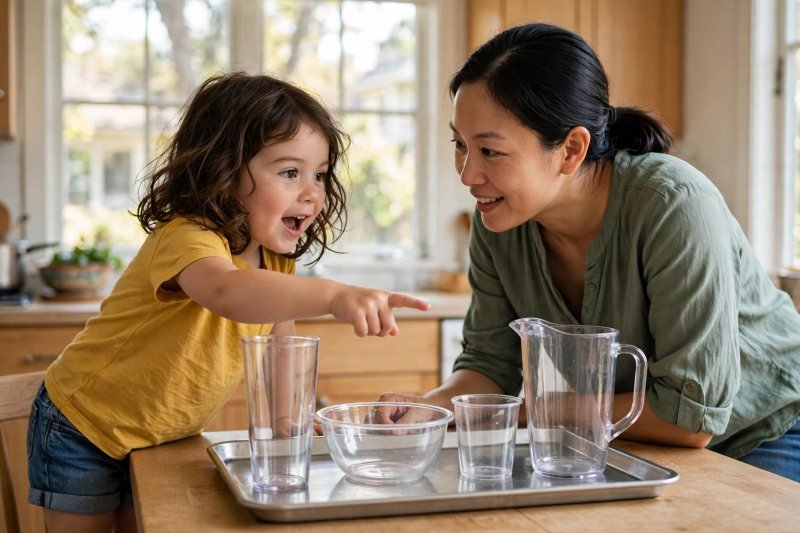
**Make a prediction.** "Which one holds the MOST water?" Nearly every child picks the tall tumbler — height looks like "more." Do not correct them; wrong guesses make the next step thrilling.
-
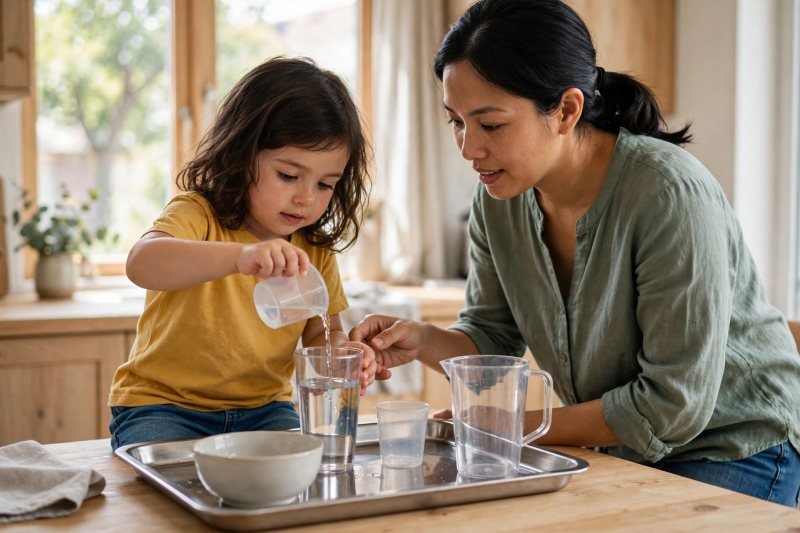
**Fill it with cupfuls.** Let your child pour cupfuls into the tall tumbler, counting aloud: "One… two… three!" Stop at the brim and remember the number together.
-
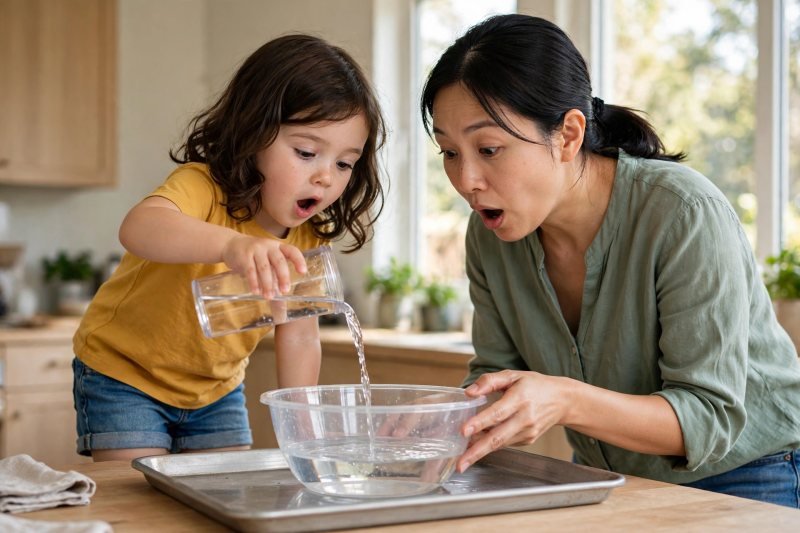
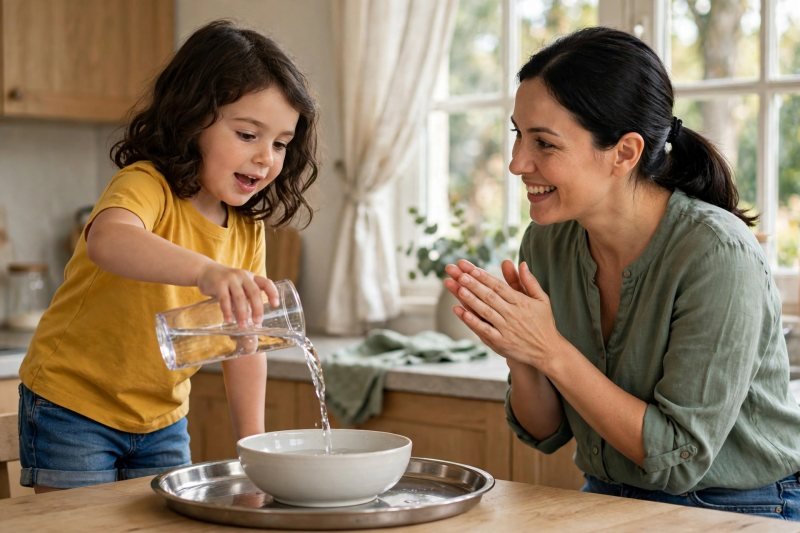
**Spring the big surprise.** Slowly pour the full tumbler into the short, wide bowl. The water line sits LOW — barely halfway up. "Same water! Different container! It looks like less — but is it?"
-
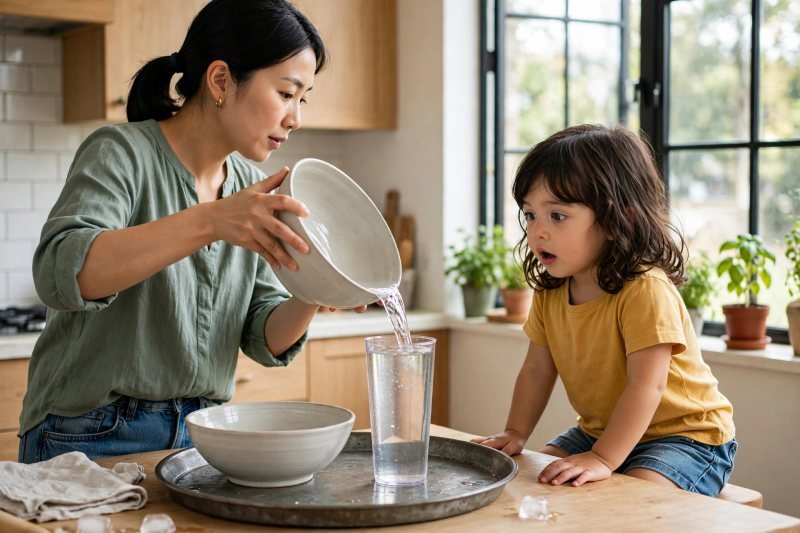
**Prove it.** "Which holds more — the tumbler or the bowl?" Pour the water BACK: brim-full again, exactly. Same water, same amount. Shape fooled their eyes — now they know.
-
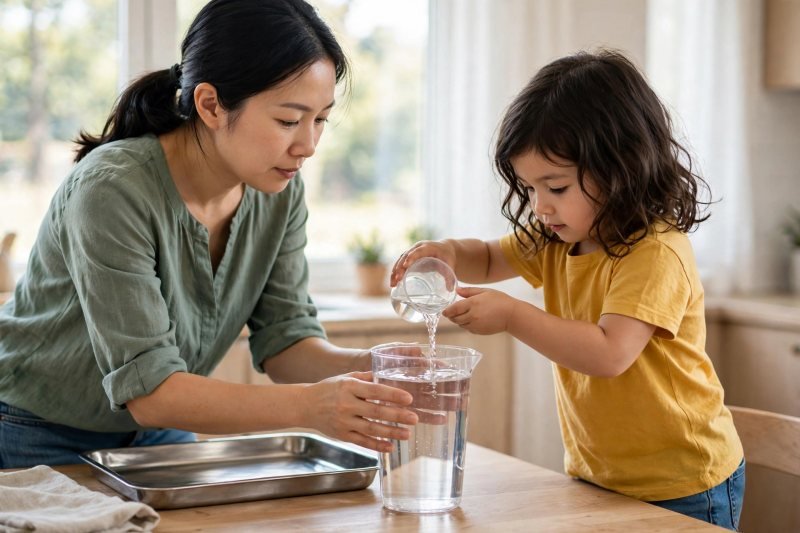
**Show two cups making a pint.** Hold up the pint pitcher: "In our kitchen this is a pint. Watch." Pour in one cup, then a second — full to the top. "Two cups fill a pint, every time."
-
**Order them.** Line up all four from the one that holds the LEAST to the one that holds the MOST — with real evidence for every spot.
-
**Let your child be the teacher.** "Show me again — which one looks like it holds more?" Your child runs the pour: "Same water, different shape!" Teaching it back locks it in.


Make it easier
Start with two containers — tallest and widest — and skip the counting. You pour while your child points, predicts, and shouts "full!" and "empty!" Use colored water; the level is easier for young eyes to see.
Make it harder
Add a fifth mystery container: estimate its capacity in cupfuls BEFORE measuring. Try "half a cup" — pour roughly half a measuring cup. Eyeballing is fine. "How many small cups fill the big pitcher?" — the answer changes with the cup.
Other ways to play it
- **Dry run:** swap water for dry rice, beans, or pom-poms — same experiments, zero spills.
- **Bathtub edition:** take three containers into the tub and run the lab at bath time.
- **Rainy-day gauge:** leave the four containers out in the rain; which collects the most?
- **Cooking connection:** next time you bake, let your child measure the real cups and pints.
How it changes by age
- Four is the sweet spot: children pour with reasonable control, count small numbers, and delight in being safely "wrong." Three-year-olds can run a two-container version (steps 1–4 and 7) with you pouring. Six-year-olds are ready for the estimation challenge in "Make it harder."
What they're learning
**Capacity vocabulary:** full, empty, half full, holds more, holds less, holds the most. **Conservation of liquid:** the amount stays the same when the container changes. **Standard units:** cupfuls as consistent units; 1 cup ≈ 8 ounces, 2 cups = 1 pint. **Predicting and checking:** guessing before testing, the core habit of science. **Ordering and comparing:** arranging containers from least to greatest capacity.
Clearing up
Pour leftover water into the sink or onto garden plants. Stack containers smallest-inside-largest, hang towels to dry, wipe the tray. Let your child "measure" the cleanup: which container holds the most soapy water?
Questions parents ask
What is capacity in simple words for kids?
At what age do kids understand capacity?
How do you teach capacity at home?
What is the difference between capacity and volume?
Why does my child think the tall glass holds more?
Can you teach capacity without water?
Say the vocabulary out loud every time: "The bowl HOLDS MORE than the cup." Children learn capacity words the way they learn animal names — by hearing them attached to real things, over and over.

save it for later
Pin this for the next rainy afternoon
Keep it on a board so it is there when you need it, rather than when you happened to find it.
Save to Pinterest

